

14+ Employee Newsletter Examples, Ideas & Templates


Writing a proposal is your chance to show a client, investor, or decision-maker that you understand their problem, have a real plan to solve it and are the right person to trust with the job.
The challenge is that many proposals fail not because the idea is weak, but because it is poorly presented. The message is unclear, the structure is confusing, or the value is buried under too much noise. When that happens, even the most valuable proposals get ignored.
In this guide, you will learn how to write a proposal that actually wins approval. We will break down what goes into a great proposal, how to structure it, what mistakes to avoid and how to present your ideas so it's easy for someone to say yes.
To help you create one quickly, you will also find 29 customizable proposal templates you can use as a starting point.
Before we dive in, here's a short selection of 8 easy-to-edit Proposal templates you can edit, share and download with Visme. View more below:


A proposal is a formal document outlining a plan, idea, or suggestion intended to gain approval or funding. It presents specific objectives, actions and benefits that are carefully tailored to the audience’s needs.
The audience for a proposal can include clients, investors, employers, donors, or government agencies. Rather than simply describing what you want to do, a proposal explains why it should be done and why you are the right person or organization to do it.
Not all proposals look the same. Their structure, tone and content vary depending on why they are being created and the organization issuing the request for proposal (RFP).
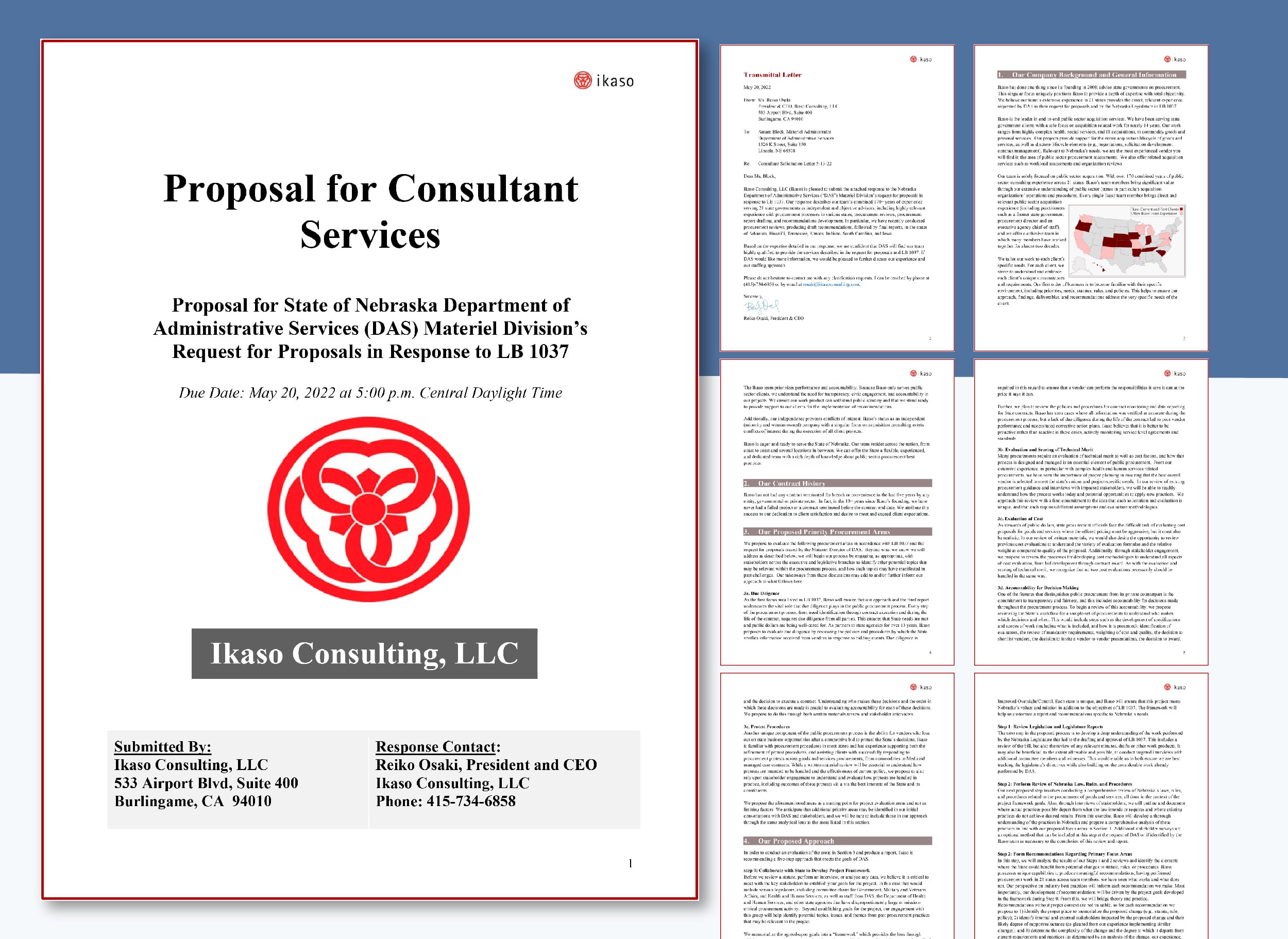
For example, this business proposal below was submitted to the Nebraska Department of Administrative Services (“DAS”) Materiel Division’s request for proposals. It focuses on solving a client’s problem and showing a return on investment.
Research proposal examples differ in that they discuss the objectives, methodology and expected outcomes. Additionally, grant proposals focus heavily on their social impact and accountability. They not only outline the intended use of funding but also emphasize how the project will benefit the community or target population.
As I’ve mentioned earlier, business, research, grant and project proposals differ in content. But they are all built from the same core elements.
The elements I’ve shared below form the backbone of any winning proposal. They’ll guide how you present your idea, demonstrate its value and persuade your audience to take action.
Made with Visme Infographic Maker
Now that you’ve seen what a strong proposal should include, it helps to see how all of that looks in practice.
Each of the examples below takes a different approach, but they all do the same thing well: they make the offer clear, show real value and guide the reader toward a confident decision.
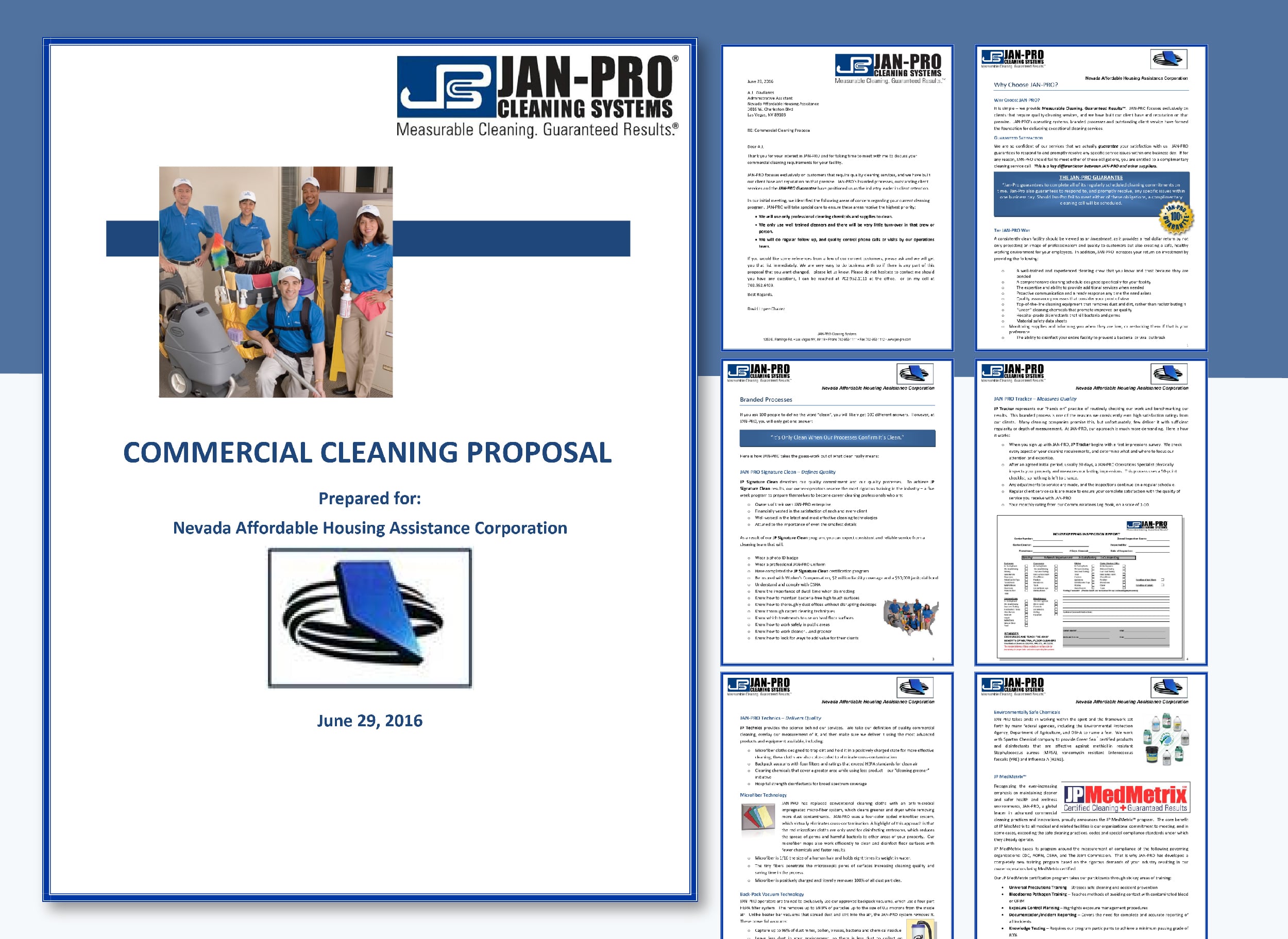
Our first example is a 16-page commercial cleaning proposal created for the Nevada Affordable Housing Assistance Corporation. It includes a branded cover page, a formal cover letter, a table of contents, service breakdowns, cleaning schedules, pricing and a signed agreement.
This proposal does three important things well. First, it feels credible from the moment you open it. The branded cover, company photos and clean layout immediately signal that JAN-PRO is established and professional. Second, it does not just promise quality; it proves it through sections such as “The JAN-PRO Guarantee,” “Branded Processes,” and detailed cleaning schedules. Finally, it removes friction by including the pricing agreement and contract at the end, so the client can move straight from reviewing to approving.
If your proposal leads to a paid service, include everything needed to say yes in one place. That means scope, proof, schedules, and pricing should all live in the same document so the client does not have to chase you for next steps.
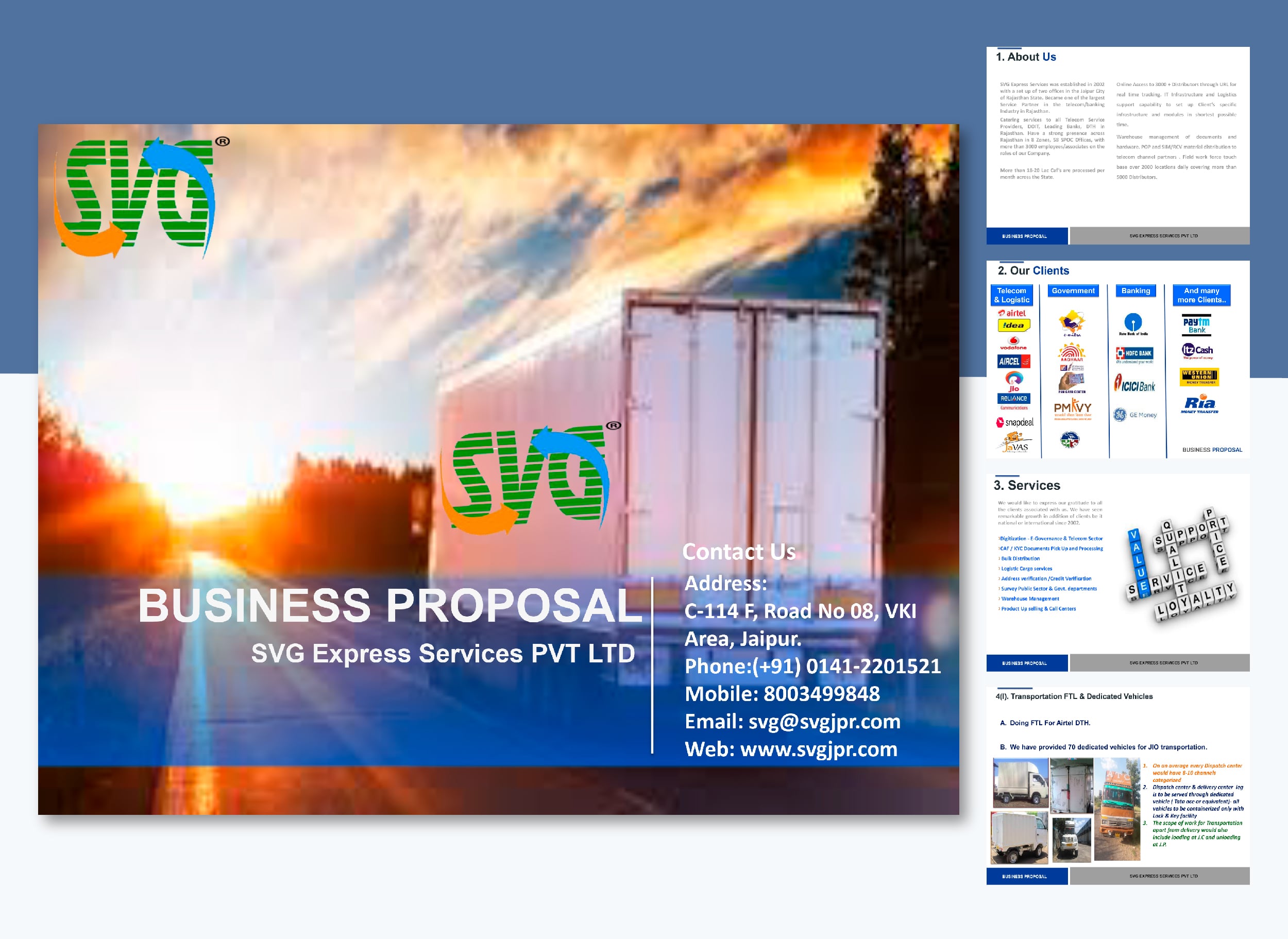
Unlike the JAN-PRO proposal, this one is built as a slide-based presentation rather than a traditional document. SVG Express uses it to pitch its logistics and delivery services, covering everything from transportation and warehousing to COD management, last-mile delivery, and server infrastructure.
Instead of long pages of text, the proposal presentation walks the client through their operation visually. You see fleet photos, flowcharts, route diagrams, warehouse layouts, and step-by-step delivery processes, all designed to explain how the business actually runs.
This proposal makes a complex operation easy to understand. Logistics is hard to explain on paper, but SVG turns it into something you can follow at a glance. The robotic delivery process, COD flow, and line-haul management diagrams show how packages move from booking to delivery. The client logos and performance numbers add credibility without heavy sales copy. It feels less like a brochure and more like a guided tour of their operation.
If your service involves multiple moving parts, do not hide it behind paragraphs. Use diagrams, process flows, and visuals to show how your work actually happens. A visual proposal helps clients trust what they cannot physically see.
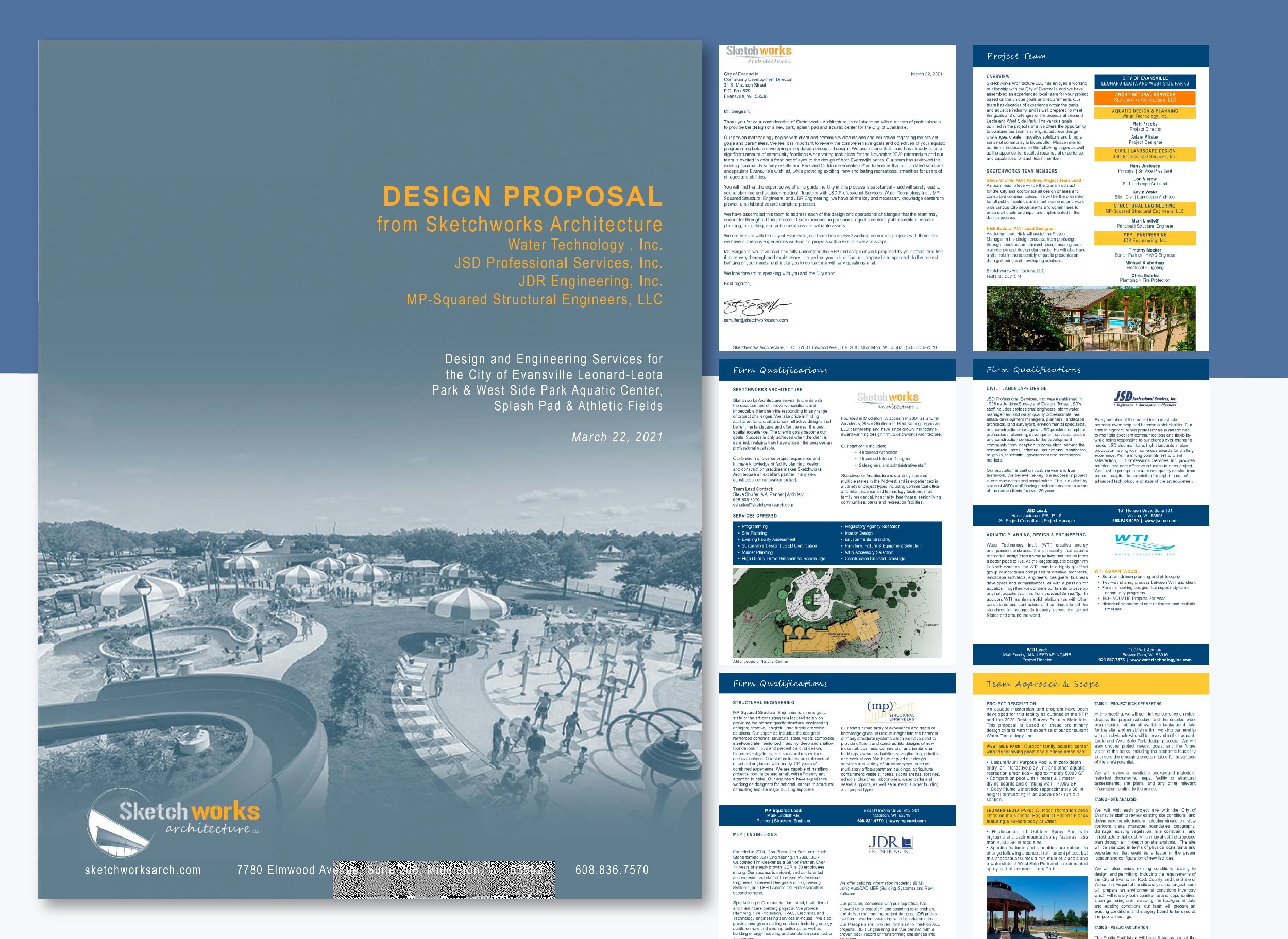
If you’re in architecture, engineering, or any kind of large-scale infrastructure work, this next proposal is one to pay attention to. It’s a full-scale, professional design proposal created by Sketchworks Architecture and its engineering partners for the City of Evansville’s new aquatic center, splash pad, and athletic fields.
I love how the 30+ page proposal walks you through every layer of the project. It opens with a formal cover letter, then introduces the full multidisciplinary team across architecture, landscape, engineering, water systems, and structural design.
From there, it moves into design vision, site plans, renderings, community engagement strategy, construction phases, budgets, and timelines.
By the time you reach the back of the document, you also have resumes for every lead designer and engineer, references from past municipal projects, and proof of insurance.
Sketchworks understands what public-sector clients need in order to approve a project. The early pages sell the vision with realistic renderings and master plans that show what the park will look and feel like. The middle sections prove feasibility with clear scopes, deliverables, and schedules. And the appendices remove risk by showing who is responsible, where they have done this before, and that they are fully insured. Nothing important is left to guesswork.
Instead of forcing city officials to request follow-up documents, the proposal anticipates every question and answers it in one place. This is exactly what a serious public-sector proposal looks like when it is done right.
If your proposal is meant to secure large budgets or long-term projects, treat it like a complete business case or project plan, not just some sales brochure. Leave nothing to chance. Show the idea, show the people behind it, and show how it will actually get built. When you include your team, past work, track records, awards, timelines, and risk coverage, you make it much easier for decision-makers to move forward with confidence.
Follow this step-by-step guide on how to write a proposal template
To truly connect, dig deep into who your prospects are and uncover their specific needs, preferences, and pain points.
Understanding your audience on this level lets you shape your proposal’s content, tone, structure, and design in ways that speak directly to them—skyrocketing your chances of winning their trust.
We asked Elisa Montanari, Head of Organic Growth at Wrike, about her approach to audience-tailored proposals - here's what she had to say.
Head of Organic Growth at Wrike
Mira Nathalea, CMO at SoftwareHow, knows this firsthand. In the tech space where features and systems can quickly overshadow clarity, she’s found that nothing beats direct communication with decision makers.
"In tech, there’s often a lot of noise—fancy features, complex systems. When I speak directly to the people who will decide, I know exactly what they need, and I can adjust the proposal to meet those specific needs. On the flip side, things can fall apart when I make too many assumptions about what the client wants without digging deeper. I've learned the hard way that ignoring client feedback leads to proposals that miss the mark." says Mira.
Review past emails and meeting notes for recurring concerns. Ask direct questions during discovery calls: What's kept previous solutions from working? What does success look like six months from now? Who else is involved in this decision? Look at their website, recent press releases, and LinkedIn to understand company priorities and culture. These insights will inform your approach.
Before writing, understand the landscape your client operates in. What challenges are common in their industry right now? Who else might they be considering? What recent changes (regulatory, economic, technological) might affect their decision?
This research does more than fill knowledge gaps—it positions you as someone who understands their world, not just their immediate problem. When you reference industry trends or acknowledge competitive alternatives in your proposal, you demonstrate strategic thinking that decision-makers value.
Start by searching for industry reports and recent news about their sector. Look for pain points that keep appearing across multiple sources—these are likely concerns your client shares. Tools like Perplexity can quickly summarize market trends and surface insights you might miss scrolling through dozens of articles.
Next, study how competitors position similar solutions. Visit their websites, read their case studies, and note their messaging angles. The goal is to find gaps you can fill or approaches you can improve upon.
If you know which specific alternatives your client is evaluating, dig deeper into those offerings so you can differentiate your approach without directly criticizing competitors. Focus on what makes your solution uniquely suited to their situation rather than what makes others inadequate.
Imagine reading a proposal that feels like a maze: your clients will definitely feel frustrated and probably zone out.
Break up your proposal into logical sections that lead the reader smoothly through your ideas. Typical sections to include are an introduction, problem statement, objectives, methodology, timeline, deliverables, pricing, and terms.
Customize each section to fit your client’s needs and project scope. Need a jumpstart? Visme’s professionally designed proposal templates come with these essential sections ready to personalize, so you can focus on what matters most—building a winning proposal.
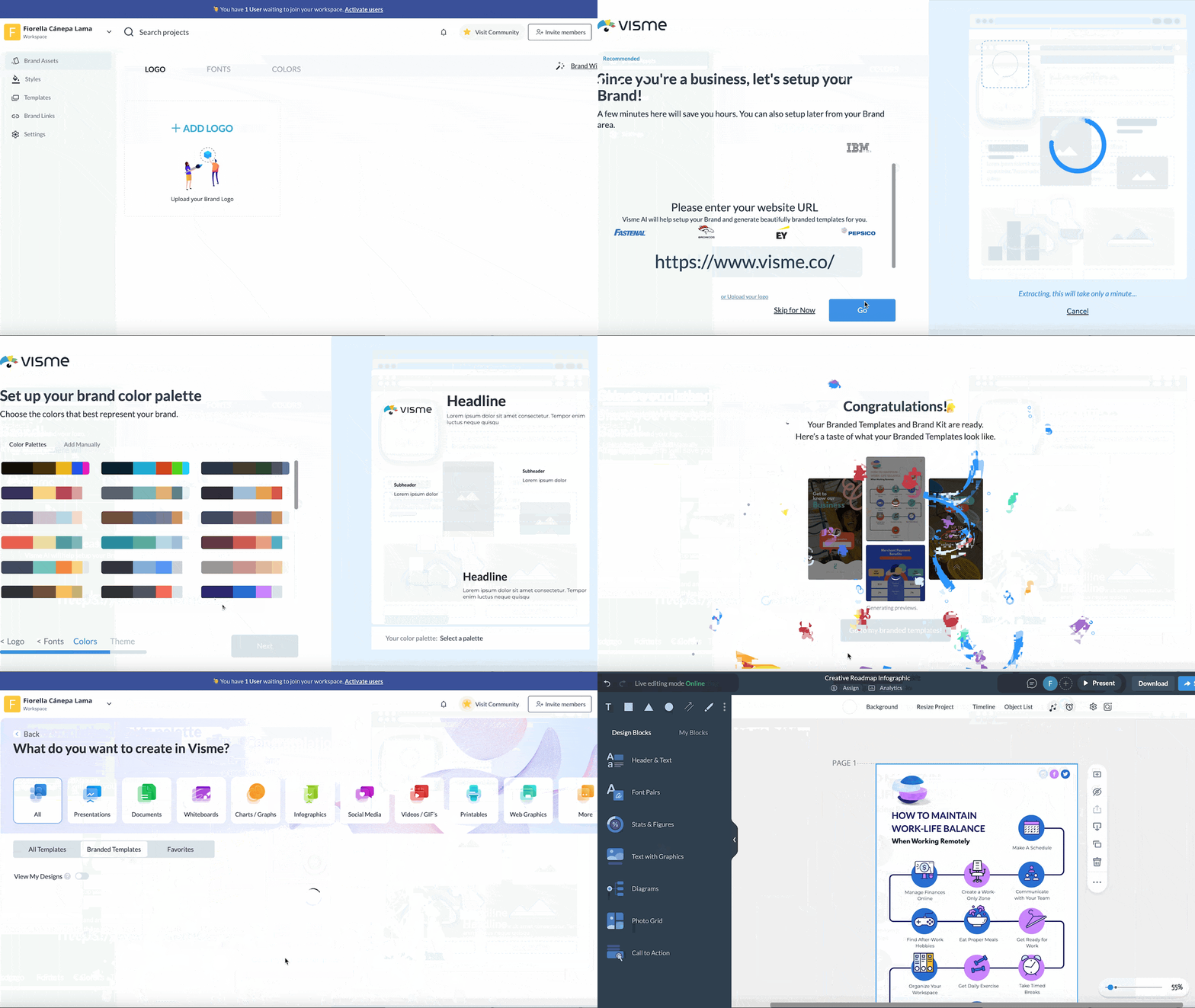
All you need to do is swap 0ut the colors, fonts and other design elements to fit your branding. To keep your brand consistent, input your URL in the Visme brand wizard and it will pull in your assets (colors, fonts, and logo) and save them in your brand area. That way, you need to manually set it up every time you do a design.
Your proposal’s content should start strong with an eye-catching title page and a summary that hooks them from the beginning. Then, guide the reader through:
After you’ve put together the content for these sections, write your executive summary last. This lets you pull the most compelling points from your full proposal rather than guessing what will matter most.
In your executive summary, recap the client's main problem in their own words, preview your solution in 2-3 sentences and highlight the most compelling benefit upfront.
For the company introduction, skip the founding story unless it's directly relevant. Focus instead on experiences that match their needs and on credibility markers that matter to this specific client.
Throughout the proposal, use the client's actual language from conversations and emails. If they said their "inventory tracking is a nightmare," write "to solve your inventory tracking challenges" instead of generic terms like "improve operational efficiency." Drop in their company name, specific project names and quoted goals to show you're speaking directly to their situation, not recycling a template.
All in all, your proposal should focus on the client's needs and why you're the right fit.
Don't make it difficult for clients to understand why they should choose you.
Spell out the specific value you bring: How much time will they save? What revenue increase can they expect? What risks will you eliminate?
The most effective approach is converting features into outcomes. Instead of "24/7 monitoring," write "catch system issues before they cause downtime, keeping your operations running smoothly." Include numbers whenever possible—percentages, timeframes, cost savings, efficiency gains. If you don't have exact figures, use ranges or industry benchmarks to give clients something concrete to evaluate.
For a research proposal, instead of "novel methodology," explain "this approach will reveal patterns previous studies missed, advancing our understanding of early cancer detection."
Include numbers whenever possible, such as percentages, timeframes, cost savings, efficiency gains, or projected impact metrics. If you don't have exact figures, use ranges or industry benchmarks to give evaluators something concrete to assess.
You can also create a simple table comparing their current state versus their future state with your solution. This visual contrast makes the value immediately clear and gives decision-makers something tangible to discuss internally.
Back up your claims with relevant proof. Add 1-2 case studies from similar industries showing how you've solved comparable problems with measurable results. This demonstrates relevant experience without making them guess whether you can handle their situation. Choose examples that closely mirror the client's industry, company size or challenge.
Decision-makers always have doubts, even when they like your proposal. "What if this doesn't work?" "Why does this cost more than alternatives?" "Can you really deliver on this timeline?" Strong proposals acknowledge these concerns directly instead of hoping readers won't notice them.
Think about the objections you typically hear during sales calls or in feedback from declined proposals. These patterns reveal what evaluators worry about most. Common concerns include budget constraints, implementation timelines, organizational change management, technical feasibility, or your firm's capacity to handle the project alongside existing commitments.
Address these proactively in a dedicated section or weave them naturally into your methodology and approach. If clients often worry about project delays, explain your buffer strategies and your milestone-tracking approach. If the budget is typically tight, break down costs transparently and show where there is flexibility. For grant proposals, address potential methodological challenges and explain your contingency plans.
The key is framing risk mitigation as evidence of thorough planning, not defensive hedging. Instead of "If we miss the deadline, we'll...," write "To ensure on-time delivery, we've built in weekly checkpoints and a two-week buffer for unexpected technical issues." This shows foresight without undermining confidence.
Consider including a brief FAQ section for complex proposals, especially RFPs, where evaluators are comparing multiple submissions. Answer the questions you know they're asking about all proposals: "How quickly can you start?" "What happens if key team members leave?" "How do you handle scope changes?"
Before you hit send, give your proposal a thorough review for grammar, spelling and clarity. Make sure each section flows logically and edit for a professional finish.
Read it out loud to catch awkward phrasing that looks fine on screen but sounds clunky when spoken. Check that every claim is supported and every promise is realistic. Remove repetitive sections and tighten wordy paragraphs—if you're saying the same thing twice, you're diluting your message.
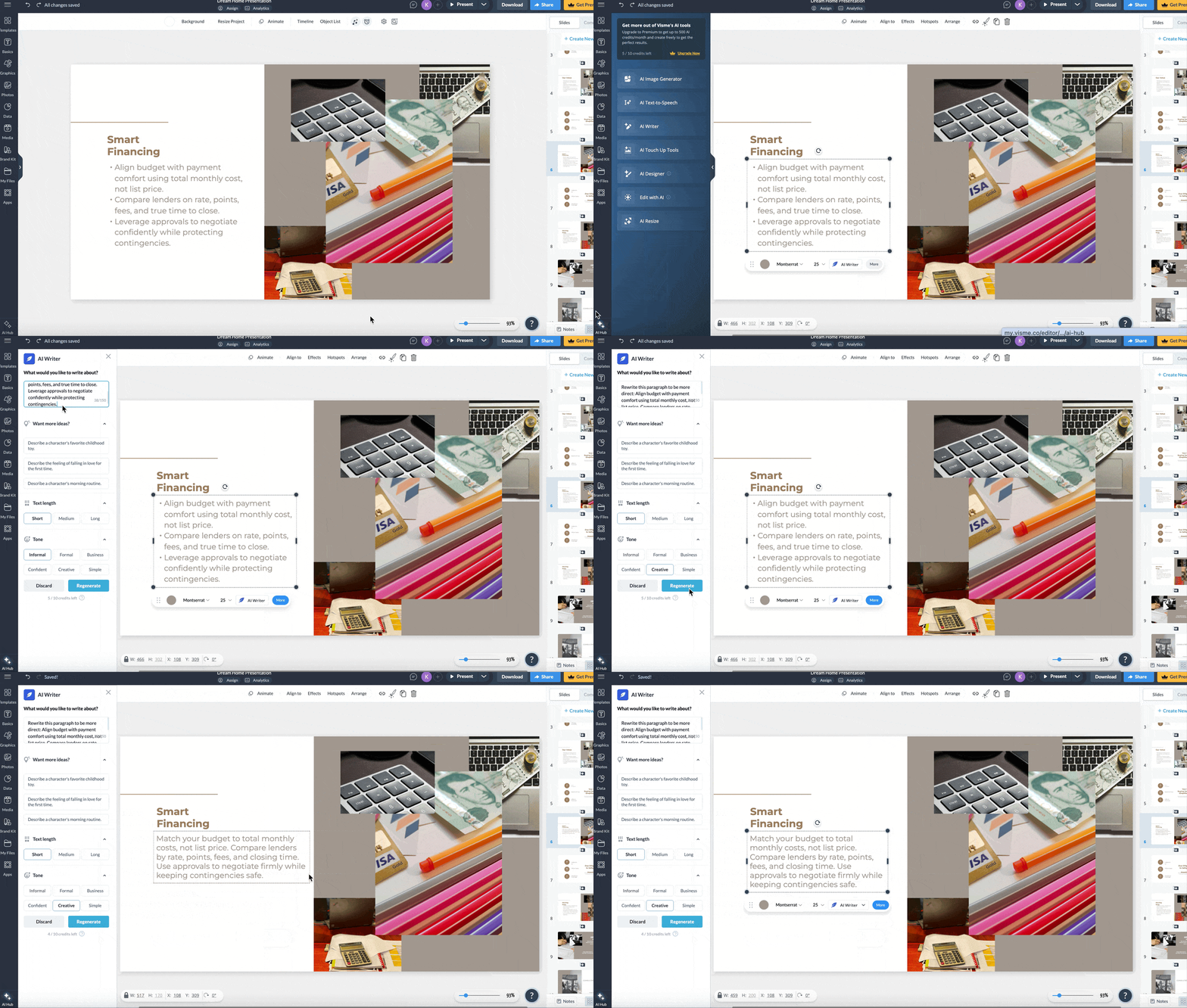
Have someone unfamiliar with the project read it. If they have questions, your client will too. Visme's AI writer can help with proofreading or text generation. Just provide a prompt and it'll help polish your proposal in seconds, catching errors and suggesting clearer phrasing you might have missed after multiple rounds of editing.
Finding the perfect proposal template is one of the crucial first steps in designing an eye-catching proposal.
Here's how to choose one that helps you seal the deal:
Who are you sending this proposal to? Are they investors? Potential clients? Or maybe a non-profit organization? The tone, voice, design and every aspect of your proposal should match your audience's expectations.
For example, your audience would mostly want a detailed proposal if you are creating a research or academic proposal. On the other hand, if your audience is B2B clients, they might be busy and you would need to explain everything concisely and effectively. Also, in both these cases, you will need templates with different images, colors, fonts and other design elements.
Think of your proposal as a guided tour—each element is there to lead the reader to your ultimate goal.
What do you want to achieve with this proposal? Are you trying to sell your products or services? Or are you looking to secure funding from a potential investor?
Whatever the purpose is, choose a template that aligns with your goals.
For example, if your goal is to secure funding for your business, your proposal will need to highlight your business plan, financial projections and potential for growth. In this case, you'd want a business proposal template with sections for market analysis, financial data and investor information.
But if your purpose is to get approval for a new project, your project proposal should highlight the project's benefits to the company, its feasibility and your implementation plan.
Did you know you only have around 7 seconds to make a first impression? That’s just enough time for your reader to glance at your proposal and decide if it’s worth their attention.
So, choose a well-designed proposal template that is more likely to grab your audience's attention at first glance.
Here are some tips to make that first impression count:
Visme's template library includes a variety of templates with different design styles, so you can find one that matches your brand and requirements.
Imagine jumping into your proposal creation, excited to bring your ideas to life, only to find it clunky, hard to navigate or limited in terms of customization options. Frustrating right? You just want to focus on creating an amazing proposal—not just spend hours figuring out a complex tool or struggling to customize the template.
Brooke Webber, the Head of Marketing at Ninja Patches, has a keen eye for design when it comes to proposal templates. "I always go for something that looks professional but not boring." he shares.
"Our projects vary so much—from small businesses wanting a few patches to larger bulk orders—so I use templates that can easily be adjusted. A flexible layout lets me customize everything without starting from scratch each time, which saves me hours says Brooke."
Your template should not only be visually engaging but the tool for customizing it should be easy to use. Make sure every aspect of the template you choose is easily customizable, from the fonts and colors to design elements and images.
With Visme, you don't have to worry about it. You can fully customize every template in this article and any other template in Visme's library and save them for future use.
As a new addition to the tech stack, AI content writing tools take the slow, messy parts of proposal writingand make them faster and less painful. This includes sorting information, drafting, rewriting, structuring, and designing the proposal.
Let’s discuss how you can use AI to simplify these tedious parts of proposal writing.
Most proposals begin with a chaotic mix of emails, meeting notes, client requirements, executive biographies, and background documents. Before you can start writing, you need to organize and make sense of all this information.
According to Loopio’s 2024 RFP Trends and Benchmarks Report61% of early adopters use AI to summarize information—and for good reason. This step alone can save hours of manually sorting and condensing information.
Tools like ChatGPT, Claude, or Microsoft Copilot excel at pattern recognition. They can pull out requirements buried across multiple emails, spot contradictions between what was said in different meetings, and turn dense background documents into digestible summaries.
Instead of rereading the same 50-page compliance document three times, you can ask AI to extract exactly what matters for your proposal scope.
Useful prompts:
The hardest part of writing a proposal is getting something on the page that feels good enough to build on. But a mediocre first draft is infinitely easier to improve than a blank page.
That's why 44% of teams rely on AI to create faster first drafts using tools like Visme’s AI writer, ChatGPT, Jasper, and Writesonic. AI can quickly generate sections based on your outline or rough notes, letting you shift from "creator mode" to "editor mode," which most people find less mentally exhausting. You can also feed it your previous successful proposals and ask it to match that style and structure.
Useful prompts:
Tools like ChatGPT, Grammarly, Visme’s AI writer and Wordtune are popular for editing proposals. Up to 43% of teams use them to improve clarity and flow. Beyond basic grammar fixes, these tools can help you match your tone to your audience.
For example, you can prompt these AI tools to rewrite the same information for different readers, strip out buzzwords that weaken your message, and catch the kind of repetitive phrasing you stop noticing after your third revision.
Useful prompts:
Effective proposals highlight your competitive position in the market. Tools like Perplexity, Gemini, and ChatGPT with web access help teams quickly pull together competitor insights, trends, and benchmarks—something 37% of proposal teams now do regularly.
When crafting your proposal, it is essential to understand the landscape your client is assessing. What alternatives are they considering? What industry shifts might affect their decision? What objections are they likely to have based on what they've heard elsewhere?
AI can quickly aggregate this context, letting you frame your solution against real alternatives rather than in a vacuum.
Useful prompts:
A proposal can have great content and still fail if it's poorly organized. That's why 32% of teams ask AI to create outlines or storyboards before writing begins.
AI can suggest logical flows based on proposal type—RFPs follow different structures than unsolicited sales proposals or research grants. It can also check whether you've covered all the basics: problem statement, approach, qualifications, timeline, and pricing. Think of it as a structural audit that catches gaps before you've invested time writing sections that might need to move or merge later.
Useful prompts:
A well-written proposal in a plain Word document still looks like a draft. And unless you’re a design expert, creating a good-looking proposal is not only time-consuming but nerve-racking.
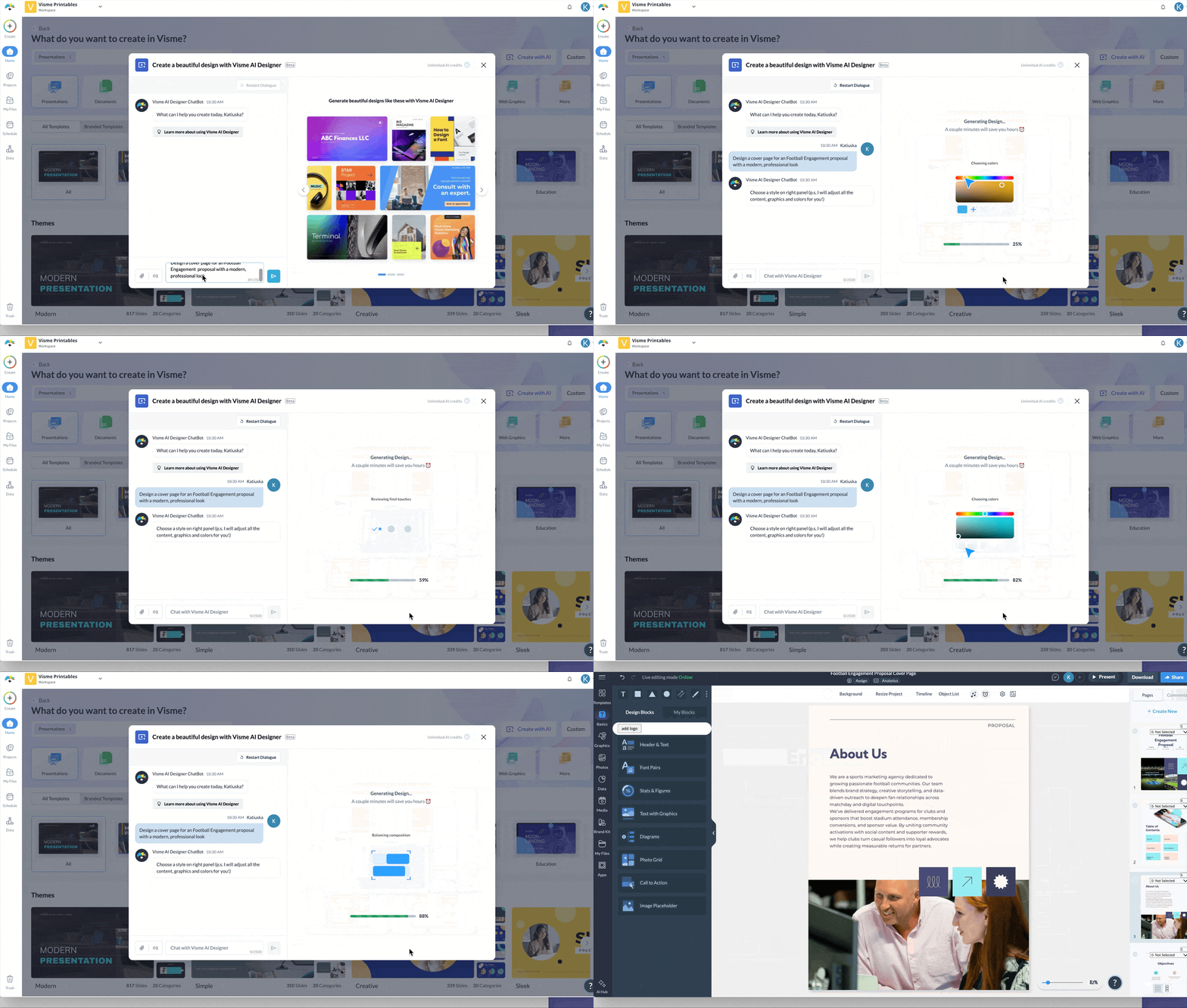
AI design tools like Visme’s AI Design Generator help you generate polished proposal designs in seconds. Just input your text prompt and the Visme Chatbot will ask a few questions and suggest proposal designs. Select the one that fits your project most and the AI will generate a first draft that you can easily customize with AI tools.
It works alongside other amazing features in Visme like our extensive library of proposal templates, brand kits, charts, timelines, and team collaboration tools to handle the visual heavy lifting.
Instead of manually formatting every page or hunting for the right way to visualize your project timeline, AI can suggest layouts, generate charts from your data, and apply your brand consistently across all pages.
When multiple people are working on different sections, the collaboration features keep everyone aligned without the chaos of emailed versions.
Useful prompts:
Jump to the category that suits your needs:
This corporate proposal template is another great version to use for higher end, enterprise clients and projects.
Its professional look and feel will help ensure anyone you hand it to will know they’re in good hands with their project. Get started with this editable sales proposal design and you’ll be amazed by the result.
Design Tip: Use icons to help visualize your content. Visme’s icon library has over 10,000 different options, so you should be able to easily find icons relevant to your industry and the content written in your proposal.
Who Is It For: Web designers, agencies and freelancers offering website design services.


Need to create a flowchart to showcase business processes within your sales proposal design? It's never been easier to make a flowchart than with Visme's shape and line tools.
You can also include other types of data visualizations like charts, graphs, tables, maps and more in your business proposal.
Design Tip: When creating a flowchart with Visme, you can customize your line design, shape, color and more. Make sure to match your flowchart to the rest of your proposal so it doesn't look out of place.
Who Is It For: Any business or organization looking to create a general business proposal.

Don't be afraid of color. Proposals don't always have to be a black and white, boring document. Instead, you can bring them to life by strategically incorporating an accent color throughout your proposal pages.
This contemporary design creates a nice mixture of photos, geometric shapes, icons and text so that no single element is too overwhelming, and the messaging is easy to digest and understand.
Keep the pages of your business proposal design and other projects on brand using Dynamic Fields in Visme. You can insert your personal and business information, personalize the fields and assign any value to them.
Design Tip: Try incorporating small squares to house your outline icons, like you see in this proposal template. Icons are great for adding a visual element while still being able to control the color scheme.
Who Is It For: Fashion designers, boutiques and businesses in the fashion industry.

Here’s a project proposal template you can customize for different project types.
Many of Visme's proposal templates also include a placeholder area for you to drop your logo right into the template. This helps to immediately brand your proposal and help your customer trust that it's coming from you.
Design Tip: Using your brand colors and fonts is essential in a proposal. You can easily add these into your Visme Brand Kit to access for any design, not just your proposals.
Who Is It For: Engineering firms, construction companies and project managers in various industries.

If you're looking for a unique and modern way to share your proposal information with your audience, this project proposal template is the perfect solution.
With a minimalistic look and feel and tons of white space, you can easily customize this to fit any information you might need to fit within your proposal. For example, you can turn it into a construction proposal template or even a bid proposal template.
Design Tip: Use abstract images to decorate your proposal pages. You can easily find the perfect photos in Visme's stock photo library. And if you don’t find any image that fits the bill, Visme’s AI image generator can ignite your creative spark. Simply type your prompt and the tool will generate professional-looking photos, paintings, pencil drawings, 3D graphics, icons, abstract art and more.
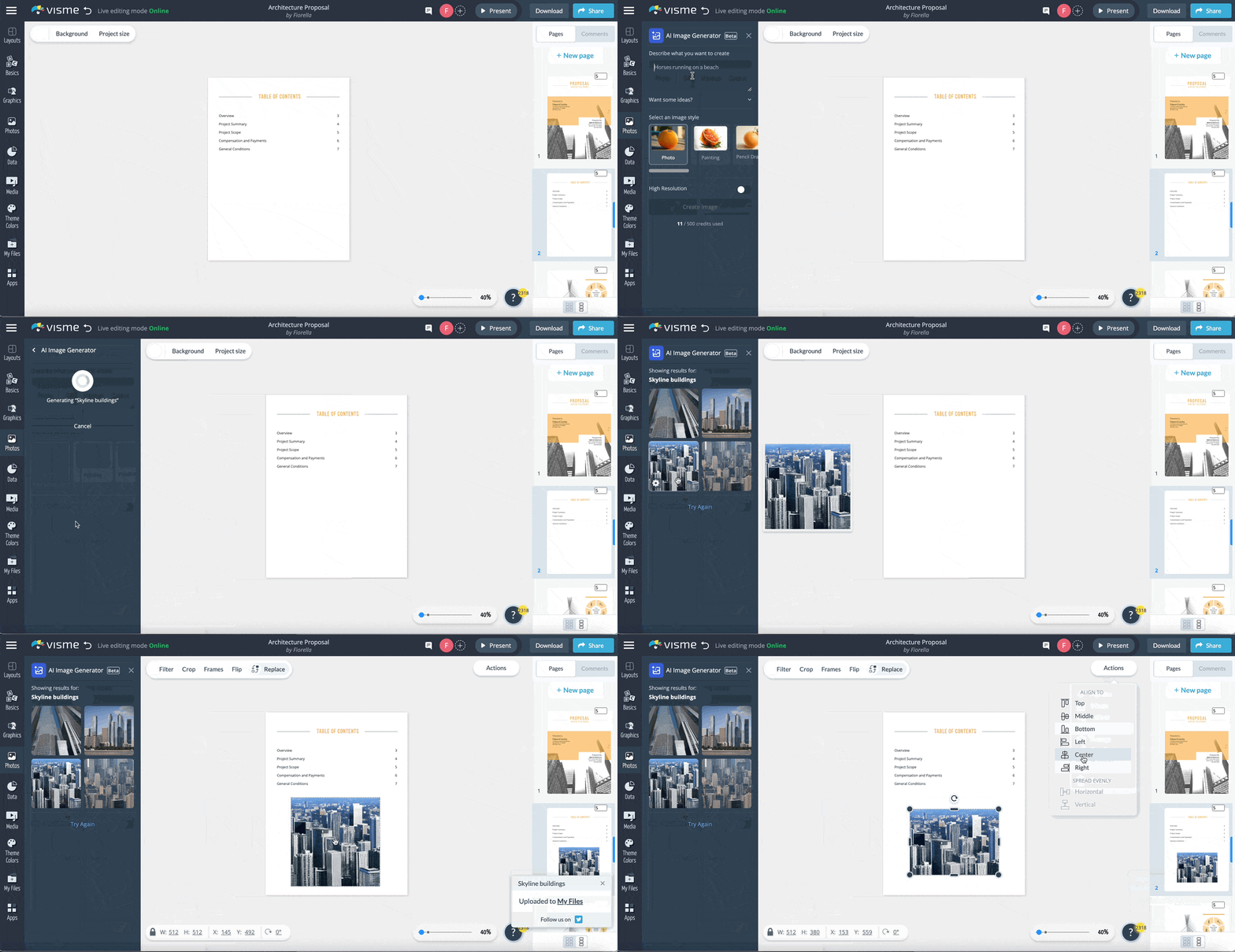
Who Is It For: Architects, architectural firms and design professionals.
Tech proposals have a different job: they need to explain how things will work without overwhelming the reader. These templates help you walk clients through systems, development plans, testing, and technical deliverables so they can see exactly what they’re getting and how it will be delivered.
This business proposal example is perfect for a more corporate look and feel in your proposal.
With a professional design and an easy-to-follow table of contents at the beginning of your proposal, your potential clients will love this proposal setup.
Design Tip: Give each new section in your proposal a similar header, as seen in this template. This will create a cohesive design, while letting your reader immediately know that they’ve moved onto a new section within your proposal.
Work together with various teams on design and content using Visme’s collaboration tool. Assign different pages to team members to work on, set deadlines and track completion with our workflow feature.
Who Is It For: Web developers, agencies and freelancers offering web design and development services.

If your brand colors focus on a single accent color, this is the perfect proposal template to customize. Here, we see a single accent purple used, while the rest of the information maintains a black and white look.
Even the data visualizations use a monochromatic scheme by incorporating other shades of purple.
Design Tip: Use a stock photo on your proposal cover with a transparent color overlay. This is a great way to create depth in your design, while still allowing your title and information to stand out.
Who Is It For: IT consultants, technology firms and businesses offering IT solutions and services.
If you're aiming to create a product proposal that aligns seamlessly with your eCommerce strategy, we've got you covered. Our comprehensive article on how to write a product proposal takes a deep dive into the essential elements for an effective product proposal.
This template for business proposal has a modern design, using a geometric layout throughout the document. These square sections help to break up large paragraphs of content in a visually appealing way.
You can also easily crop your images into various shapes to fit them into your geometric design.
Simply update the content in this business proposal sample, upload your own photos or use the options in the left-hand sidebar to add visuals to your proposal.
If your photos need polishing, prompt Visme’s AI editing tools to either
Design Tip: Try playing with geometric shapes in your design. Using squares to house various sections of content is a great way to separate your paragraphs and avoid crowding your design.
Who Is It For: Software testing companies, quality assurance professionals and development teams.

Check out one of the best proposal templates you’ll find anywhere. This proposal template makes it easy to input a map to showcase your business's various locations, your team, your workflow and more. Simply plug in your information, find relevant photos, change the fonts and colors, and complete your proposal design.
Design Tip: Play with columns or rows in your proposal. You don't have to use a full page. Instead, try working with a two-column look in your proposal.
Who Is It For: Technical writers, documentation specialists and businesses offering technical writing services.
If you’re offering SEO, branding, social media, or growth services, these templates help you tell a compelling story about how you’ll drive traffic, conversions and other impressive marketing results.
The bold, serif headings in this branding proposal example help you to create a contemporary design perfect for online businesses and modern branding companies.
Use this proposal writing format sample to deliver the perfect project overview and timeline for your potential clients. Simply edit the template, input your information and download.
Design Tip: Using grayscale photos can help create a level of professionalism within your proposal that might not otherwise be there. With Visme’s editor, you can add filters to your photos to find the perfect tone.
Who Is It For: Branding agencies, marketing consultants and businesses offering branding and design services.
Putting together a proposal for social media marketing services? This proposal cover template offers the perfect layout for your information, pricing and service details.
With sans serif fonts through and a modern look and feel, this proposal template is perfect for digital age services, like social media marketing.
Design Tip: Use a bold sans serif font as your page or section headers to really grab attention and create a contemporary design feel throughout your proposal.
Who Is It For: Social media marketers, agencies and businesses offering social media management and marketing services.
To provide you with an all-in-one solution for your social media marketing needs, Visme comes with a social media scheduler. With this tool, you can design your posts and schedule them instantaneously without using any other software. Build a complete social media plan for your content, including the types of posts you’ll be posting and when they will be published.
This business proposal brings in a few pops of color very strategically. Using a two-color scheme – magenta and grey – this template allows the colors to really run the show.
There are several well-designed sections within this template that can be customized to fit a variety of needs, so you can make this proposal template work for any type of business or service.
Design Tip: Add shapes and adjust the opacity to create glimpses into your background photo without distracting from the proposal content.
To make your proposal super engaging, use animations and interactive elements. Link pages or slides to objects, incorporate hover effects and clickable pop-ups and use animated icons, illustrations, 3D characters and special effects.
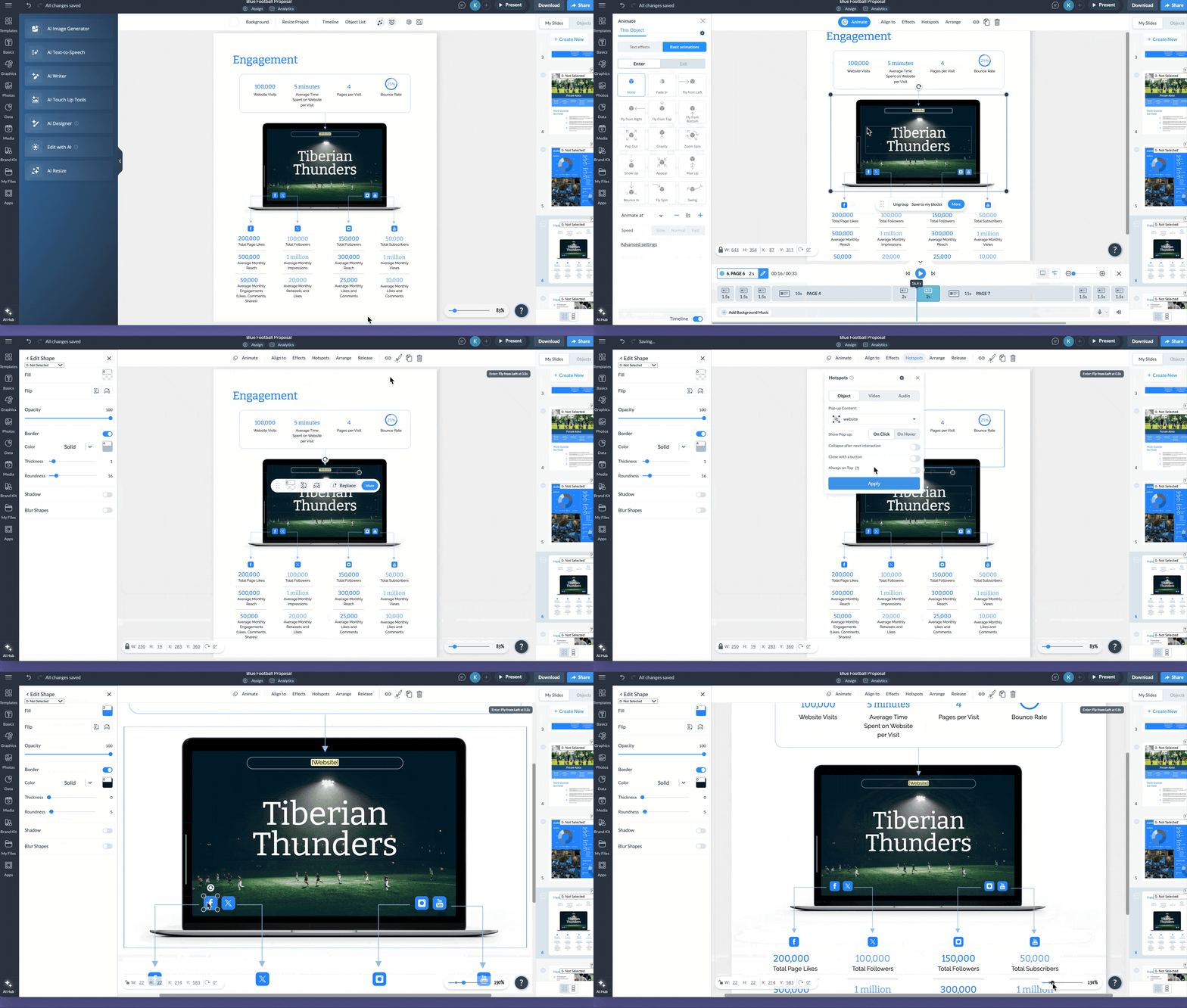
Want to create a proposal that pops? This eCommerce proposal template is the perfect way. By incorporating a bright red hue alongside images with black and white translucent overlays really helps important parts of this proposal template stand out.
Design Tip: Use a bright color as an accent hue within your proposal to really grab attention. Using this bright color to highlight the most important sections, like pricing, service options and things like that can be beneficial to your reader.
Who Is It For: SEO specialists, digital marketing agencies, and businesses offering search engine optimization services.

The warm color scheme in this company proposal template is perfect for business services. While orange is a focal color, the use of yellow and red in the icons and data visualizations fit right in.
Make your headings and most important tidbits of information stand out from the rest of your proposal by using a bold headline or highlighting them in bright shapes.
Design Tip: Using shapes, like ribbons and arrows, can add even more depth to your proposal, helping to call out specific information that you want your audience to read or understand.
Who Is It For: Marketing agencies, CRO specialists, and businesses offering conversion rate optimization services.

Depending on your audience, sometimes a more creative proposal template is the right look for the job. Other times, a more straightforward, minimalistic, professional design is the best choice.
Using popular fonts like Arial, Times New Roman and Verdana can also create a traditional look and feel for more corporate proposals.
Design Tip: Be sure to include a good bit of white space and margins in your proposal to ensure your content doesn't look too crowded and overwhelm your reader.
Who Is It For: Businesses and organizations looking to present a social media strategy or campaign plan.

This is another highly professional proposal template that your potential clients and customers will eat up. You can also use this template to create a partnership proposal.
The serif font in the headers presents a more traditional look and feel that is perfect for Enterprise businesses.
Design Tip: Use colorful image overlays to ensure images remain branded to the rest of your proposal. You can easily choose a color and select its opacity in Visme's photo editor.
Who Is It For: Marketing agencies, consultants and small business owners.
Additionally, Visme offers collaborative design features that help you collaborate with your team members to work on the proposals.
With these advanced collaboration tools, you can seamlessly invite team members via email and use functionalities like live editing, commenting, annotating, and version control to ensure a smoother collaborative experience.
Watch the video below to learn more about how collaborating right inside Visme
Here’s what Jaime Kelm, the Director of Business and Data Strategy at LAFC, expressed while talking about Visme:
Director of Business and Data Strategy at LAFC
This highlights how Visme's collaborative features can truly elevate not just your proposal creation process but all the other documents you create with Visme.

This standard proposal template includes another example of using a bold, sans serif font as the header throughout each page and main section to really grab attention and create a modern design.
With a variety of different pages and text boxes, your brand will easily be able to customize this two-tone proposal template and make it your own.
Design Tip: Use colored sections as a backdrop to your text. Colors don't only have to be used in accent elements, they can be a feature of the proposal, highlighting text boxes and adding more depth to your pages.
Who Is It For: Digital marketing agencies, consultants and businesses offering online marketing services.

Showcase a lot of color on your proposal designs with a template like this one. With this stunning bright blue utilized throughout the pages, your content will really stand out to your audience.
You can take advantage of this beautiful blue, or update the accent color to your brand color. Use this color in a variety of page designs to grab your reader's attention.
Design Tip: You can create mockups or use cutouts provided in Visme's stock photo library to create this effect.
Who Is It For: SEO specialists, SEO agencies and digital marketing agencies.
When your work is visual, your proposal should be too. These templates give you room to show off portfolios, mockups, photography, and style so clients can picture the final result before they ever sign a contract.
This proposal cover template allows you to easily add your company introduction, portfolio, testimonials and budget information for your potential clients and services.
Simplify the budgeting process with Visme's budget planner. You can create it from scratch as a standalone document to share with decision makers or use a budget template.
Visme also allows you to overlay website examples on top of a computer screen cutout to provide an even better website portfolio presentation for your clients.
Design Tip: Get creative with your table of contents. It doesn’t have to be a basic list of pages. Instead, take a page out of this template’s book and use a grid or other creative setup.
Who Is It For: Web designers, agencies and freelancers offering website design services.
Showcasing your work within your photography proposal example is a fantastic idea to really sell your services. This proposal design inspiration for event photography makes it easy to include previous project information, but incorporating screenshots or testimonials can work just as well.
Try including portfolio information within your proposal, too, so your reader can get a full scope of your previous work and get a good idea of if your business will be the right fit.
Easily share your proposal with your team members to get feedback. Or push the final version to your clients right inside your Visme account.
Design Tip: Get creative with your project timelines within this event proposal writing sample. Visme offers a wide selection of timeline and process diagrams that make putting together pieces of your proposal easy.
Who Is It For: eCommerce businesses, online retailers and agencies offering eCommerce solutions.

Want a more muted proposal template? This beige monochromatic color scheme creates a really beautiful look and feel.
The muted imagery also fits in perfectly with the rest of this proposal design. All you have to do is switch out the template content and send this off to your prospective client.
Design Tip: Use varying shades of a single color to create a uniform spectrum that you can use for timelines, process charts, subscription tables and more.
Who Is It For: Web designers, agencies and freelancers.

Want something more bold and unique? This modern proposal template utilizes a bright pink and purple color scheme that's perfect for a female audience.
The stock photos of female models throughout the proposal also help to resonate with their audience, and help potential customers to see themselves in the photos, creating a strong connection and making them want to work with you.
Design Tip: Create some kind of unifying factor on each page to keep your proposal design consistent. For example, in this proposal template, we see a solid pink line on the left side. Find something that meshes well with your design and stick with it.
Who Is It For: Fashion designers, boutiques and businesses in the fashion industry.
When money, partnerships, or event contracts are on the line, your proposal has to sell. These templates are designed to highlight what you’re offering, what it costs, and why it’s a smart decision for the client.

And just because your proposal design doesn't have to be all black and white doesn't mean you can't make this style work for you.
This proposal template uses a minimal amount of a secondary color, instead focusing on creating a stunning greyscale design that still feels modern and visually appealing. Feel free to tweak this template for your next brand collaboration proposal.
Design Tip: Don't clutter too much information on a single page. The less text and information, the better. Dedicate a single page (or more if necessary) to each section, like you see one page housing sponsorship plans with no other info. Learn more about how to write a proposal.
Who Is It For: Organizations seeking sponsorships, event planners and non-profit organizations.

While we tend to recommend using only serif and sans serif fonts to ensure a readable and professional proposal, there are still instances where a script font can work. This event proposal template is one of them.
Because the branding is lighter and more feminine, a script font is the perfect accent font for callouts and headers throughout this proposal.
Design Tip: If you do choose to incorporate a script font, ensure it's only used for quick tidbits of text or large font sections like your header. Using a script font for paragraphs of body copy will be too hard to read and you'll likely lose out on sales.
Who Is It For: Catering companies, event planners and any business in the catering industry.
When you sell writing, editing, or language services, your proposal is your first sample. These templates help you show clarity, authority, and value before the client ever reads a single deliverable.

If you're looking to create a sleek proposal to impress your audience and sell your service, this is the perfect proposal template for you. The serif font creates a classic look within your proposal that your prospective clients will appreciate.
Design Tip: You can easily use the same font to create different effects, like how you see some headings in all caps and others in title case. You can also try bold versus light, italicized versus normal and more.
Who Is It For: Editors, proofreaders and freelance writers.

Utilize stock photos strategically to provide accents and visual details within your proposal. This proposal template places navy blue color overlays on top of most stock photos, which you can easily customize with your own brand colors.
Design Tip: Use relevant icons to kick off each section. Visme's icon library is full of thousands of color-changeable vector icons and illustrations that will set your proposal apart from the rest.
Who Is It For: Email marketers and marketing agencies.

Showcasing testimonials is an important part of your proposal, so you want to take advantage of a proposal template that already has a page set out for these. Testimonials are a great way to show potential clients that you have previous client success stories.
Peter O'Callaghan, Head of Marketing at ScrapingBee, emphasizes the need to include testimonials in proposals.
"When we can drop in a quote from a happy client or show how quickly we can deliver results, it brings our proposal to life says Peter."
Design Tip: Place a stock photo across your entire page and use translucent or opaque sections to place text and other informational elements on top.
Who Is It For: Copywriters, content writers and marketing agencies.

This standard proposal template is perfect for international companies who want to showcase the vast variety of services offered by their business. Include a map, flags, icons, text and more to give prospective clients the full scope of what you can offer them.
Design Tips: Using white and light grey to create two-tone pages can create a new depth for your proposal.
Who Is It For: Translation agencies, freelance translators and businesses offering language services.

There's a plethora of information you might want to include within your proposal, but our proposal templates include pre-written copy to help guide your proposals.
You can easily customize our proposal designs to make them work for your business or industry and to perfectly sell or promote your product or service to your prospective client or customer. Use Visme’s analytics tool to see who has clicked on or viewed your proposal.
Design Tip: You don't have to take up a full page with your content. Take a page out of this proposal template's book and create a ton of white space and minimal content by using a full page for a small piece of content.
Who Is It For: Transcriptionists, language service providers and businesses offering transcription services.
There are many mistakes you can make in a proposal that will cost you opportunities. Here are five of the most common ones.
As teams grow more confident in what they sell, proposals start to drift. They become catalogs of features, workflows, and technical details instead of a response to a real business problem. This is especially dangerous because it looks thorough, but it fails to persuade.
Mira Nathalea, CMO at SoftwareHow, describes this perfectly:
“Two mistakes I’ve seen, and even made myself early on, are overcomplicating the proposal and neglecting the client’s main pain points. I’ve often caught myself writing pages of product details that, in reality, don’t help the client understand what we’re offering. Now, I stick to simple language and make sure I have thoroughly researched what’s bothering the client most, so I can speak directly to that.”
Start every major section by anchoring it to a client problem. If you cannot point to a specific pain point your content is addressing, it does not belong in the proposal. A simple test is to ask, “Does this help the client make a decision?” If it does not, cut it.
One of the most common shortcuts experienced consultants and agencies take is copying a previous proposal, swapping out the client name, and sending it off. On the face of it, it feels like you’ve saved 90% of the time.
Richard Millington, in his article, Five Business Proposal Mistakes You’re Probably Making Today, explains why this is a dangerous habit:
“It’s far too easy for errors (especially past client names) to slip through the cracks. If you mistype a client name in one place and later use a ‘find and replace’, you’ll likely leave the typo in. It’s hard to earn respect when you make mistakes like this.”
The problem is not just the risk of embarrassing errors, although those happen more often than people admit. It is the deeper signal it sends. A reused proposal feels generic, detached, and careless at exactly the moment when the client is deciding whether you truly understand their situation.
Millington also points out the real issue behind this habit:
“You’re not personalising your proposal enough. It’s nuts to expend such an incredible effort to attract clients and then get lazy at the proposal stage. This is the moment when you need to customise everything to the client.”
Use templates for structure, not for content. Your sections, layout, and formatting can remain the same, but the story inside them should change.
Rewrite the problem statement, value proposition, and recommendations to reflect this specific client’s goals, challenges, and context. Going the extra mile can be the difference between getting the deal or getting turned down.
Seasoned teams often assume their reputation or brand will do the heavy lifting. So they make strong claims in their proposals but do not slow down to show how those claims are earned.
You will often see phrases like:
Most proposals already sound confident; the problem is the missing evidence. When a proposal does not back up its promises with case studies, data, or examples, decision-makers have no way to assess risk. And when money or contracts are on the line, that uncertainty makes people hesitate.
Experienced buyers are trained to ask one question as they read:“How do I know this will work for us?”
Every major claim should have something attached to it. That could be a short case study, a metric, a client quote, or a concrete example of how you have done this before.
The purpose of a proposal is to effectively communicate a well-structured plan, address a problem or opportunity, and persuade the audience to accept the proposed solution or take the desired course of action. Proposals also help communicate value, build trust and credibility and guide decision-making for stakeholders.
Here are some of the benefits of using a proposal template:
A well-crafted business proposal should include the following key elements:
A business plan serves as a comprehensive document that outlines the overall strategy, objectives, and operational details of a business. It provides a roadmap for internal stakeholders and potential investors to understand the company’s goals, operations, and financial projections.
On the other hand, a business proposal is a focused document that presents a specific solution or project to a potential client or business partner. The goal of a business proposal is to persuade the recipient to accept the proposal, enter into a partnership, or engage in a business transaction.
The best proposal template format can vary depending on the specific requirements of your industry, organization, or the type of proposal you’re creating. However, the format below communicates your ideas effectively and is applicable to a wide range of use cases.
There are generally four types of proposals: external, internal, unsolicited and solicited.
When a proposal is written by and for the stakeholders or members of the same company or organization, it’s called an internal proposal.
Businesses primarily use these types of proposals to offer solutions to internal problems, suggest new projects, request funding or propose changes to company policies.
An external proposal is written for some individuals or organizations outside the writer’s organization. They are mostly written in a formal tone and are used for purposes like winning a new customer, securing funding from investors, selling products or services and more.
A solicited proposal is mostly the one you submit to respond to a request for proposal. When an organization or individual needs a solution to a problem, they ask for proposals to address it. Then, they choose the most convincing proposal from several options to decide which service they will use.
An unsolicited business proposal is one you send to offer your products, services or solutions to a business or organization without being asked. This proposal aims to introduce a new product, service, or idea and persuade the potential customer to work with you. Unsolicited proposals are generally broader than solicited ones because you haven’t discussed the prospect’s needs beforehand.
The three C’s are simple principles that make proposals effective:
There is no single universal format, but the best proposals follow a logical, reader-friendly structure:
This format works because it mirrors how people make decisions—first understanding the need, then the solution, then the cost and impact.
Most strong proposals include these core components:
There you have it: everything you need to create proposals that win approvals. The strongest proposal samples you saw in this guide all did the same thing in different ways. They explained the problem clearly, presented a real solution, backed it up with proof, and removed friction from the decision-making process.
Now the only thing left is to put it into practice.
Visme offers a wide range of proposal templates to help you find the perfect fit for your next proposal. You can also streamline your proposal-making process with Visme's AI Proposal Generator; enter your prompt, and the AI chat assistant generates a proposal that fits your needs, industry and style within minutes.
Utilize one of these proposal templates to start customizing your own proposal and generate sales and conversions today.
Sign up for your Visme account and start creating your proposal, wowing your audience and showcasing your product or services.

Design visual brand experiences for your business whether you are a seasoned designer or a total novice.
Try Visme for free


![How to Create a Practical Crisis Management Plan [+ Templates]](https://visme.co/blog/wp-content/uploads/2025/07/How-to-Create-a-Practical-Crisis-Management-Plan-Thumbnail.png)