Keeping branding consistent while creating content as a team has always had its pitfalls. Brand guidelines help with that, of course. But it’s not enough anymore.
Most companies, and probably yours, have brand guidelines and templates for sales reps and marketing content creators to use. But, according to our research, off-brand content still goes out.
We put these brand consistency statistics together to show where that happens. They come from The Brand Execution Gap 2026, our survey of 304 brand owners and 303 content creators at mid-market companies in the US, UK, Canada and Australia, plus 2025 and 2026 research from Gartner, McKinsey, Forrester, Optimizely and System1.
You'll see how confident creators are with each part of the brand, where guidelines live, how many hours brand owners spend on reviews and why templates alone don't keep content on brand. Together, they show the Brand Execution Gap: the difference between defining a brand and applying it in everyday business content.
Quick Reads
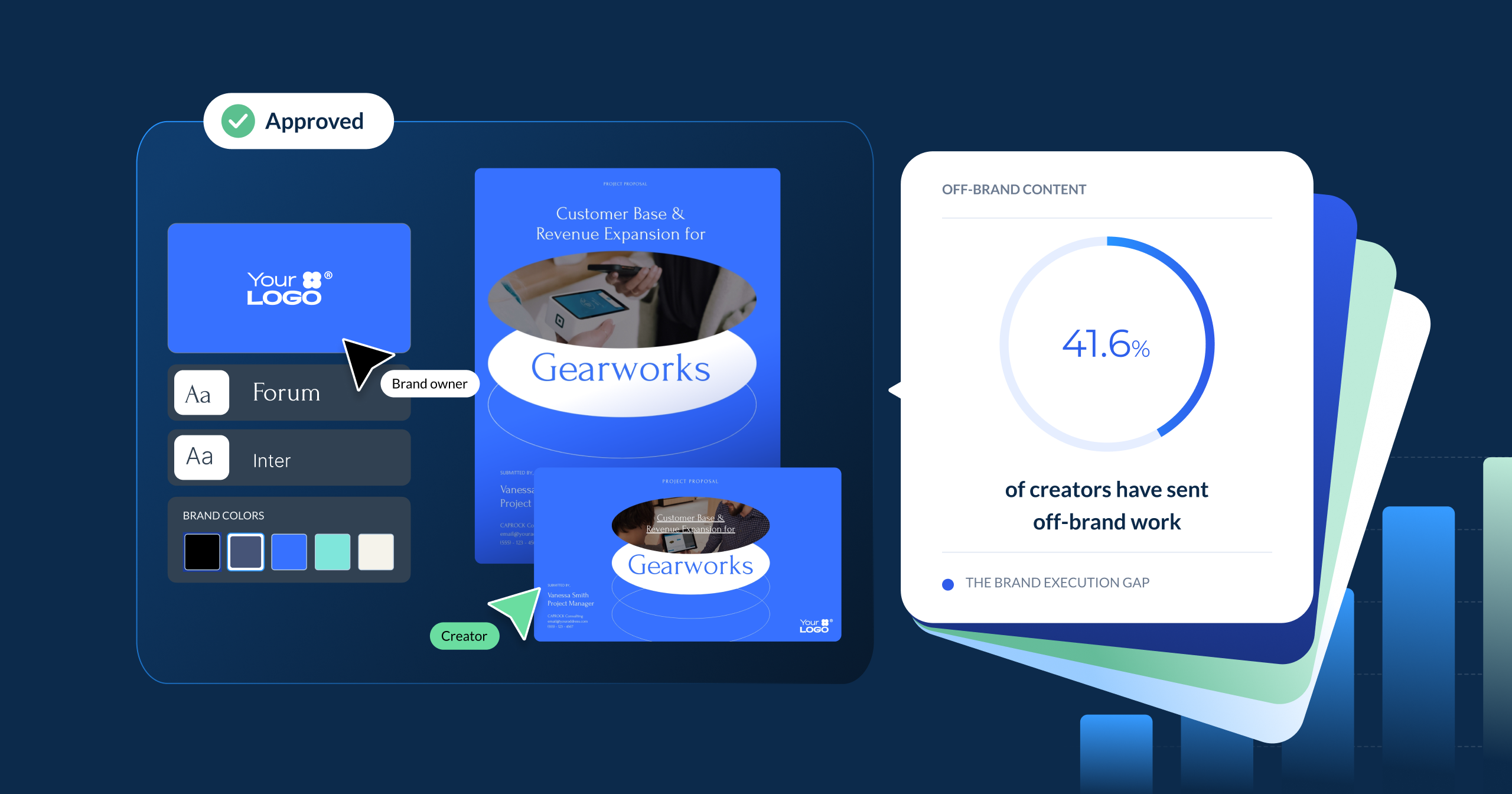
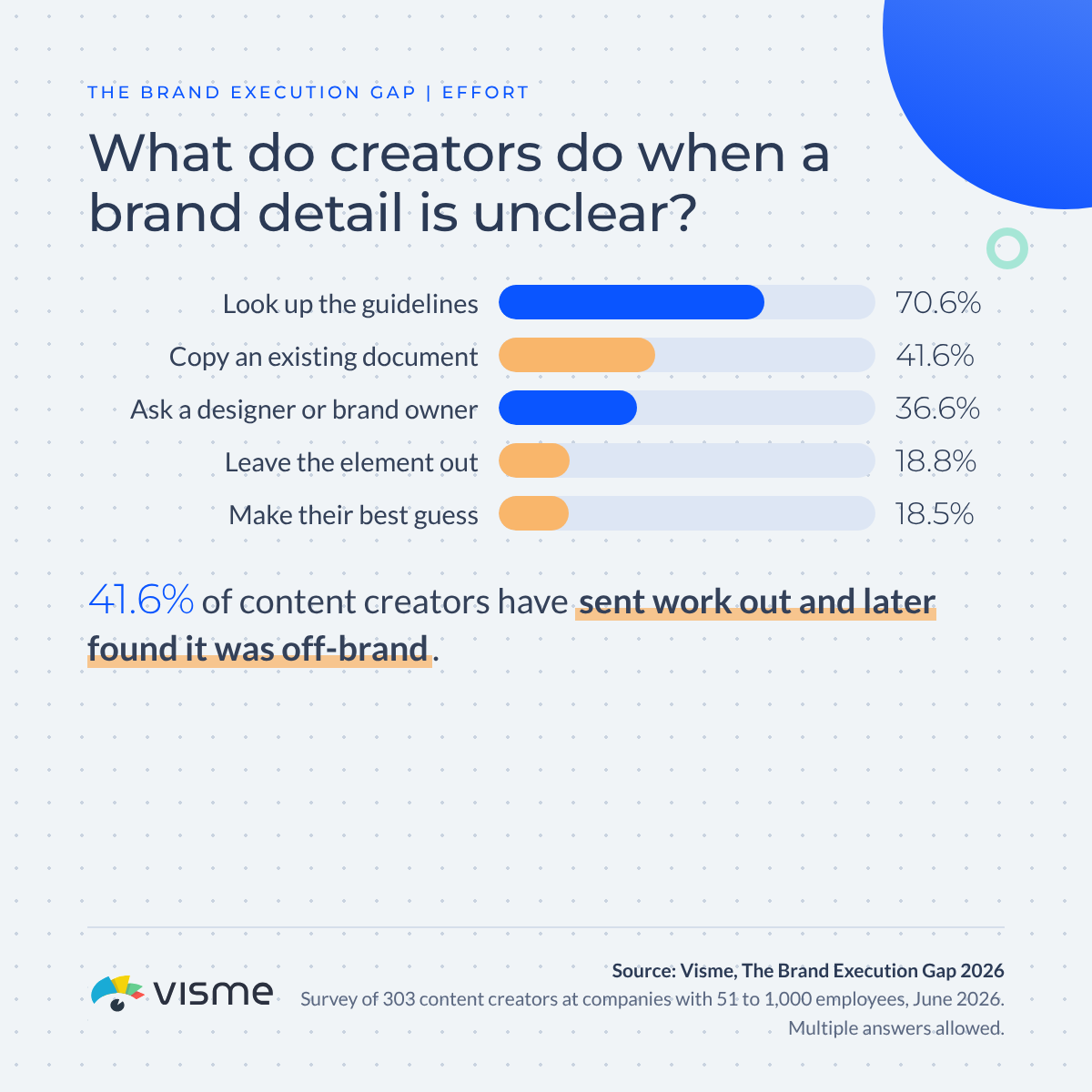
41.6% of content creators have sent content out and later found it was off-brand.1
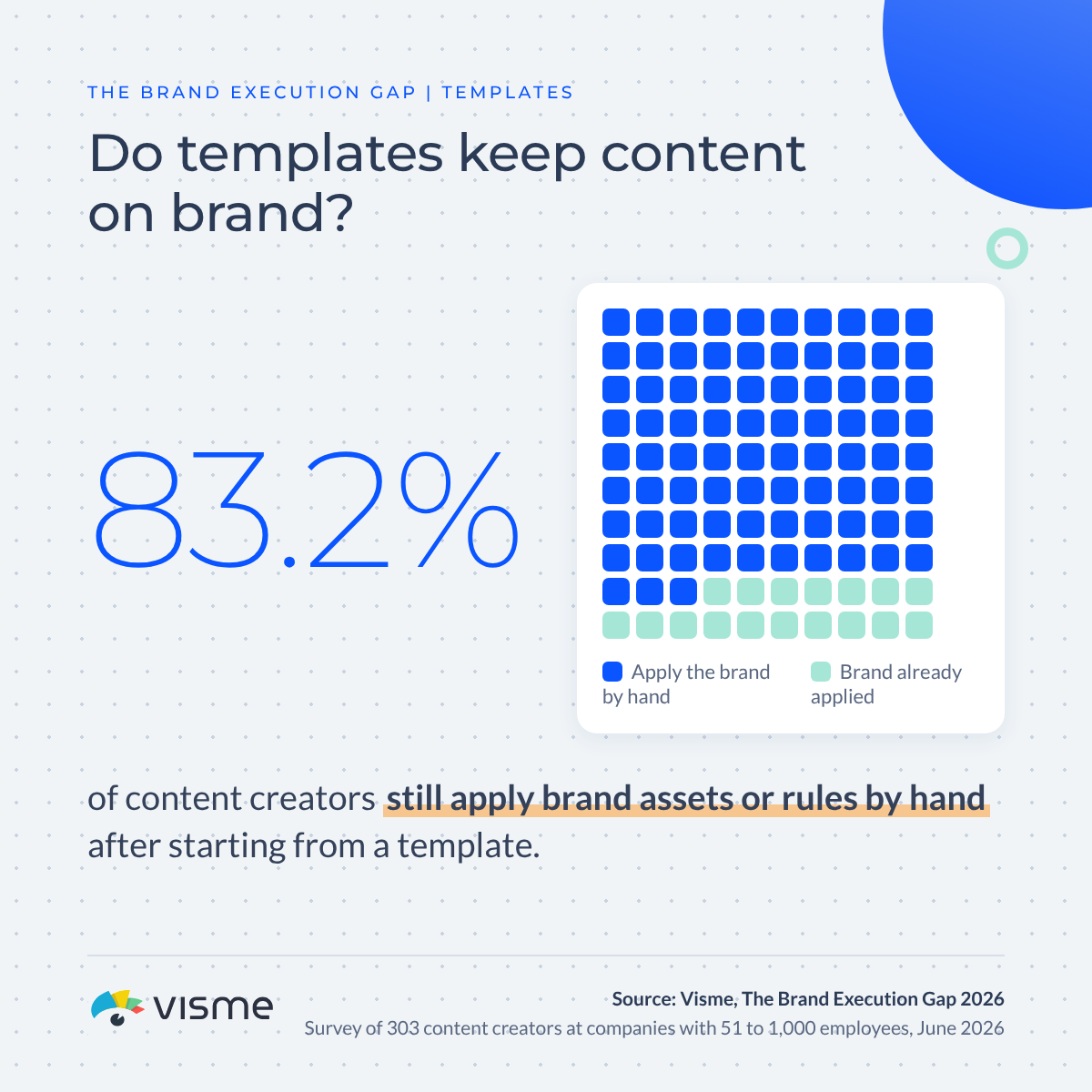
83.2% of content creators still apply some brand assets or rules by hand after starting from a template.1
58.1% of content creators open a separate reference to find a brand color or font while editing.1
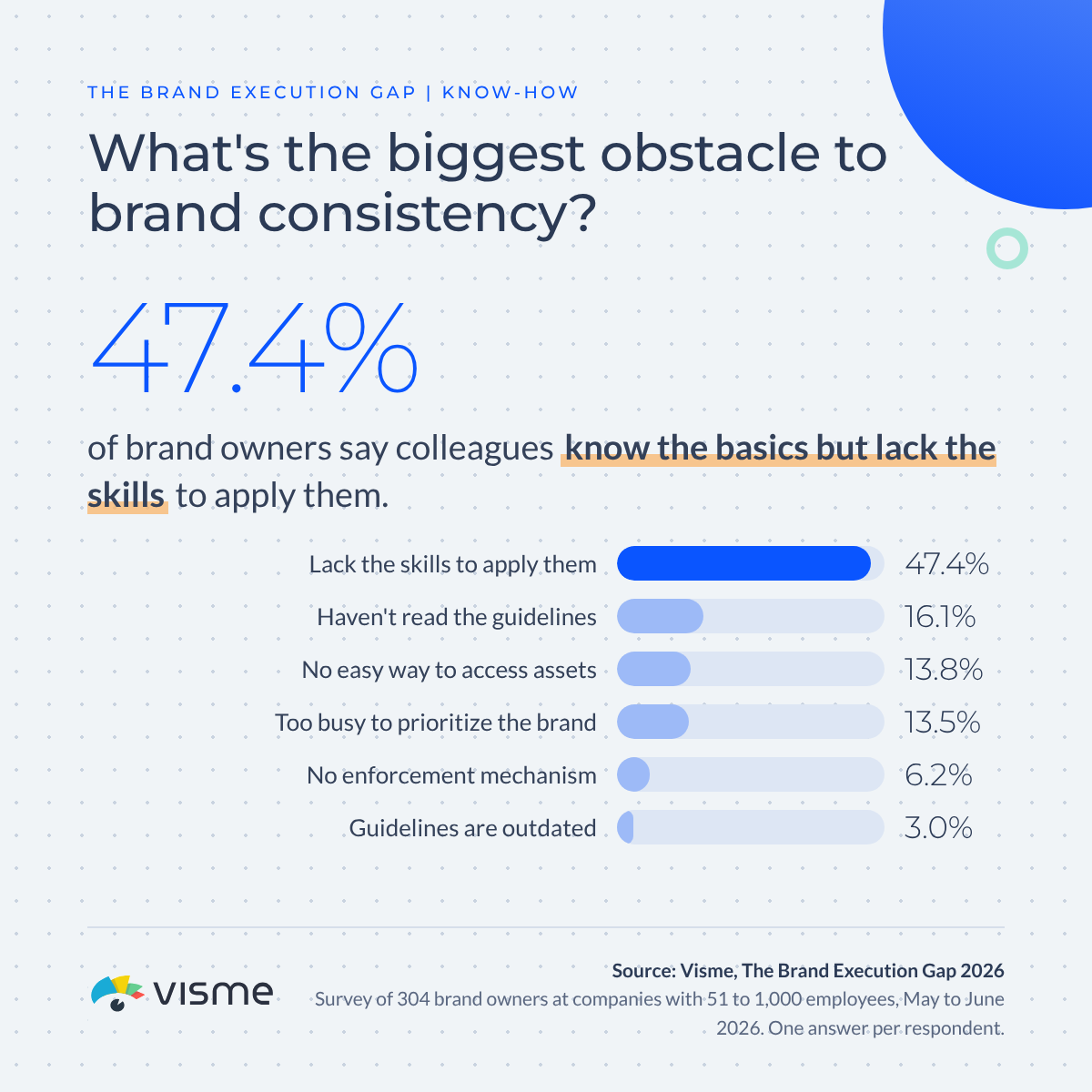
47.4% of brand owners say the biggest obstacle to brand consistency is colleagues who know the basics but lack the skills to apply them.1
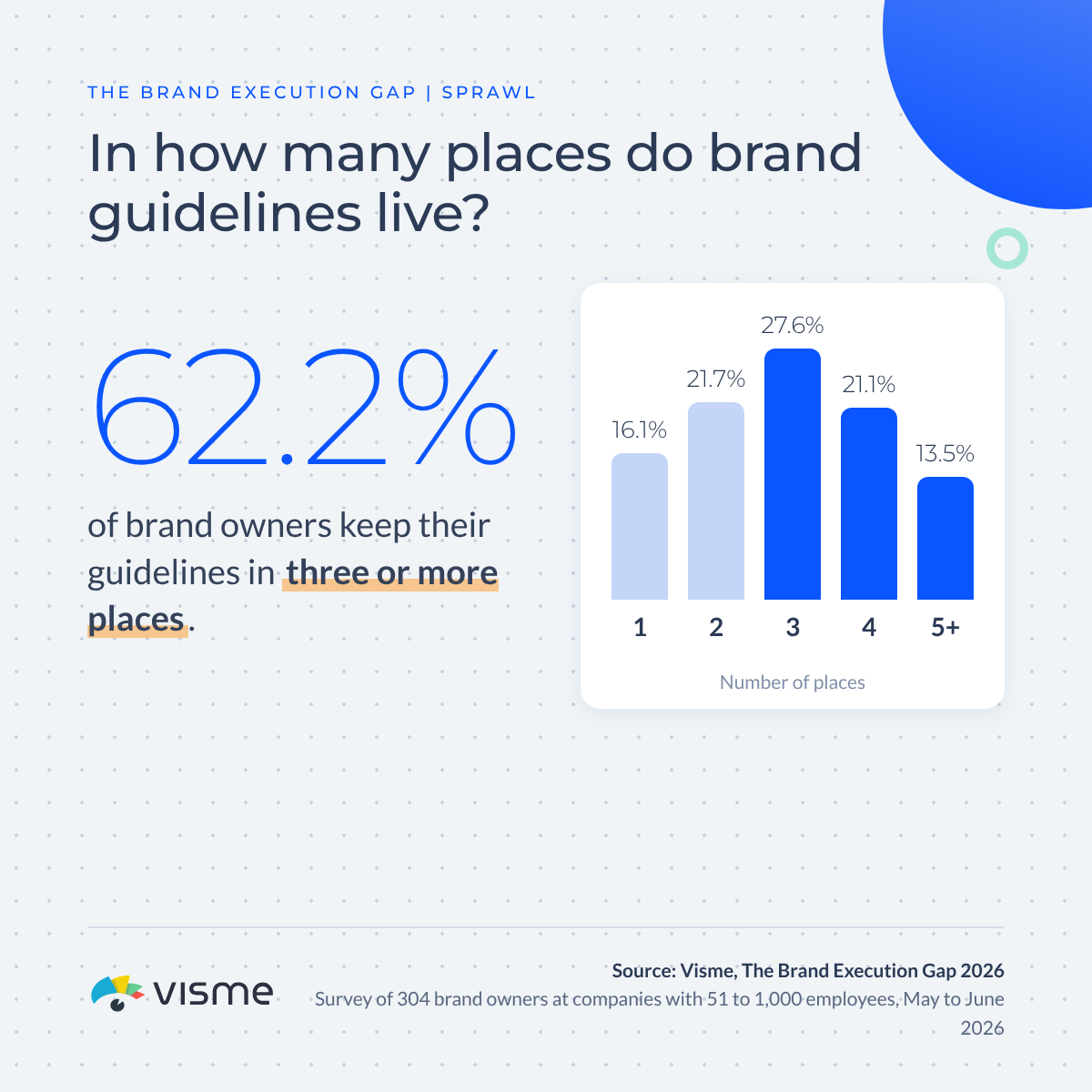
62.2% of brand owners keep their brand guidelines in three or more places.1
65.5% of brand owners spend three or more hours a week on brand questions, reviews and fixes.1
You Have Brand Guidelines. So Why Is Off-Brand Content Still Going Out?
42% of content creators found out their content was off-brand after they'd already sent it. See where brand consistency breaks down.
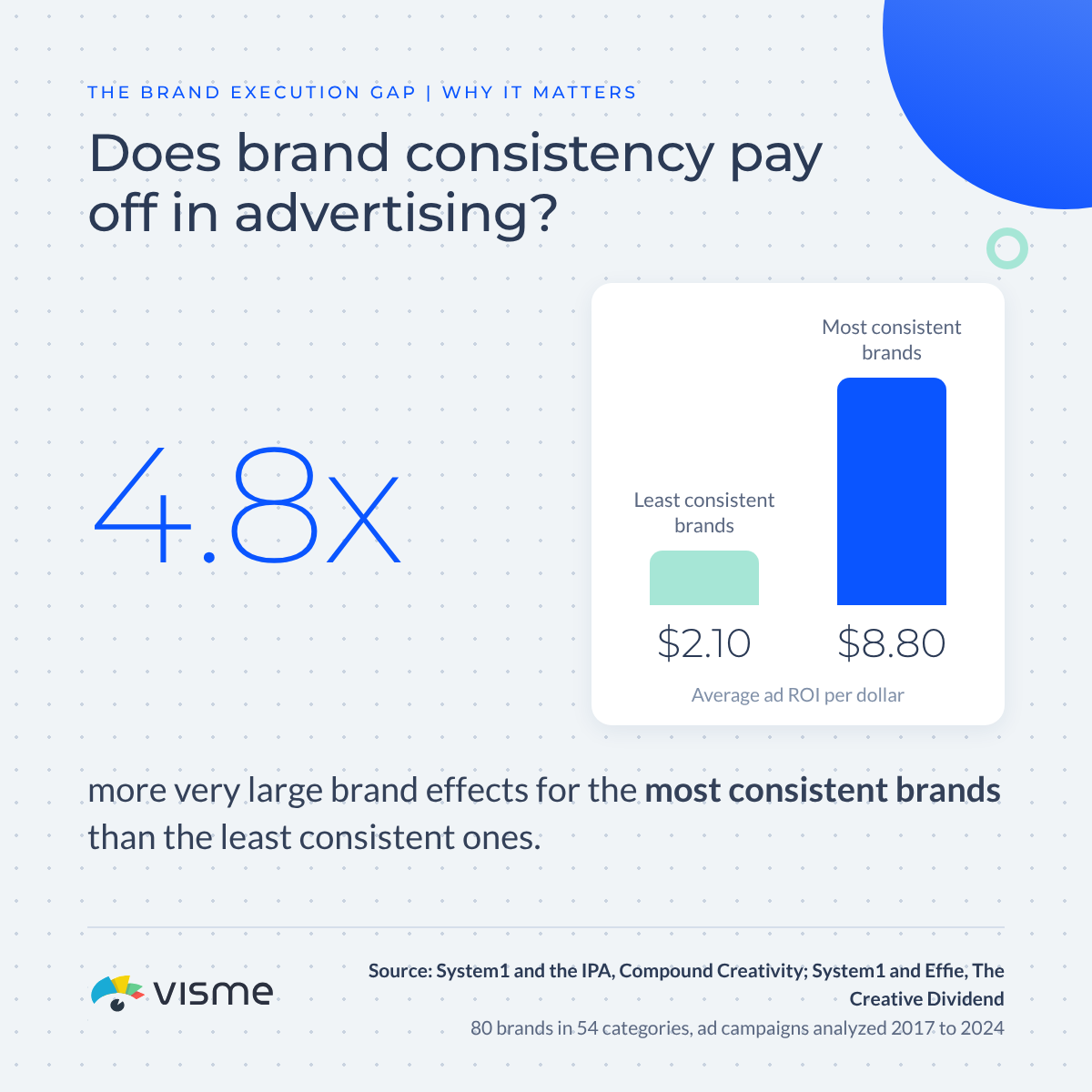
The most consistent quartile of brands gets 4.8x more very large brand effects than the least consistent, according to System1 and the IPA's Compound Creativity study of 80 brands in 54 categories, analyzed from 2017 to 2024.3
Average advertising ROI rises from $2.10 per dollar for the least consistent brands to $8.80 for the most consistent, according to The Creative Dividend, a companion study by System1 and Effie.3
Both System1 figures cover advertising campaigns. The rest of this page looks at everyday business content: the decks, reports, proposals and one-pagers employees make every week.
Confidence in knowing the brand basics doesn't stop off-brand work every time. Content creators feel sure about fixed rules like colors and logos, but confidence drops on judgment calls, and the most confident creators tend to go off-brand almost as often as everyone else.
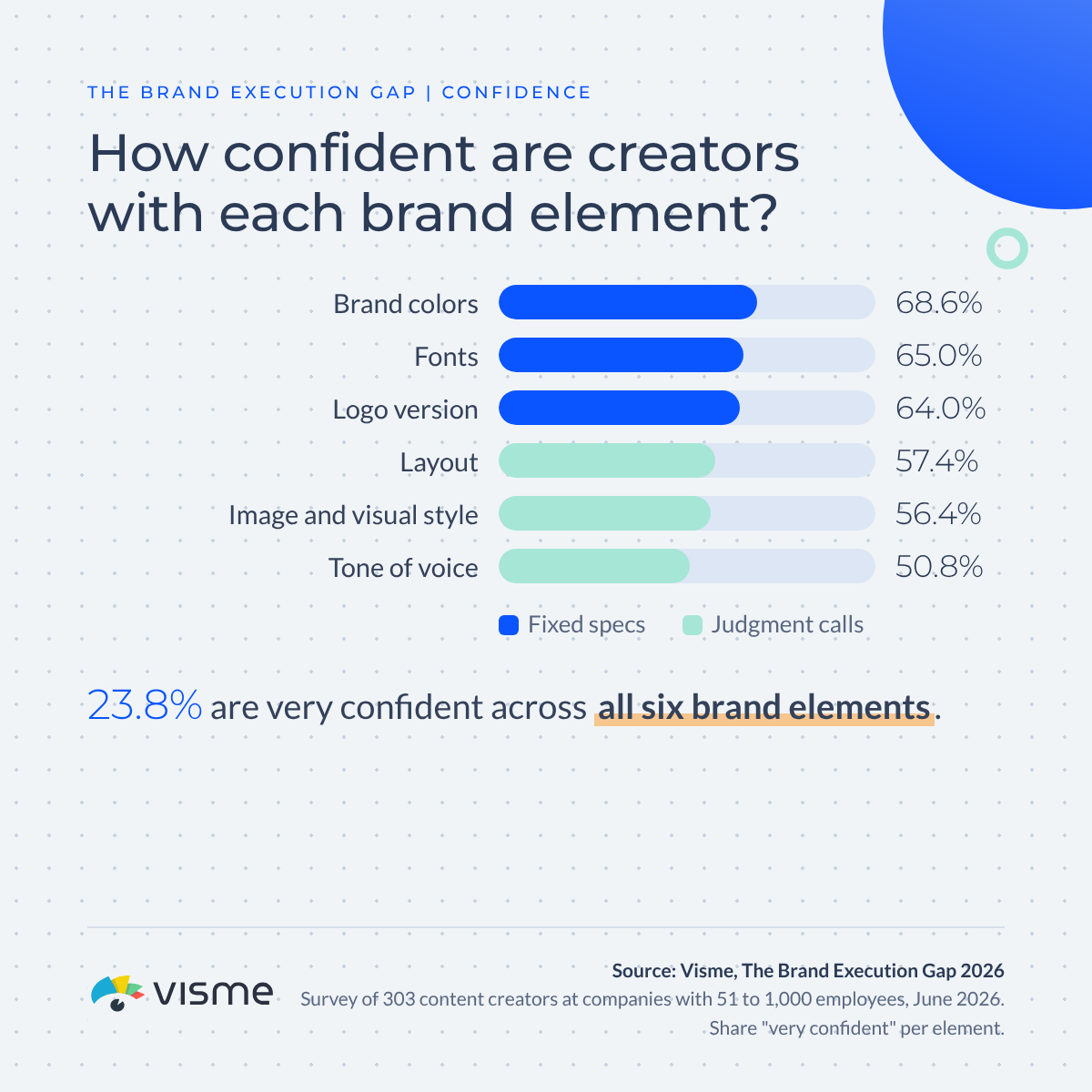
68.6% of content creators are very confident choosing brand colors.1
65.0% of content creators are very confident using the correct fonts, and 64.0% are very confident picking the right logo version.1
Confidence drops for judgment calls: 57.4% are very confident on layout, 56.4% on image and visual style and 50.8% on tone of voice.1
Only 23.8% of content creators are very confident across all six brand elements.1
41.6% of content creators have sent content out and later found it was off-brand.1
Among creators who are very confident across all six elements, 37.5% have still sent off-brand content, against 42.9% of everyone else.1
29.2% of the all-six-confident group have had a colleague correct their work for being off-brand, against 28.1% of everyone else.1
Where Confidence Helps Most
Confidence makes the biggest difference on fixed specs like logos, fonts and colors.
29.9% of very confident creators have been unsure which logo to use, against 43.1% of less-confident creators.1
12.7% of very confident creators have lacked the exact font spec, against 40.6% of less-confident creators.1
16.8% of very confident creators have had to guess or search for a brand color, against 31.6% of less-confident creators.1
A brand owner in Australia described what happens when work goes out without a check:
People putting in the time and then committing to publishing and then realizing they don't fit the recommended guidelines and we have to go back and fix it.
Brand owner, analyst
Australia
Tough pill to swallow, but knowing the brand just isn’t enough for the work to go out perfectly on brand and at scale.
Say a sales rep knows the brand logo and the colors by heart. They need a proposal by the end of the day, so they stretch a layout to fit a new pricing table and the logo gets pushed tightly towards the edge. The deck goes out like that.
Unfortunately, next to a competitor's polished deck, that almost-right proposal can make your company look less put together.
Brand owners point to skills more than knowledge when content goes off-brand. Most colleagues know the brand guidelines exist. But applying them perfectly to a pre-made layout is the hardest part.
47.4% of brand owners say the biggest obstacle to brand consistency is that colleagues know the basics but lack the skills to apply them.1
16.1% of brand owners say colleagues don't read the guidelines, and 13.8% point to trouble accessing the right assets or templates.1
41.8% of brand owners describe colleagues who know the basics and struggle with nuance.1
24.7% of brand owners describe colleagues who work from a general sense of the brand and make mistakes regularly. Together with the group above, that's 66.4%.1
23.7% of brand owners say colleagues know the guidelines well and apply them confidently, and 9.5% say colleagues copy existing materials rather than read the guidelines.1
Among brand owners whose colleagues apply the brand confidently, 45.8% still name missing skills as the biggest obstacle, and 65.3% still spend three or more hours a week on brand work.1
The Brand Mistakes Brand Owners See Most
Layout and spacing errors top the list, ahead of the fixed specs.
50.3% of brand owners see mistakes in spacing, layout and alignment.1
49.3% see mistakes with fonts.1
44.4% see mistakes with colors.1
43.1% see mistakes in logo use.1
How Brand Owners Handle Brand Governance
Brand governance at most companies runs on training and review.
64.8% of brand owners train colleagues on brand use.1
62.8% of brand owners review other people's content for brand compliance.1
67.3% of content creators say their work goes through formal approval or designer review, and another 23.4% get comments from peers.1
A brand owner in the US described the review load:
The biggest challenge is that while team members know our basic brand colors and logos, they lack the specific design training to handle visual nuance. I constantly have to catch and correct manual layout errors, spacing inconsistencies, and off-brand formatting choices during my review cycles before materials can be approved.
Brand owner, manager
United States
When seeing these issues, a lot of brand teams put their effort towards a fix, but in the wrong direction. They run more training on the guidelines and help with knowledge, but most of the colleagues already have that.
What really trips them up are the small design decisions nobody planned for, like a CSM adding a second chart to a QBR slide or someone in ops turning a one-pager into a full report.
Off-Brand Content Statistics: What Creators Do When Unsure
Content creators put in the effort to get the brand right. Off-brand content shows up when they look for an answer and can't find a clear one.
97.4% of content creators describe an approach where getting the brand right matters.1
53.5% of content creators want their work to look exactly right and will spend extra time on it.1
32.7% aim for close enough, 11.2% match past work and 2.6% put the brand second to the content.1
When a Brand Detail Is Unclear
Most creators check the guidelines first. Many also copy old work or leave the element out.
70.6% of content creators look up the guidelines when unsure of a brand detail.1
41.6% copy an existing document.1
36.6% ask a designer or brand owner.1
18.8% leave the element out, and 18.5% make their best guess.1
A content creator in Australia explained the pull to get it right:
Definitely the perfectionism in me. I want to always make sure I'm putting my best foot forward, and also making sure that what I create aligns with the company.
Content creator, administrative
Australia
More 2026 Data on Off-Brand Content
25% of marketing leaders frequently or always publish AI-generated content they know isn't fully on-brand when under deadline pressure, according to Optimizely's 2026 Global Study of 2,003 marketing leaders.4
49% of US consumers say GenAI has made the quality of available content worse, and 57% of Gen Z and millennials agree, according to a Gartner survey of 307 US consumers.5
53% of B2B content leaders say outdated, off-brand or incorrect content reaches their customers monthly or more often, according to Visme's B2B sales content statistics.6
Above everything else, off-brand content tends to move and spread mistakes further. A buyer might land on your polished website, then get a proposal in a different font and, a few months later, a renewal deck with last year's logo. When several people are involved in the deal, each of those mismatches is a small reason to wonder how organized your company is.
Brand guidelines rarely live in one place. The scatter costs creators time while they edit and sends more questions to brand owners.
62.2% of brand owners keep their brand guidelines in three or more places.1
16.1% of brand owners keep guidelines in one place, 21.7% in two, 27.6% in three, 21.1% in four and 13.5% in five or more.1
88.2% of brand owners look after more than one brand, and 51.0% manage three to five.1
Among brand owners with a single brand, 30.6% still keep its guidelines in three or more places (a group of 36, so indicative).1
Where Brand Guidelines Live
Company brand hubs and shared documents is where most brand guidelines live. A branding kit inside a content tool sits in the middle of the list.
Where brand guidelines live
Share of brand owners
Company brand hub
55.9%
Shared document or wiki
52.0%
Branded slide deck
51.3%
PDF brand book
46.4%
Brand kit in a content tool
32.9%
Brand portal
26.3%
Design tool library
20.1%
Chat channel or someone's head
12.5%
Not documented
2.0%
Finding Brand Details While Editing
More than half of creators leave their tool to check a color or font.
58.1% of content creators open a separate reference to get a brand color or font while editing.1
55.4% use colors saved in their tool, and 32.3% go from memory.1
Only 18.8% have a tool that shows the brand values without asking.1
81.2% of content creators supply brand values themselves because their tool doesn't show them.1
A content creator in Canada described the cost of old versions:
Oftentimes people at my company will reference brand guides or rules that are out of date because they are referring to an old document or version. Updates aren't communicated very effectively or in a timely manner.
Content creator, vice president
Canada
Brand owners with several brands feel this most. One brand owner in Canada said juggling brand books makes them feel "less like a designer and more like a librarian."
Having guidelines in so many places also makes every brand update risky. When you refresh your colors or messaging, the brand hub gets the new version first. Meanwhile, the old PDF, the sales team's master deck and that message someone pinned in a chat channel keep going around for months. That's how a partner ends up with two documents from you that don't agree on what your brand looks like.
Brand review takes hours every week, and the load grows with each brand an owner manages.
65.5% of brand owners spend three or more hours a week on brand questions, reviews and fixes.1
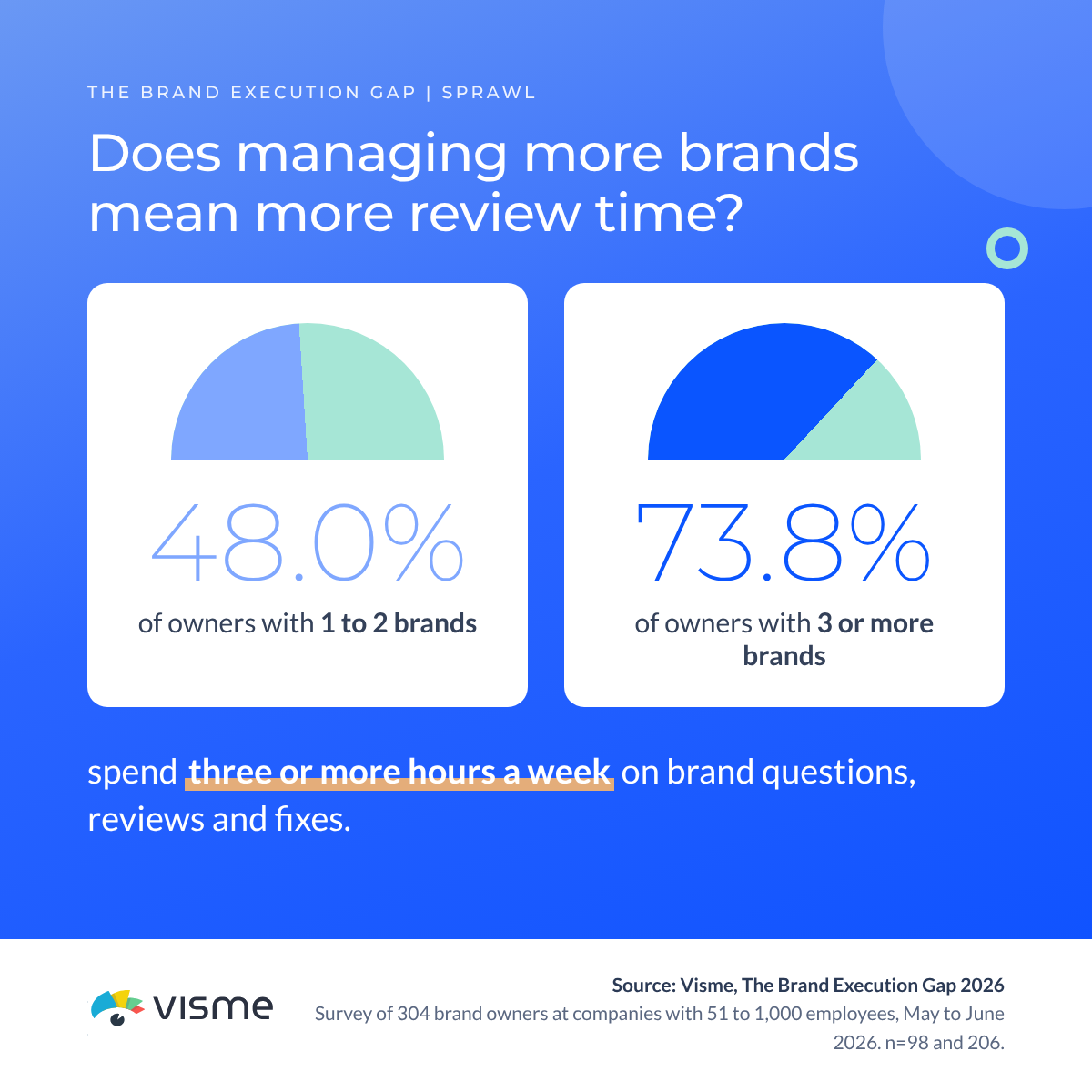
48.0% of brand owners with one or two brands spend three or more hours a week on brand work, against 73.8% of owners with three or more brands. Company size made no reliable difference.1
58.6% of brand owners field brand questions at least once a day.1
What Colleagues Ask Brand Owners
66.8% of brand owners get asked to confirm work is on-brand.1
53.6% get asked which color, font or logo to use.1
42.4% get asked where an asset lives.1
More 2026 Data on Review Time
Three-quarters of marketing leaders spend at least three hours each week editing, fact-checking or correcting AI-generated output, according to Optimizely.4
Just over half of marketers name inefficient content creation and reviews, and misalignment between sales and marketing, as their biggest content operations challenges, according to Forrester.7
Three hours a week might not sound like much. Over a year, that's more than 150 hours per brand owner that could have gone into campaigns, launches or new brand work. And reviews pile up at the worst times, like the end of a quarter or the week of a big pitch, when the most content goes out and there's the least time to check it.
Almost every creator starts from a template, and most still apply the brand by hand. Templates carry the brand decisions made in advance. Content that changes still needs new decisions.
99.7% of content creators work from templates.1
Only 16.8% of content creators get templates with the brand already applied, and 83.2% still apply some brand assets or rules by hand.1
Among creators making brand fixes, 49.2% make small adjustments, 27.1% regularly apply colors and fonts to new elements and 6.9% rebuild the styling for most elements.1
Only 1.3% of content creators say a template is usually ready to use as it is.1
28.7% of content creators get templates by copying a colleague's document, and 26.4% build from scratch in the brand style.1
What Needs the Most Work Before a Template Is Ready
Text and images need the most changes, followed by layout and the brand specs.
60.7% of content creators change text and content.1
52.1% replace images.1
42.9% fix layout or spacing.1
35.3% adjust colors, and 34.0% adjust fonts.1
Orana Velarde, Head of Content at Visme, explained where the brand slips in the report announcement:
Every team has a template library. But even then, a huge problem shows up the moment the copy runs long or a chart needs another column. That's when people start adjusting spacing, picking content components and colors. A lot of the time, they're guessing, and that's where the brand slips.
Orana Velarde
Head of Content, Visme
Templates are great for the first draft. The trouble starts when the content changes, like when a prospect needs a custom pricing slide or a chart needs one more column. Someone fixes it in their own copy, the next person copies that version and so on. A few months later, your team's real template is whatever was used last.
Few creators start branded work in AI tools, and marketing leaders are still working out how AI affects their brand.
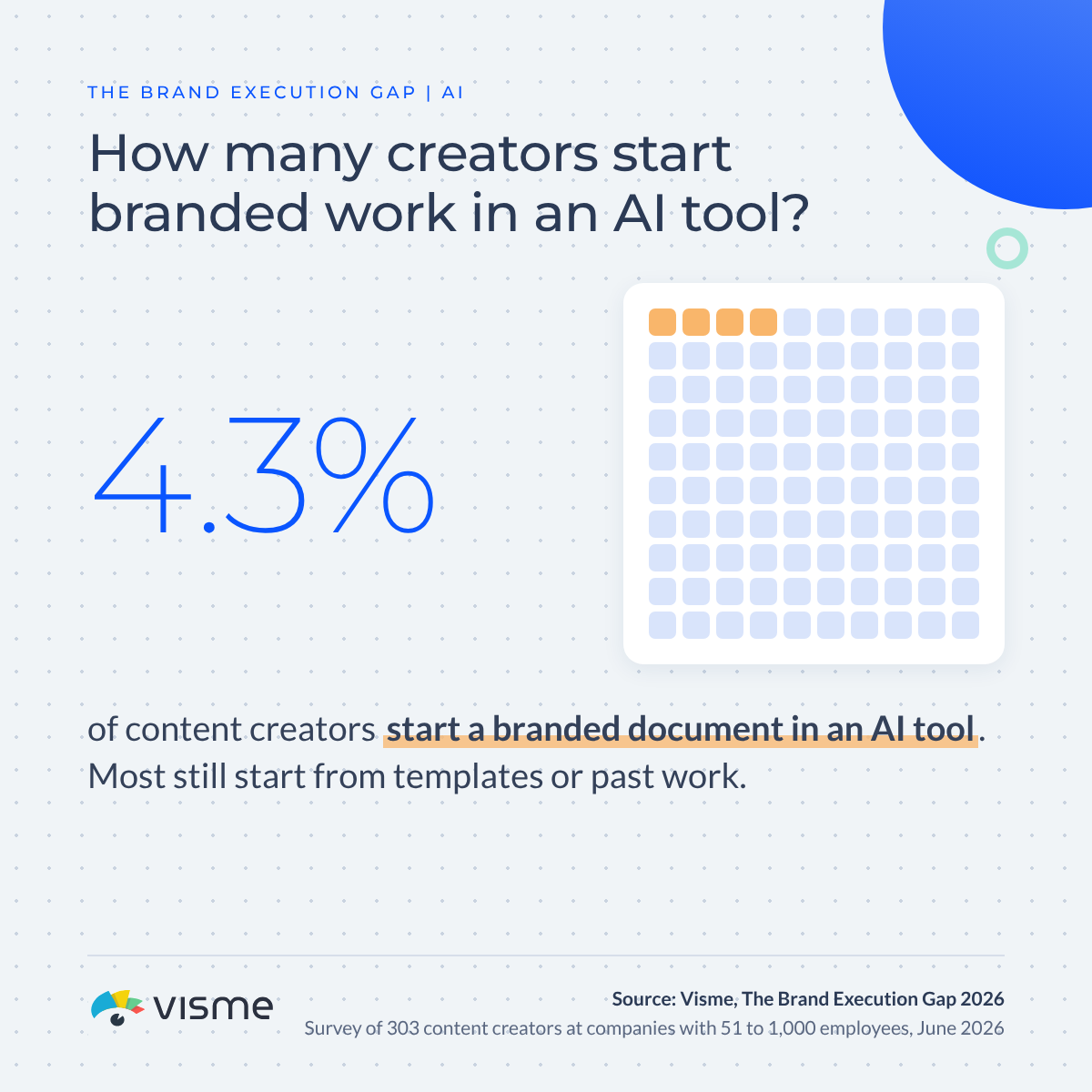
Only 4.3% of content creators start a branded document in an AI tool.1
AI came up unprompted in 17 of 1,461 open-text answers, in both directions.1
Only 30% of marketing leaders believe their brand voice is unmistakable, according to Optimizely.4
61% of CMOs have adapted content strategies to improve machine readability and visibility in AI-driven experiences, according to a Gartner survey of 408 senior marketing leaders.8
42% of CMOs have taken steps to monitor and correct misinformation about their brands in AI-generated content.8
50% of US consumers say they would prefer to give their business to brands that don't use GenAI in consumer-facing content, according to Gartner.9
For more on how teams set rules for AI content, read about AI content governance. A brand owner in the US said guidelines need to live where content gets made:
Brand guidelines are only useful if they're easy to find and apply in real world workflows. Many teams now create content using [design and AI tools], so the biggest opportunity is making actionable guidelines and integrating them into those platforms rather than living in a fixed PDF that rarely gets opened.
Brand owner, manager
United States
AI makes all of this more pressing. Teams can now create more content, faster, and more people are doing it. If your brand only lives in a PDF, AI will repeat the same gaps, just at a higher volume. The brands that stay consistent will be the ones that put their rules where content gets made, for people and for AI tools alike.
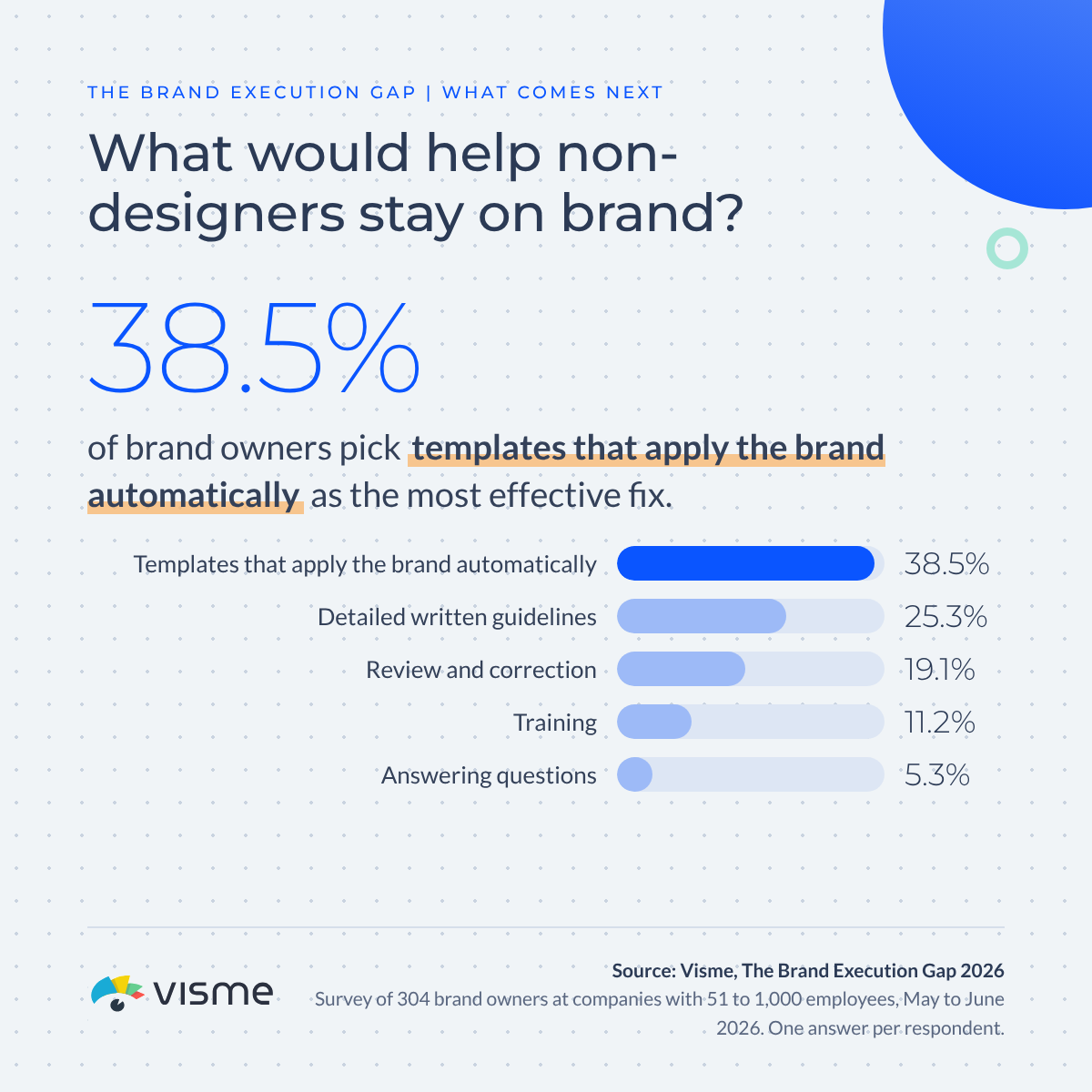
Brand owners rank templates that apply the brand automatically as the most effective way to help non-designers.
38.5% of brand owners choose templates that apply the brand automatically.1
25.3% choose detailed written guidelines.1
19.1% choose review and correction.1
11.2% choose training, and 5.3% choose answering questions.1
Thera Martens, VP of Marketing at Visme, described the gap in the report announcement:
Most companies already have guidelines, templates and a review process. Yours likely does too. But there's always a gap in the process when it's time to build new content.
Thera Martens
VP of Marketing, Visme
How LAFC Cut Deck Reviews From Three to One While Keeping Brand Consistency
LAFC's 13-person partnership team built a shared slide library and five deck templates with the brand applied in Visme. Reps assemble decks from visuals that have already passed design review, so decks that went through three reviewers now need one.
I'm not needed to review and make sure all the data is up to date, because we know that as long as they're using the library slides, everything is good to go.
Alex Zani
Corporate Partnership Strategy, Los Angeles Football Club
For teams that rebuild the same decks every week, the Visme team is testing Visme Playbooks, a new product now in beta. Upload your best deck, lock the content that must never change and let your team make on-brand decks from it in minutes. Join the Playbooks waitlist for early access.
The Brand Execution Gap 2026 is based on two surveys of 607 people at companies with 51 to 1,000 employees in the US, UK, Canada and Australia.
304 brand owners answered 15 questions from May 28 to June 8, 2026. Brand owners are the people responsible for brand guidelines, assets, templates or approvals. Only 7.2% of them work in marketing.
303 content creators answered 20 questions from June 4 to 8, 2026. 12.3% of them hold design titles.
Both surveys ran on the UserTesting panel and collected 1,461 open-text responses.
Each survey has a margin of error of about ±5.6% at the 95% confidence level, so treat the figures as directional. Smaller subgroups carry a wider margin.
Content creators were screened as non-users of Visme. The 16.8% and 18.8% tool figures are likely conservative.
Verbatim quotes are shown with role and country only.
System1 and the IPA, Compound Creativity. 80 brands in 54 categories, analyzed 2017 to 2024. Includes The Creative Dividend (Effie and System1, 2026) ROI figures.
Optimizely, 2026 Global Study. 2,003 marketing leaders in seven markets, fielded by Savanta, May to June 2026. Published June 30, 2026.
Orana Velarde is Head of Content at Visme, where she has been writing since 2017. She plans and writes content for both readers and search engines, including AI answer engines. Her topics include design, visual marketing, data visualization, visual content creation and AI tools. Orana has a background in graphic and web design. She is also an artist and illustrator, and has worked as a makeup artist for film and theater. Follow her on LinkedIn.