



A Quick Guide on Sponsorship Marketing: Best Framework, Examples & Tools


Nobody wakes up excited to shop for life insurance.
It’s the kind of product people know they need but actively avoid thinking about. And that’s because thinking about it means confronting morality, financial vulnerability and the uncomfortable reality of “what happens after they’re gone.”
And yet, that avoidance creates one of the biggest opportunities for life insurance marketing.
Studies show that 100 million Americans lack adequate life insurance coverage. But all these people who need your product aren't indifferent. They're stuck, held back by misconceptions about costs, inertia, discomfort and the absence of a compelling reason to act immediately.
Good marketing gets your message across and removes those specific barriers using techniques like storytelling and omnichannel strategies.
This guide breaks down these tactics and shows you what effective life insurance marketing looks like in practice. We’ll also cover other strategies that move people from avoidance to action, the lead-generation techniques that bring in qualified prospects, and the best practices that keep your messaging compliant, trustworthy and effective.
At the end, you’ll walk away with practical techniques you can implement right away.
Before you start, open the video below in a different tab and save it for later. It’s a 101 on how to produce cohesive, branded content for your insurance marketing efforts using Visme.
Disclaimer: Visme is not a HIPAA-compliant platform and should not be used to store, process, or transmit protected health information (PHI). Users are responsible for ensuring their use of Visme complies with applicable data privacy and security regulations.
Life insurance marketing is the practice of building awareness about your life insurance products. While also making it easy for prospects to contact you and start a real conversation about the decision they’ve been putting off.
Once they’re in your funnel, you can educate them on the options they don’t fully understand and build enough trust that they’re willing to act on something deeply personal.
Done well, life insurance marketing turns potential clients into new clients by removing the barriers that keep potential customers from taking the next step towards signing a life insurance policy.
What life insurance isn’t: aggressive selling, fear-based manipulation or treating prospects like transactions. The brands and agents winning in this space today understand that life insurance marketing is fundamentally about education and storytelling, not pressure.
One of the biggest challenges in life insurance marketing is overcoming the emotional resistance that keeps people from taking action.
The idea is that you have to meet them where they are emotionally. And by using relatable information, you can make the journey feel less intimidating than they originally expected.
Here are four strategies that work.
Storytelling is the thread that must run through everything you do, from TV commercials to Instagram captions, email sequences and beyond.
As Jeff Sams, VP of Marketing at ASG Life, puts it:
"The art of storytelling in life insurance sales isn't about dramatizing fear. It's about helping people visualize the future they want for the people they love."
Some of the most effective life insurance campaigns have leaned into storytelling. For example, Thai Life Insurance’s “Unsung Hero” commercial went viral by showing everyday acts of kindness and the impact one person can have on others. This commercial set the tone for all insurance marketing thereafter.
Most recently, New York Life’s “Love Takes Action” campaign reframed insurance from a financial product into a symbol of love and responsibility. It all started with TV commercials during the Super Bowl and then grew into a podcast.
New York Life described the objective as a collection of “rich and compelling stories of people putting their love in action in everyday situations or during extraordinary events, sharing emotional moments of love, strength, resiliency and humanity. Independent experts offer insights, takeaways and inspiration.”
So, how can you apply storytelling to your insurance marketing?
For starters, share real client stories (with permission) about how a policy made a difference during a family crisis. Use high-quality video testimonials that focus on the feeling of security. Frame your content around life milestones that your potential policyholders are experiencing.
Omnichannel marketing unifies several marketing strategies into a seamless experience. The objective is to connect touchpoints and channels through cohesive messaging, signals and visual identity.
Touchpoints in an omnichannel marketing strategy work side-by-side or flow into each other to support a prospect's transition from awareness to conversion. These touchpoints cover several channels, including digital, social media, content, email, event and more.
But why does omnichannel marketing work for life insurance?
Because even as digital research becomes the norm, life insurance buyers want human guidance before committing. According to a LIMRA study, 72% say they want to speak with a financial professional, but only 15% actually do. That gap between intent and action is exactly what omnichannel marketing is designed to close.
Experts at ABM see this play out constantly: “Most insurance marketing doesn’t fail because people aren’t clicking. It fails because nothing clear happens after they do. Across independent, Captive, Medicare and life insurance agents, we see the same pattern repeatedly: A prospect searches. They find you. They click. And then… momentum stalls. Not because the prospect wasn’t interested — but because the digital experience didn’t guide them forward.”
This lack of clear flow is where opportunity lies for your omnichannel marketing strategy.
The thing is, omnichannel marketing doesn’t have an exact formula.
There are many ways you can arrange it. Your actual flow must be informed by market research and a clear understanding of your target audience. Analyze your target market by demographics, life stage and buying triggers, then build your flows around how that specific audience researches and makes decisions.
Finally, you must ensure that every touchpoint is seamlessly connected through visuals, content and tone.
And most importantly, remember that it’s not about “being everywhere”. It's about being consistently 'you' across touchpoints, making the handoff between them feel seamless. That’s why the most effective marketing campaigns coordinate messaging across multiple marketing channels so that every interaction reinforces the last.
Here are some omnichannel marketing strategies to help close that gap.
Made with Visme Presentation Maker
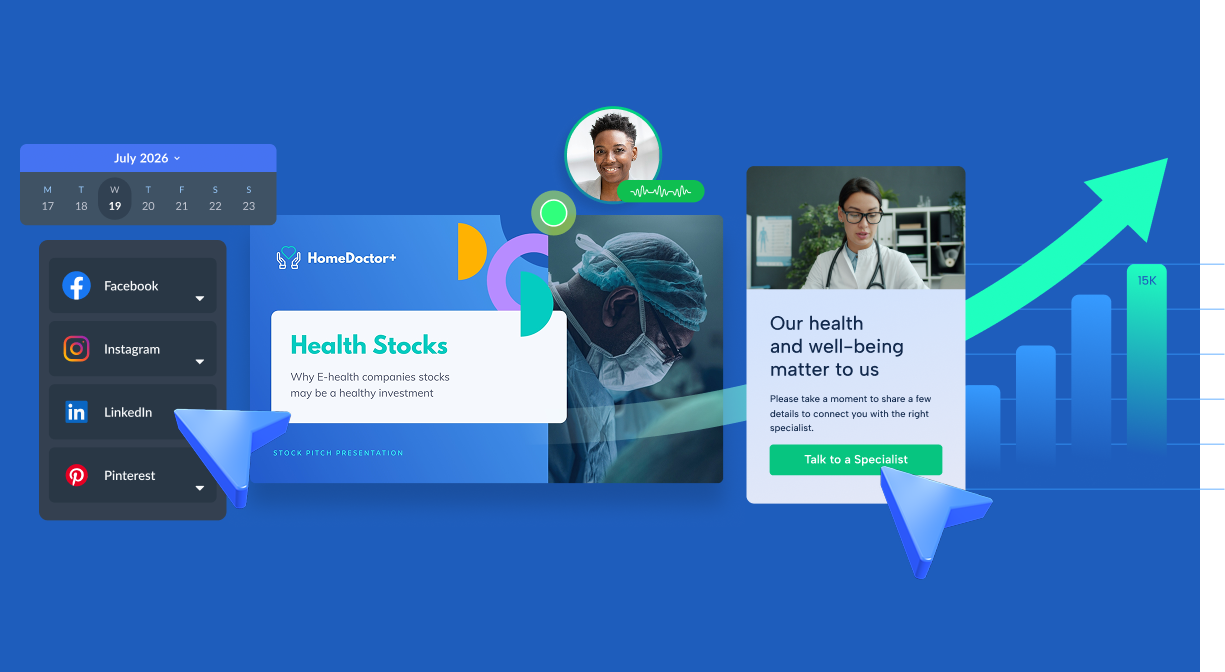
To help team members remember your flows, open and customize this infographic that maps them out as visual flowcharts. A single-page overview like this will help your team (and your partners) see the full journey at a glance.
People typically buy life insurance from people (and companies) they trust. On social media, trust is built by showing up authentically, consistently and with something genuinely useful to say.
According to the 2025 Insurance Barometer Study I mentioned earlier, 62% of all adults and 80% of those under 45 now use social media platforms to research insurance products. Nearly half of Gen Z and Millennials say they value recommendations from experts on social platforms. If you’re not active there, someone else is answering their questions.
To be successful with your life insurance social media marketing, concentrate on these two factors:
Like Smollan, Chief Experience Officer at Experior Financial, explains: "In the life insurance industry, trust is paramount. Clients need to feel confident that their financial futures are in good hands. A strong personal brand communicates reliability, competence and integrity."
Midwest Insurance Brokerage Service also supports this strategy: “The key to social media success? Stop selling and start helping. People aren’t scrolling their feeds looking for an insurance policy, but they are looking for solutions, advice and entertainment.”
The best way to spearhead a social media marketing strategy for your life insurance organization is to start with a social media plan. The template below will help you get aligned with both your team and your stakeholders.
And even without a design team, you can customize the layout using Visme's built-in library of icons, stock photos and videos.
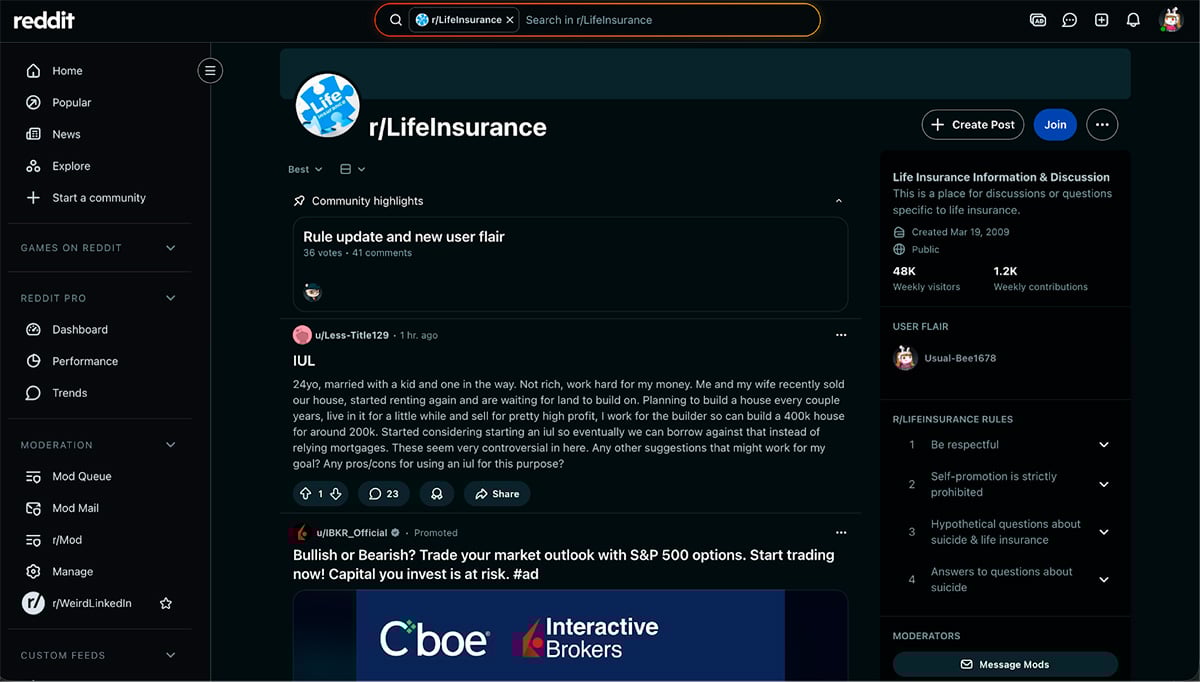
Another way to build trust is through community-based marketing. These communities can range from a subreddit with 200,000 members to a neighborhood financial literacy workshop with 20 attendees.
According to a study run by Profound, Reddit is the #1 most-cited source across AI platforms. When a prospect asks something, the answer will likely come from Reddit threads where real people have already asked the same question or had a very similar conversation.
Subreddits like r/LifeInsurance, r/InsuranceAgent, r/personalfinance and f/Financial planning are where prospects go to ask real questions about their pain points, compare experiences and get peer advice on life insurance.
These spaces can help you in two concrete ways, whether you work on the marketing team at an insurance carrier or agency, or are an independent agent or broker.
Follow this sequence recommended by Reddit experts: First, listen with Reddit Pro to monitor brand mentions and common questions in your category; then comment on existing threads with genuinely helpful answers. Once you get your bearings and start building some presence, create original posts centered on the questions people have been asking. Finally, after establishing credibility, consider a branded presence or promoted content.
Here are some tips for engaging in subreddit threads.
Community-based marketing at the local level is based on actions that help you build relationships before anyone needs a policy, so when they do, you're already the person they trust.
For any insurance business, local visibility and word of mouth are among the most reliable paths to new business. Sheldon Smollan also emphasizes that agents who position themselves as community resources see significantly higher referral rates.
Why? Because when someone asks their neighbor, “Do you know a good insurance agent?”, they’ll name the person who showed up at the school fundraiser and answered their questions at the PTA meeting, not the one who sent a cold email.
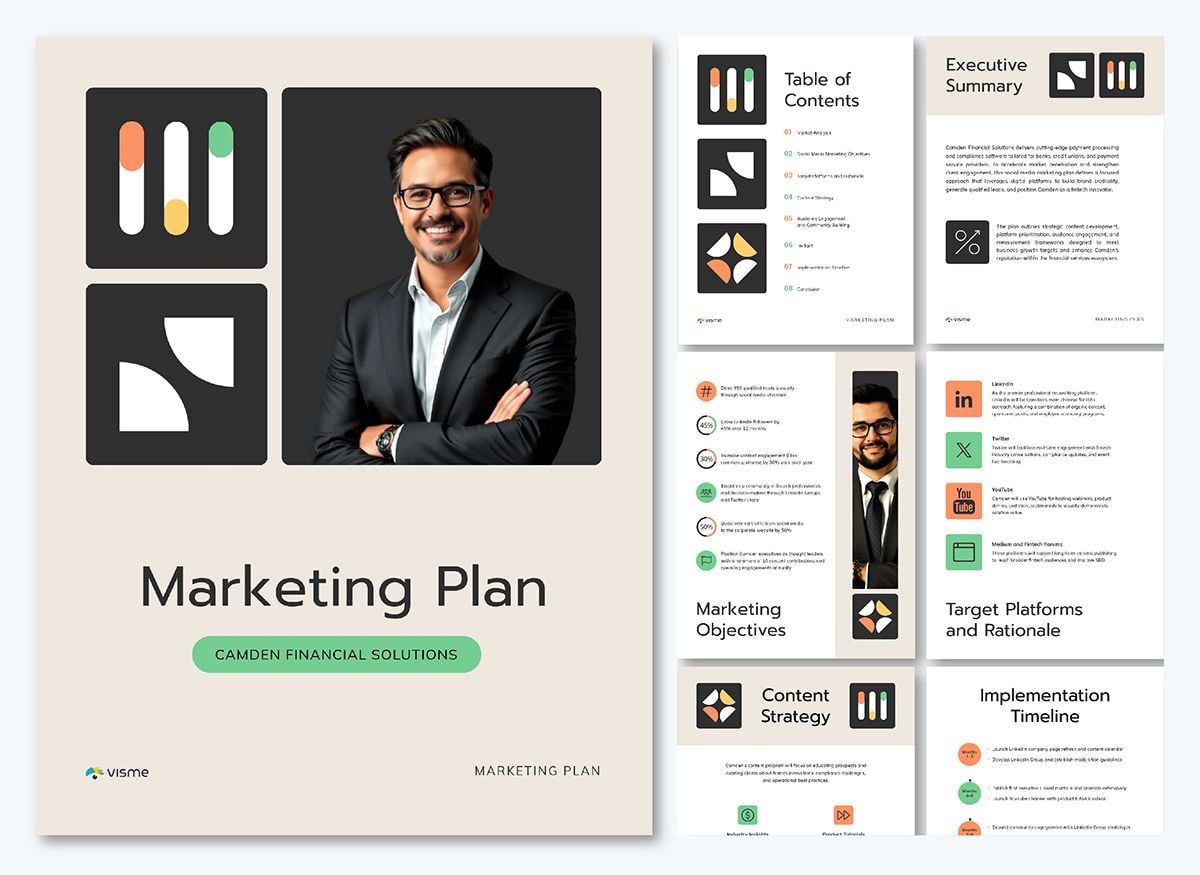
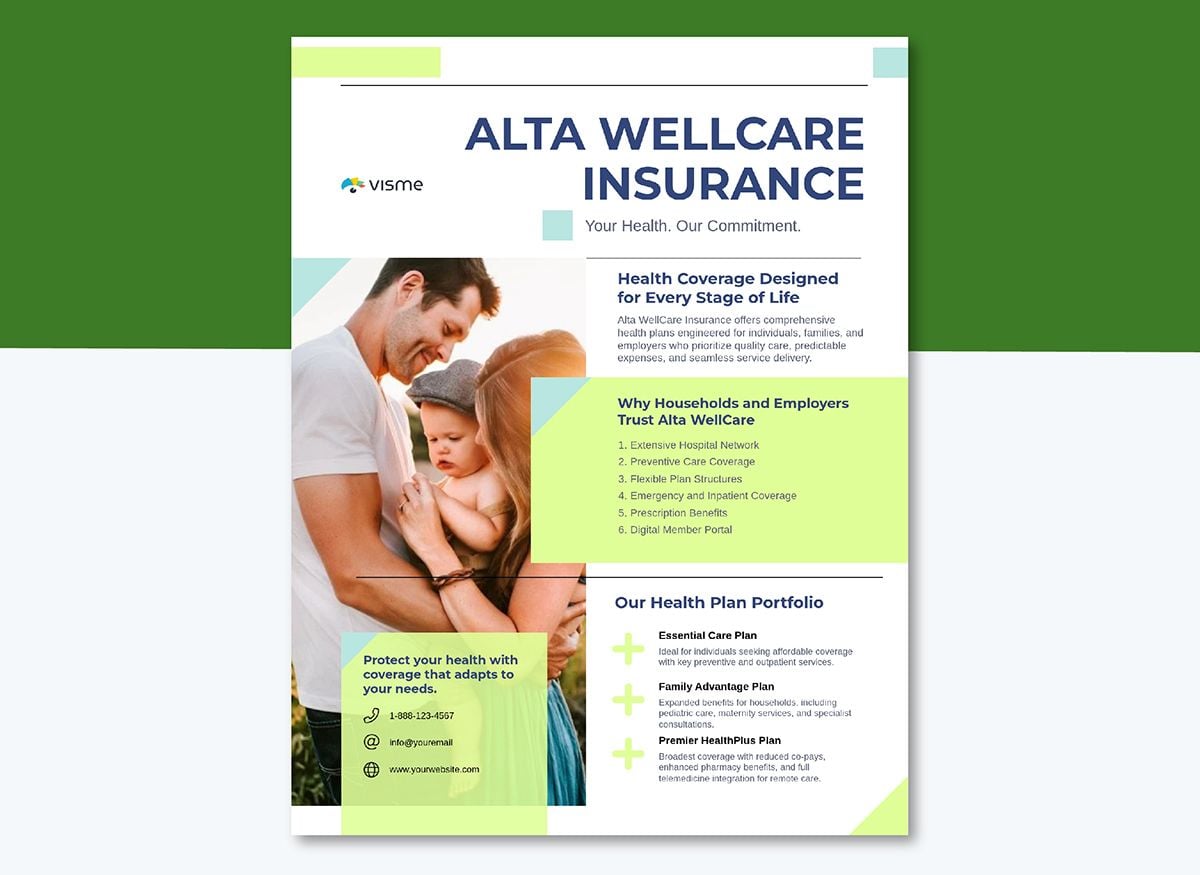
To prepare for local events, use Visme to create professional flyers and brochures.
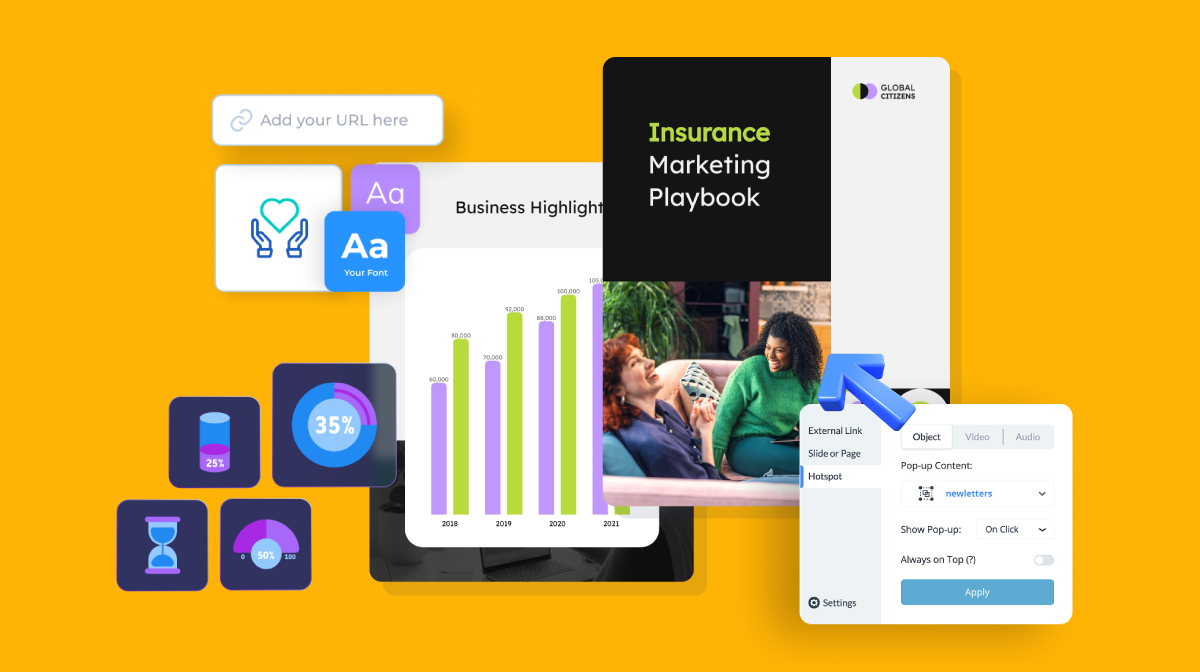
To put these strategies into action, use this Insurance Marketing Playbook Template. It covers everything from business highlights and promotional channels to KPIs and milestones in a single, structured, ready-to-use format.
When customizing and personalizing the template, use Visme’s collaboration features to invite your colleagues to the workspace and work on it together. Likewise, if you’d like to ask stakeholders for their input, advice or feedback, send them a link to the work in progress and they can leave comments for improvements.
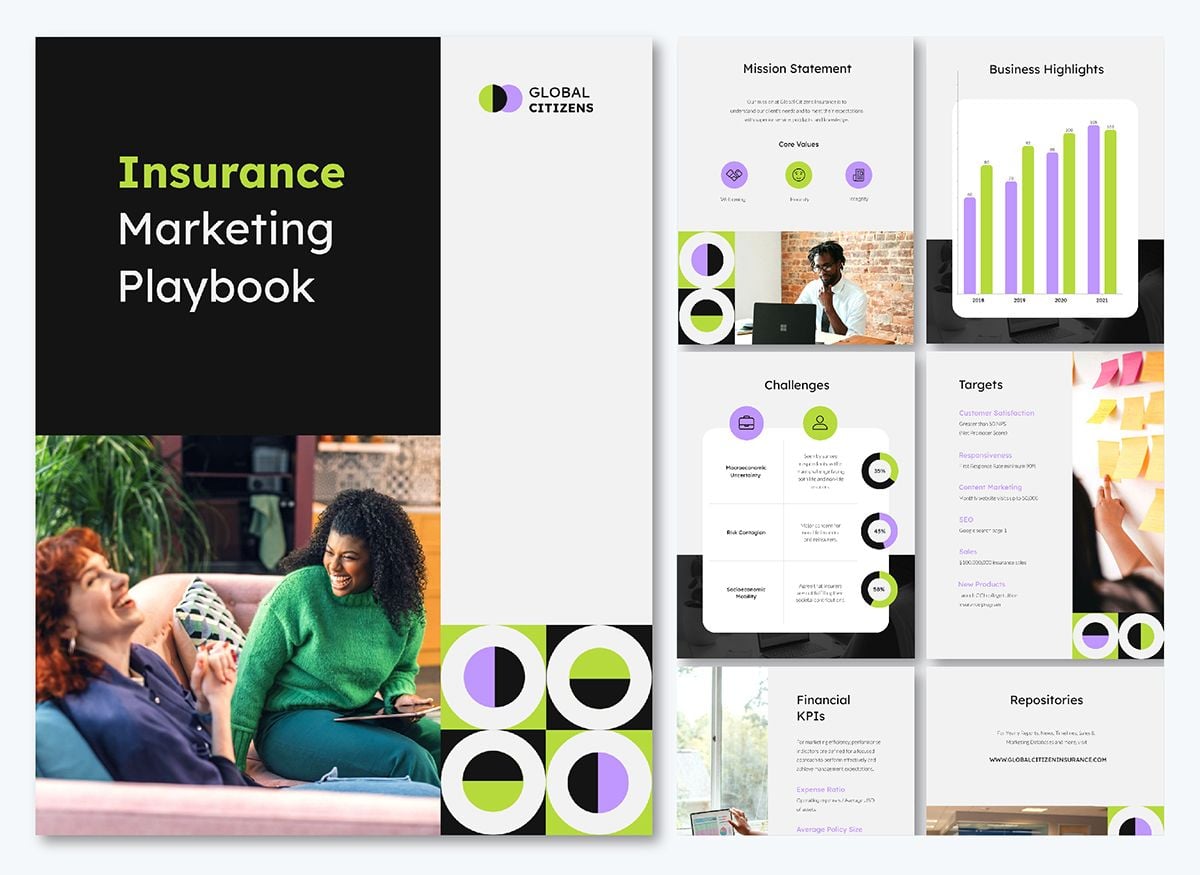
Customize each section with the strategies we've covered here, and you'll have a living document that keeps your marketing focused, measurable and easy to hand off to your team.
Lead generation is where your marketing efforts translate into real prospects who express interest by filling out forms, booking calls and requesting quotes.
The life insurance marketing techniques below are specifically designed to move people from just browsing to booking a call.
Paid advertising is the fastest way to put your message in front of people who are actively searching for life insurance, or who have just experienced a trigger moment that makes the ad appear on the platforms they use. Unlike content or community marketing, which build momentum over time, targeted ads can generate leads within hours of launch.
Insurance is one of the fastest-growing sectors in digital ad spending, with outlays increasing by 20% in 2025 alone. That means the competition for attention (and clicks) is only getting fiercer. If you're competing in this space and want to get returns at those prices, your copy has to stop people mid-scroll.
After launching the ads, track conversion rates at every stage, from click to form fill to booked call, so you know exactly which ads justify the spend. These metrics tell you what's working and where prospects are dropping off.
But first, what channels, content type and copy work best for your life insurance ads?
Facebook and Instagram are consistently recommended by insurance professionals as the best channels for life insurance ads due to their targeting capabilities and broad demographic reach. Regarding the content type on Meta platforms, the most common in 2025 was vertical video. Additionally, consider Google Ads, Google Search ads and other pay-per-click (PPC) platforms, plus Reddit ads, for a wider reach.
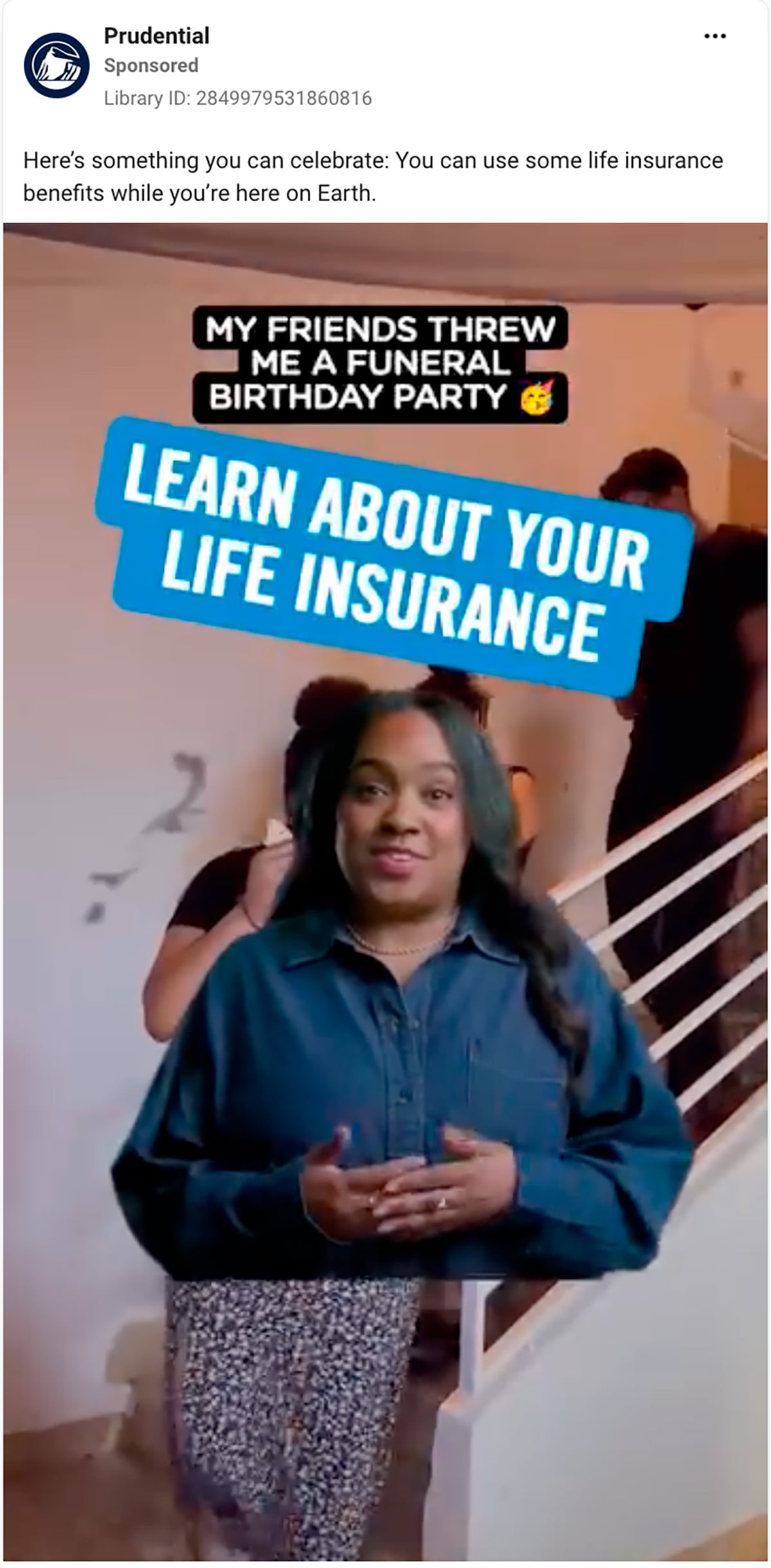
Finally, the best copy will speak directly to a specific worry or responsibility. Take, for example, this Meta ad from Prudential Insurance that uses memes and witty copy to convey its message.
The caption above the video says, "Here’s something you can celebrate: You can use some life insurance benefits while you’re here on Earth.” Then, inside the video, there's a text box that reads, “My friends threw me a funeral birthday party.” The caption and the sticker text work together to capture attention. To keep the viewer's attention, the woman in the video speaks in plain English, while gifs and memes appear at relevant moments.
If the copy in this ad wasn’t witty, it wouldn’t gather as much attention. In fact, it would easily be just another boring ad.
Your ad got the click. Now what? Every ad must connect to a dedicated landing page that speaks directly to the audience you targeted. As I mentioned before, this flow is key to successful omnichannel marketing.
Furthermore, a well-optimized landing page is a cornerstone of SEO life insurance marketing. Because, through both organic and paid traffic, search engine optimization ensures your landing pages rank for the terms prospects are already searching. For instance, if you're an agent serving a specific geography, you’ll need local SEO for optimizing your Google Business Profile. If you’re collecting location-specific reviews and targeting city-level keywords, you’ll improve your rankings and drive a steady stream of leads through these pages.
Here are some ideas for things you can add to the landing page to make it engaging and interactive once these leads land there.
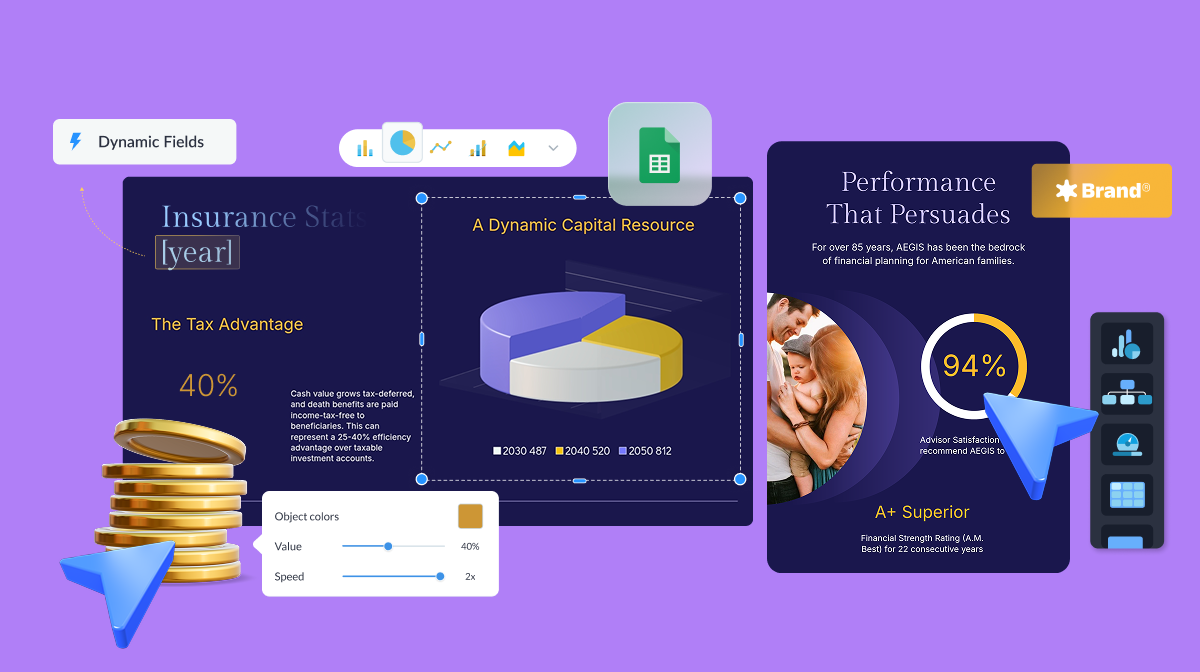
To support data collection across touchpoints, Visme integrates with tools like HubSpot, Salesforce, Google Sheets and Slack, so captured leads flow directly into your existing CRM and marketing automation workflows.

Finally, make sure every landing page element, headline, calculator, form, lead magnet, points toward a single, clear call to action.

In life insurance marketing, referrals consistently outperform other lead sources. Research from the Wharton School of Business found that referred customers are more profitable and 16% more loyal than customers acquired through other channels. This dynamic is especially powerful in the insurance industry, where client relationships and retention determine long-term profitability.
IAD Brokerage recommends structuring your referral program with incentives that will make an impact for the ambassador, like gift cards, premium discounts or charitable donations in their name. Finally, make the referral process as frictionless as possible: a single link, a text message, a QR code on their business card. The easier it is for a satisfied client to share your contact information, the more referrals you'll generate.
Ladder Life runs a standout referral program. Policyholders receive a $50 cash bonus for each person who applies through their unique referral link and receives a coverage offer, with a cap of $1,000. The program is low-friction by design: one link, instant tracking and PayPal payouts. It's a smart model because the reward is tied to a meaningful action (getting an offer), not just a sign-up.
Life insurance has one of the longest consideration windows of any financial product, sometimes spanning months or even years.
Retargeting pixels on your website, follow-up email sequences and agent-led check-ins ensure you stay top of mind during that extended decision period.
Some other ways to retarget and follow up with prospects include sending them a relevant article during a chat or inviting them to a webinar via email.
For example, Blueberry Life, a UK-based life insurance startup, ran a two-phase Meta Ads strategy that demonstrates exactly how retargeting works in practice.
The retargeting campaigns nurtured warm audiences further down the funnel, ultimately generating over 1,500 applications.
If you're an individual agent or small team, all you need is a handful of tactics you can start this week, matched to the right prospects at the right time.
The table below breaks down six ideas by what you're trying to achieve, where the prospect is in their decision journey and which tools will help you execute it.
| Marketing Idea | Goal | Funnel Stage | Lead Type | Example in Action | Tools to Use |
|---|---|---|---|---|---|
| Local Outreach | Name recognition and first conversations. | TOFU — First impressions before anyone is actively shopping. | Cold — No prior relationship. | Booth at a first-time homebuyer seminar offering free coverage consultations. | Visme flyer templates, Brand Wizard, local print shops |
| Educational Webinars/Seminars | Expert positioning and warm lead generation. | TOFU / MOFU — Attract newcomers and deepen engagement. | Cold / Warm — New prospects and referrals. | 30-minute Zoom webinar: “Life Insurance in Your 30s: What You Actually Need.” | Zoom, Visme presentation templates, Lead Forms, Registration Forms, email follow-up |
| Social Media Educational Content | Brand awareness, audience growth, credibility, traffic. | TOFU — Discovery mode. | Cold — Organic or paid traffic. | 60-second Reel debunking the real cost of a $250K term policy at age 30. | Visme Social Media Scheduler, AI Writer, Canva, CapCut |
| Cross-Selling & Upselling | Increase revenue per client and deepen relationships. | MOFU / BOFU — Moving from awareness to decision. | Warm — Existing clients. | At renewal: “You mentioned your wife is expecting — does your coverage keep up?” | CRM (Salesforce, HubSpot, AgencyBloc), email automation, Visme presentations |
| Personalized Email Sequences | Nurture over weeks/months and move toward conversation. | MOFU — Research mode. | Warm — Opted-in leads. | 5-email sequence after calculator download: basics → myths → comparison → testimonial → consult invite. | Visme Lead Forms, ActiveCampaign, Mailchimp, Dynamic Fields |
| One-on-One Policy Reviews | Convert to signed applications and uncover upsells. | BOFU — Decision stage. | Hot — Ready-to-act leads. | “A lot has changed in 5 years — let’s do a 15-minute review.” | Visme presentations, Zoom/Loom, CRM |
Getting attention is one thing. But, earning trust, staying compliant and building a brand that lasts? That requires consistency and dedication.
Here are the best practices and life insurance marketing tips that will set your marketing efforts apart from the rest.
The most persuasive life insurance marketing doesn't feel persuasive at all. It actually feels helpful and supportive.
According to LIMRA, adults under 30 overestimate the cost of a $250,000 term policy by 10–12 times,
When you educate prospects about how coverage works, what it actually costs and how to evaluate their insurance needs, you remove the intimidation that keeps them from acting.
Agent Branding & Marketing emphasizes that the best agents position themselves as advisors first and salespeople second. Answer questions before they're asked. Explain jargon in plain language. Make your prospect feel smarter after talking to you, not more confused.
It’s during these positioning efforts that marketing and customer service overlap more than most agents realize. Every customer service interaction is a marketing moment.
For example, let’s say a policyholder calls with a question about their coverage. Whether they receive a patient explanation instead of a runaround, that experience shapes what they do next; whether that’s referring a friend, leaving a positive review or upgrading their policy.
The best insurance marketers understand that the content they create to attract new prospects should mirror the experience those prospects will have as they move toward becoming clients and beyond. If your marketing promises helpfulness and your customer service delivers frustration, no amount of ad spend will fix the disconnect.
For more on building trust through educational content in regulated industries, read our healthcare marketing guide, which shares many of the same principles.
To help maintain cohesion across your messaging from marketing to sales, you can use an AI workflow like the one Bill Cutler, CEO of Seapoint Digital, uses to structure his campaigns. It’s a four-part framework: research, create, deploy and optimize. AI handles the labor-intensive middle steps while the agent’s expertise guides strategy and tone.
Most agents create one blog post and move on. A smarter approach is to use AI to turn that single piece into 10+ assets across channels. Here's how:
Step 1: Create your anchor content. Write (or use AI to draft) one in-depth educational article. For example, "Term vs. Whole Life Insurance: What First-Time Buyers Need to Know." You can use this prompt as a starting point
Write a 1,500-word educational blog article titled "Term vs. Whole Life Insurance: What First-Time Buyers Need to Know."
Audience: adults aged 25–40 buying life insurance for the first time. They're smart but not financially sophisticated.
Tone: conversational, direct, judgment-free. No jargon without explanation. No fear-based language.
Include these sections: intro acknowledging hesitation, what is term life (how it works, who it's for, what happens when it ends), what is whole life (how it works, who it's for, how cash value works), side-by-side comparison table, questions buyers should actually ask themselves, whether you can have both (laddering), common first-time buyer mistakes and a short closing that encourages action without pressure.
Use realistic cost examples for a healthy 30-year-old with $500K coverage. Use analogies where helpful. End with a clear takeaway.
Step 2: Feed it to AI for repurposing. Use this prompt in ChatGPT, Claude or a similar tool:
"Here is a 1,500-word educational article about term vs. whole life insurance. Repurpose it into the following formats: (1) A 5-post LinkedIn carousel series, with each post under 200 words, (2) An Instagram post carousel with five slides, (3) Three email subject lines and preview text for a nurture sequence targeting first-time buyers, (4) Five FAQ questions with concise answers I can add to my website and (5) A one-paragraph summary I can use as a Google Business Profile post."
Step 3: Create the visuals. Using the generated content, you can now create the visual content using Visme’s AI Designer. For example, copy the text for the Instagram post carousel and paste it into the AI Chatbot window.
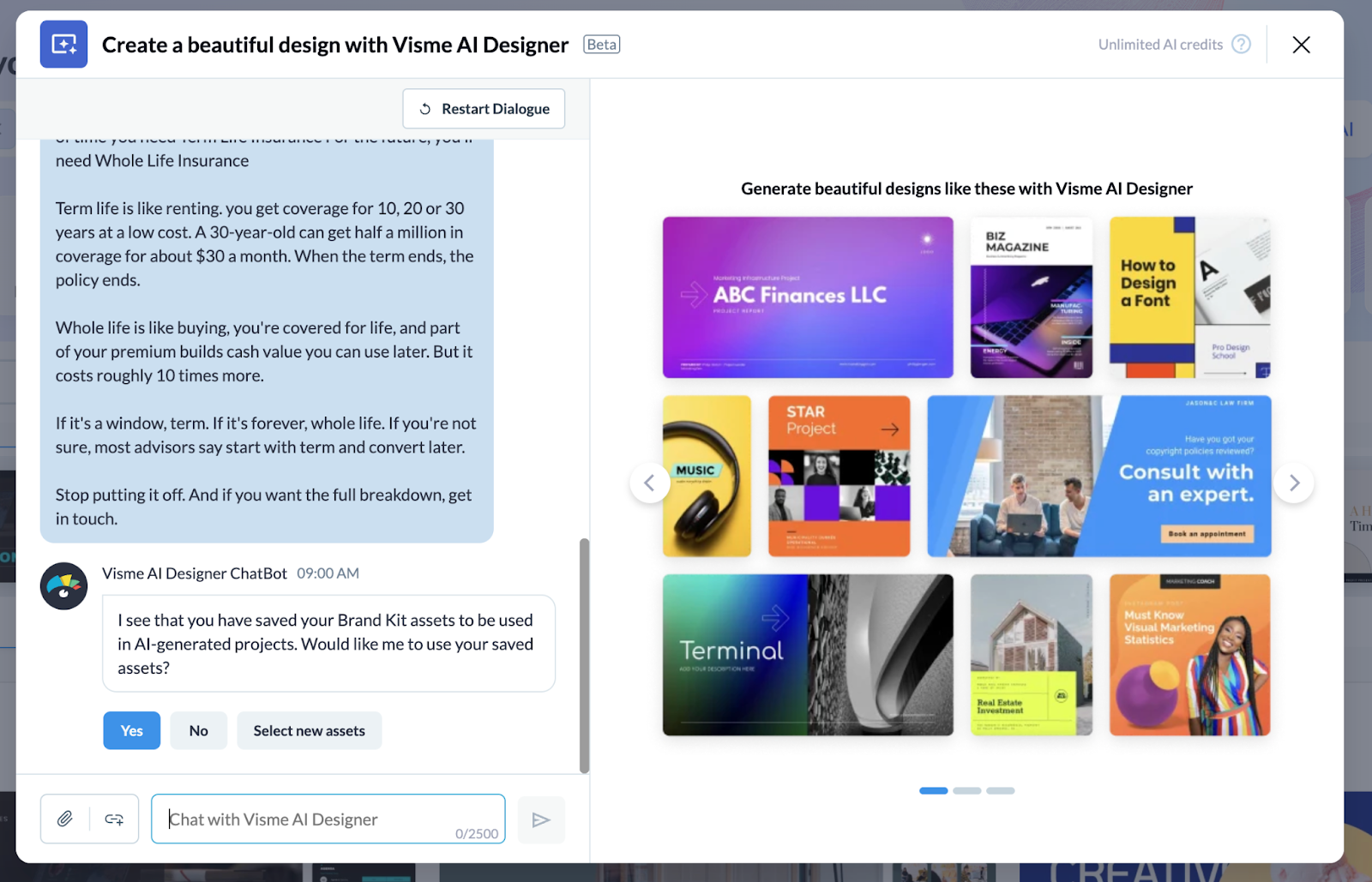
At this point, Visme AI will ask some questions, like if you want to use your saved brand kit. And if your prompt is missing information, it will ask for clarification. Also, if you enter content without specifying the required content type, the chatbot will prompt you to specify it. Finally, it will ask you to choose a style from a selection of social media templates. When the generation is ready, open it in the editor and finalize it to perfection.
Inside the editor, you’ll find the AI Hub with lots of practical tools to remove backgrounds and touch up images. The AI Writer will help you adjust the content so it’s perfectly aligned with your brand. Below is a screenshot of how the AI Writer looks in the editor. There are several options for making quick changes, such as text length and tone, plus example prompts to inspire you.
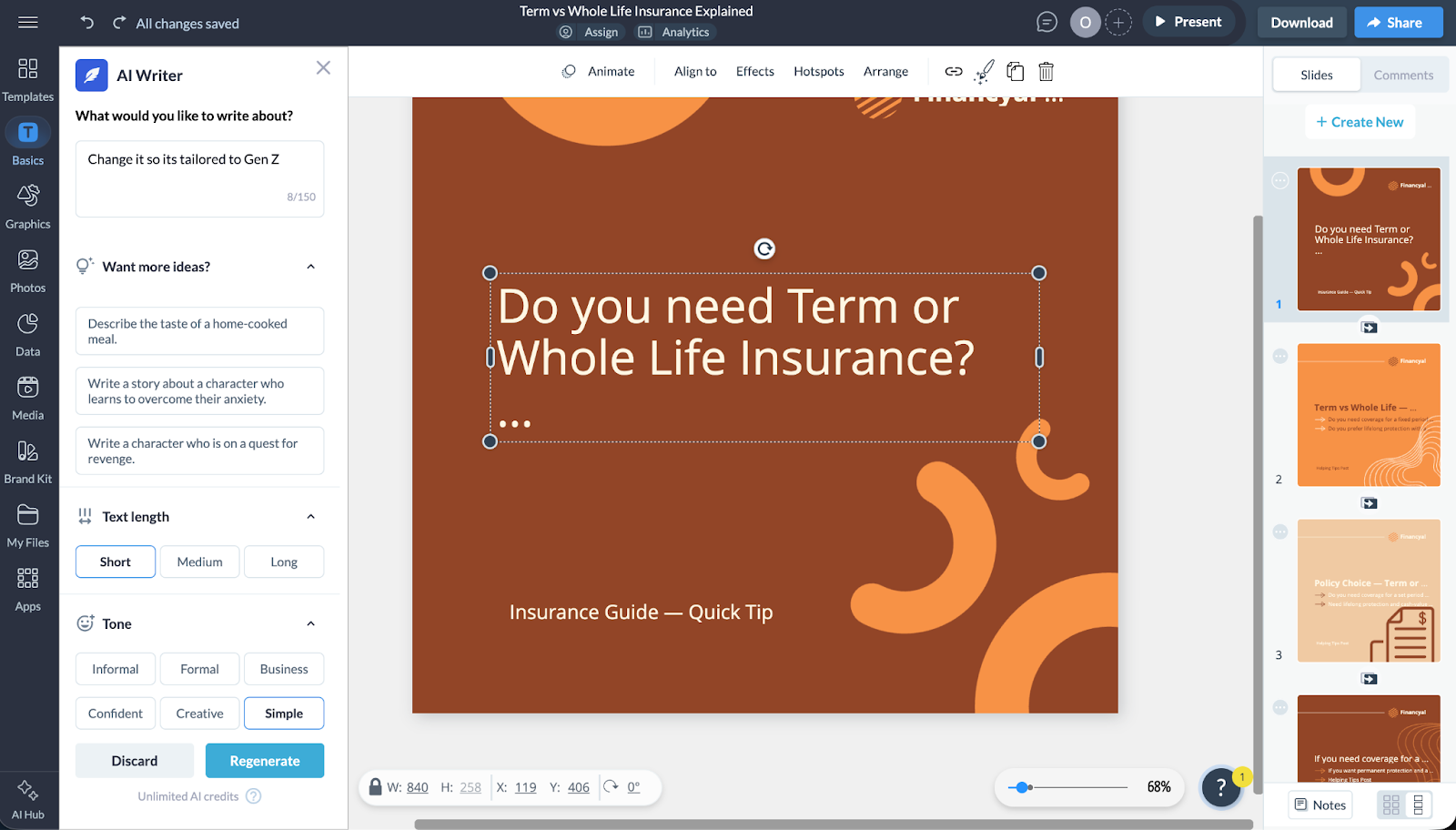
Something to take into account: When you upload your content into the Visme AI Designer, the final generation will have truncated text boxes. You’ll know because there will be an ellipsis. This ensures the design from the template maintains its layout and doesn’t change. You can then either shorten your text, minimize the font size or adjust the text box however you like.
Step 4: Track what resonates. Whichever format drives the most engagement becomes the topic angle for your next anchor piece. Repeat monthly.
Use Visme's built-in analytics to track which assets (shared via link or embedded) receive the most views and engagement. You can also connect Google Analytics for deeper performance data. Whichever format drives the most engagement becomes the topic angle for your next anchor piece. Repeat monthly.
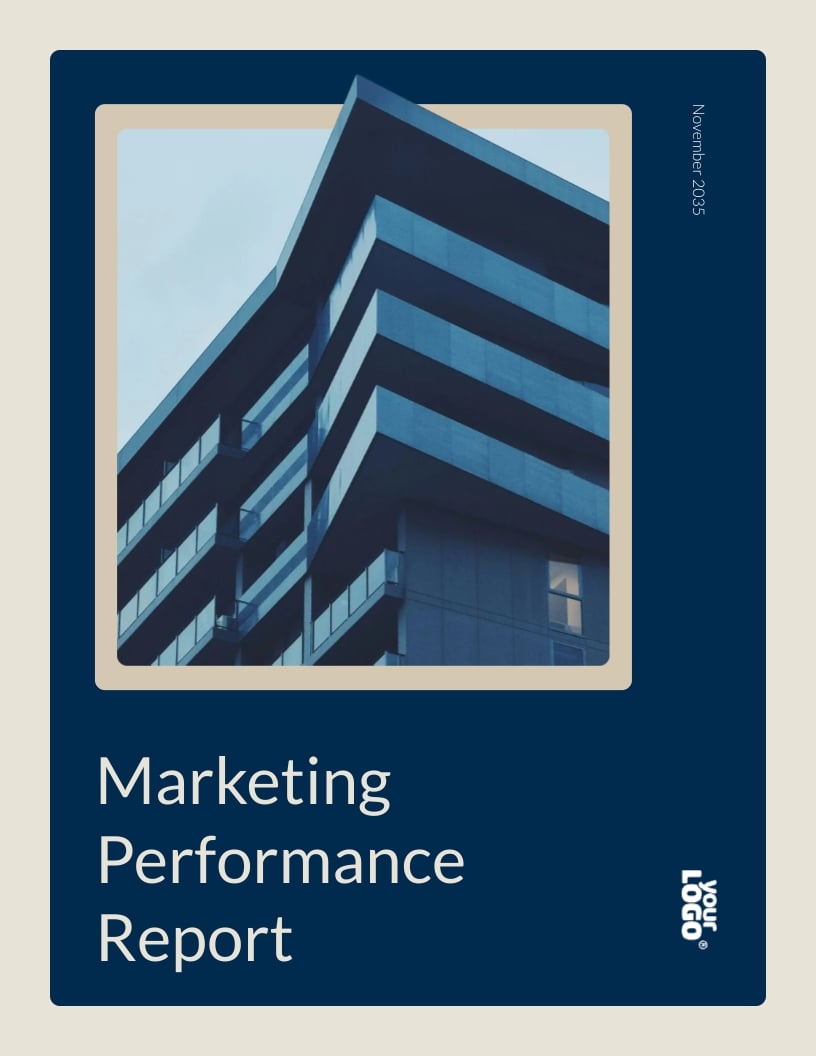
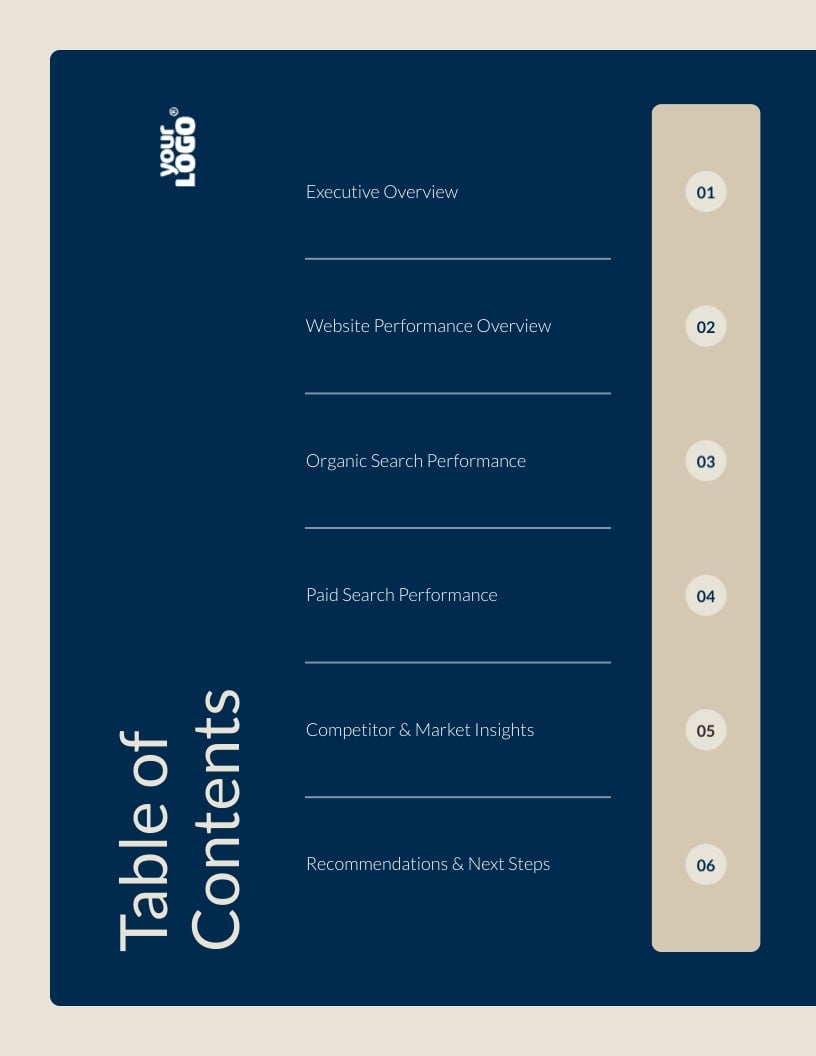
Once you've identified what's working, compile your findings into a shareable report to distribute to stakeholders and team members. The template below helps you break down results by channel, highlight top-performing content and outline next steps for your team.
In an industry where trust is the scarcest resource, social proof does a lot of the heavy lifting. Before prospects believe what you say about yourself, they need to hear it from someone else.
That’s why taglines like "We're the best life insurance agency in town" fall flat. It doesn’t really say much about what your organization stands for or what it offers. Instead, "Here's how we helped a family of four secure $500,000 in coverage for less than $30/month" is a much better approach for social proof.
Client testimonials, case studies, online reviews and video stories are your most powerful marketing assets for social proof. But don't wait for reviews to come to you. Actively ask satisfied clients after key milestones (policy delivery, successful claim, annual review) and make leaving a review as simple as clicking a link.
Visme has several video testimonial templates you can customize and embed into your website or share as a social media post. If a client prefers not to appear on camera, use Visme's AI Text-to-Speech to turn their written testimonial into a narrated video with a natural-sounding voiceover.
Insurance marketing is heavily regulated. Every state has specific rules about licensing and what you can and can't say in your marketing materials. Marketing (and selling) insurance without a license, making misleading claims in content, using unapproved testimonials, or failing to include required disclosures can result in fines, license suspension, or worse.
Specific licensing requirements vary by state. But generally include completing pre-licensing education, passing a state exam, submitting an application and maintaining continuing education credits to keep your license active.
Then, to balance compliance with marketing, build it into your content creation workflow right from the start. Use Visme's Collaborate feature to build approval workflows that allow compliance officers to review and annotate marketing materials before they go live. This flow catches issues early and keeps your creative process moving.
Yes, AI tools can dramatically speed up content creation, ad copy and email workflows. But they also introduce compliance risks. Let’s say you’re using an untrained, public AI model. It won’t:
All this isn't hypothetical. The NAIC's 2023 Model Bulletin on the Use of Artificial Intelligence Systems by Insurers — now adopted by 24 states as of late 2025 — explicitly states that compliance with unfair trade practice laws is required regardless of the tools used to create content or make decisions.
So, how do you stay compliant and safe even with AI-generated content? Put every piece of AI-generated marketing content through the same compliance review as anything written by hand.
In a market where dozens of agents compete for the same prospects, brand consistency is your differentiator. Your website, social media profiles, email templates, brochures and presentation decks should all look and feel like they come from the same source.
Use Visme's Brand Wizard to upload your brand fonts, colors and logo, then apply them automatically across every piece of content you create.
That was exactly the approach Ameritas, a Nebraska-based insurance and financial services company with over 2,500 employees, took when it adopted Visme to streamline its content creation.
As Stacy Grof, Digital Marketing Specialist at Ameritas, put it: "The hours saved each month from meeting time, working back and forth between the two groups, is an irreplaceable wow factor for my team."
By equipping non-designers with branded templates and collaborative workflows, Ameritas reduced design time from days to hours while keeping every asset on-brand and compliance-ready.
Not everyone needs the same message. A 25-year-old single professional has different motivations (student loan protection, income replacement) than a 45-year-old parent (college funding, mortgage payoff) or a 60-year-old retiree (estate planning, final expenses).
Bryan Hodgens, Senior Vice President and Head of LIMRA Research, put it clearly:
"Carriers need a different playbook when marketing life insurance to the younger generations. Our joint research shows that price misconceptions, coupled with competing financial priorities, position life insurance at a disadvantage with younger adults. Carriers must not only demonstrate the accessibility and affordability of life insurance but also need to reimagine the product to address younger adults' current financial priorities while adapting to meet their future financial goals as they age."
Segment your marketing by age, life stage and financial priorities. For example, would they need whole life insurance or term life insurance?
Create dedicated landing pages, email sequences and content paths for each demographic. Visme's Dynamic Fields make it easy to swap names, numbers and messaging across templates without rebuilding from scratch.
Segmenting by demographics is fine, but it’s better to go a bit deeper. The real advantage comes when you turn those segments into detailed buyer personas. A detailed persona goes beyond age and income; it captures your Ideal Client Persona’s motivations, usual objections, preferred communication channels and the emotional triggers that will likely drive action..
Use Visme's user persona templates to visually bring each segment to life. Map out their goals, pain points, communication preferences and buying triggers in a format your entire team can reference.
The template below is a good starting point. Customize it with your segment's demographics, motivations, objections and preferred channels so your entire team is marketing to the same person.

Then, use an AI tool to analyze and compare your buyer personas against your actual customer base. Ask it to identify patterns you might not see manually and finally, generate messaging that speaks to each persona's specific motivations.
Your colleagues are already doing it. According to SmartDev, AI adoption among life insurers reached 48% in 2025, up from 29% the year before. Over half of carriers are now using generative AI specifically for customer segmentation and personalized communications.
Here's a step-by-step workflow to use AI alongside your CRM to build actionable personas and generate tailored content for each:
Step 1: Export your customer data. Pull a CSV from your CRM (HubSpot, Salesforce, or even a spreadsheet) with fields like age, policy type, coverage amount, acquisition channel and any life events noted (new baby, home purchase, retirement).
Step 2: Use AI to cluster and name your segments. Upload the anonymized data to Claude or ChatGPT and prompt:
"Analyze this customer dataset for a life insurance agency. Identify 3–5 distinct customer segments based on patterns in age, policy type, coverage amount and acquisition channel. For each segment, give it a memorable persona name, describe their likely motivations for buying, their primary objections, their preferred communication channels and the emotional triggers that would resonate most in marketing messages."
Step 3: Generate segment-specific content. Once you have your personas, prompt AI to create tailored messaging:
"Using the persona '[name from Step 2]' — a [description], write: (1) A Facebook ad headline and body copy (under 125 characters for the headline), (2) An email subject line and opening paragraph for a nurture sequence and (3) A landing page hero headline with a supporting subheadline. The tone should be [warm/professional/urgent — based on the persona analysis]."
Step 4: Build the assets in Visme. Use Master Layout to create a base template for each asset type. Then swap persona-specific copy, imagery and CTAs using Dynamic Fields to edit across versions without rebuilding from scratch.
Once you've built your personas and generated segment-specific content, the next step is to put it all into a structured plan with timelines, channel assignments and KPIs. For a deeper look at building a strategy that accounts for audience segmentation, check out this guide on creating a marketing plan and this sales plan framework.
Focus on education instead of cold, direct selling. On Instagram and TikTok, try posting short-form videos debunking myths (like “life insurance is too expensive”), sharing client testimonials with permission and answering common questions.
Don’t forget to engage with follower comments to grow your community. LinkedIn works well for professional and B2B outreach and communication. Facebook is the best to reach consumers researching coverage for their families. Most important of all, focus on consistency and authenticity.
The 4P’s of life insurance marketing are:
To market yourself as a life insurance agent, you need to build a strong personal brand. You can achieve this by:
Life insurance marketing comes down to one thing: showing up as someone worth trusting.
The strategies, techniques and best practices in this guide all point in the same direction: lead with education, stay consistent and make every touchpoint feel like it comes from the same source.
Now you need the tools to actually do it all without spending hours on design, chasing compliance approvals or rebuilding the same asset for every channel.
That's where Visme comes in.
From branded presentations and lead-capture forms to social media content and collaborative approval workflows, Visme gives insurance teams everything they need to create professional, compliant marketing materials in-house, fast.
Sign up for Visme and start building trust with every piece of content you create for your life insurance marketing strategies.

Design visual brand experiences for your business whether you are a seasoned designer or a total novice.
Try Visme for free