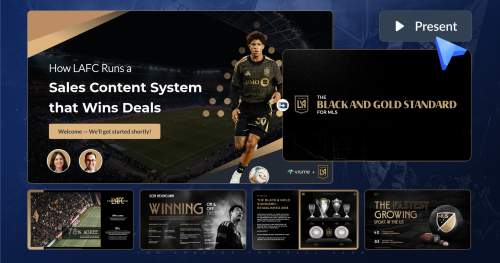
Why LAFC Builds a Personalized Sports Sponsorship Pitch Deck for Every Conversation

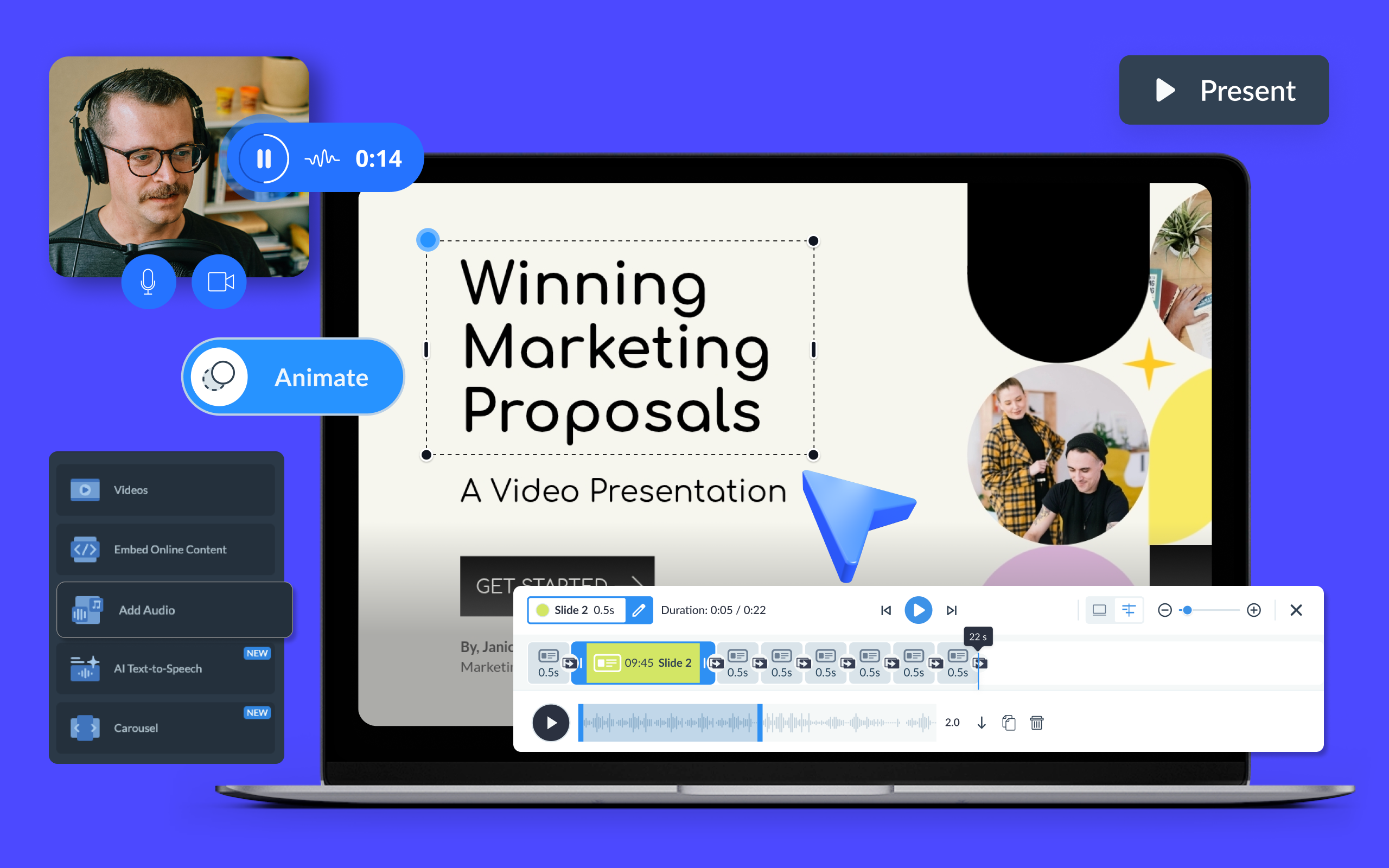
A video presentation lets people watch your slides and hear your message when it suits them, without you in the room. That makes it a practical format for training, product demos, reports and pitches you need to share with many people.
This guide covers the 8 steps to creating a video presentation with audio, from planning your message to exporting an MP4. You'll learn how to add music, voiceovers and AI narration, how to record yourself over your slides and how to turn a PowerPoint into a video.
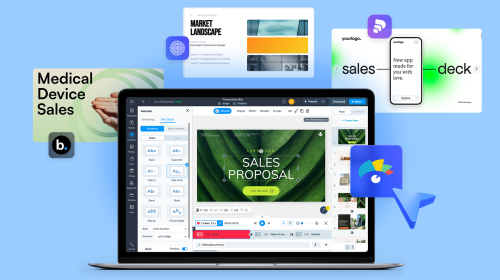
Each step shows you how to do it in Visme's presentation software, and you can start from one of our customizable templates.
Here’s a selection of video presentation templates you can edit, share and download with Visme. View more templates below:




Quick Reads
A video presentation is a presentation saved and shared as a video file, usually an MP4. It combines slides with audio, such as music, narration or a recording of you presenting, and plays from start to finish with an option to pause. By downloading the slides together as a video, each slide works as a scene in traditional video production.
You can share it on YouTube, Vimeo and other social media platforms, embed it on your website or upload it to your learning management system (LMS).
Video is also how many people prefer to learn. According to TechSmith's 2024 Video Viewer Trends Report, 83% of people prefer to watch a video when the content is instructional or informational.
The same holds for buying decisions. Wyzowl's 2026 video marketing survey reports that 63% of people would prefer watching a short video to learn about a product or service.
Video presentations with audio work in live events, too. Give a short live introduction at your webinar or summit, then play the video for your audience.
Check out this "2025 Year in Review" video presentation we created at Visme.
A good video presentation holds your audience's attention from the first slide (scene) to the last. It has one clear message that aligns throughout the content and visuals, slides tailored for watching and not reading, motion and animation applied to text and elements. And, of course, audio that supports in relaying the message.
Use these tips when creating a video presentation:
Follow these 8 steps to plan, build, narrate and share your video presentation.
Prefer watching? Here's a short video tutorial on building a presentation in Visme, the starting point for any video presentation, with or without audio.
For any project to be successful, including your new video presentation, you must plan and strategize. You and your team need to know the purpose of the video presentation before you even start putting together content or visuals.
Your goal shapes every choice that follows, from the script and storyboard to the visuals and audio.
For example, an explainer video for a new product line could aim for brand awareness, sales or both. A sales video needs a clear offer and a call to action. An awareness video can tell the story behind the product and show how it helps customers.
Answer these questions with your team to help you get aligned:
Write your goals down and keep them handy at every step. They're your North Star when you have to make a call on content, visuals or audio. These goal-setting worksheets and templates can help.
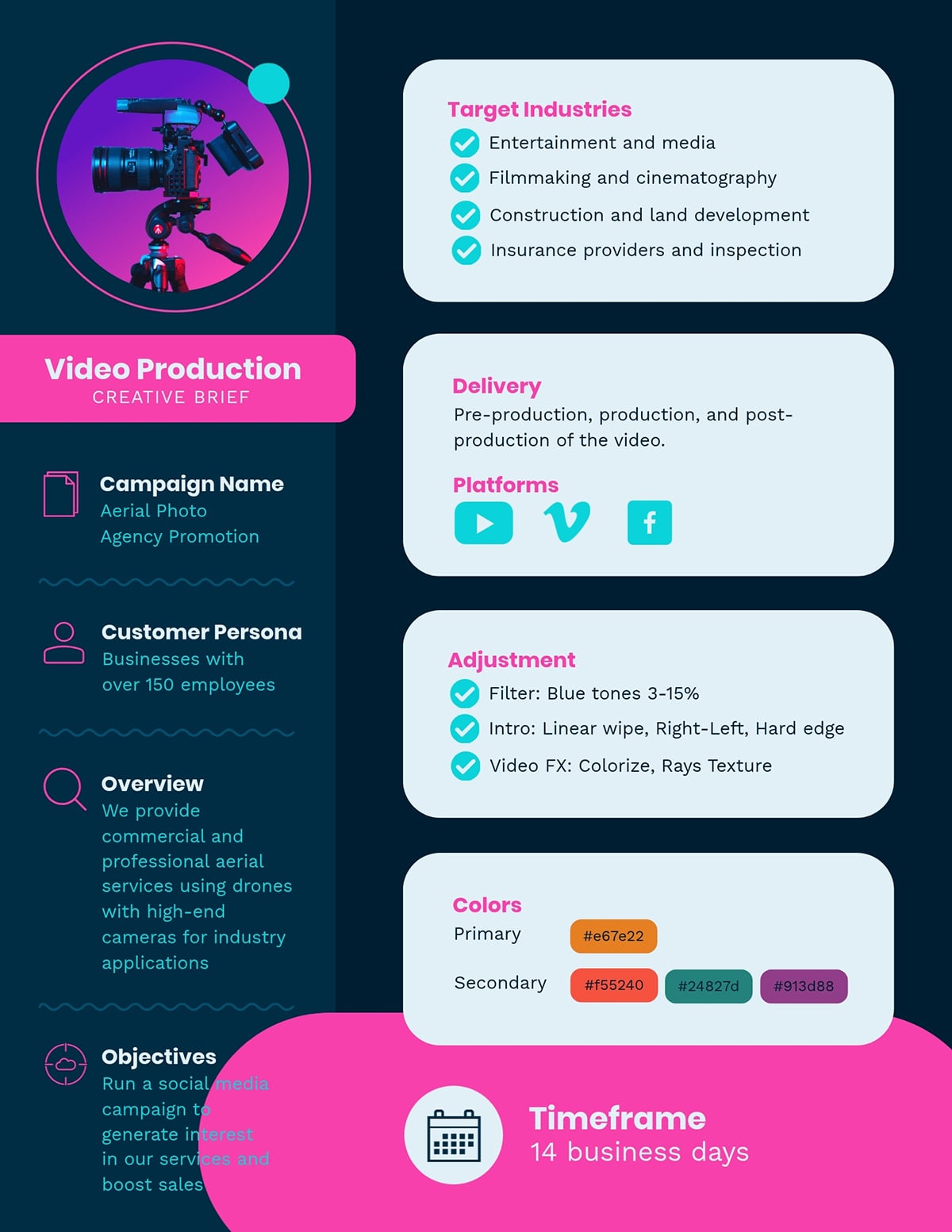
Everyone involved needs to know the plan, from stakeholders and designers to content creators, marketers and social media managers. This video production creative brief template keeps your objective, audience and key messages in one place. Share it with your team so everyone works from the same brief.
Gather everything your video needs for production. Put your graphics, photos, video clips, audio files and brand assets in one folder. Then write all your text in one document, with notes on what the audio will be for each part and what visuals go where.
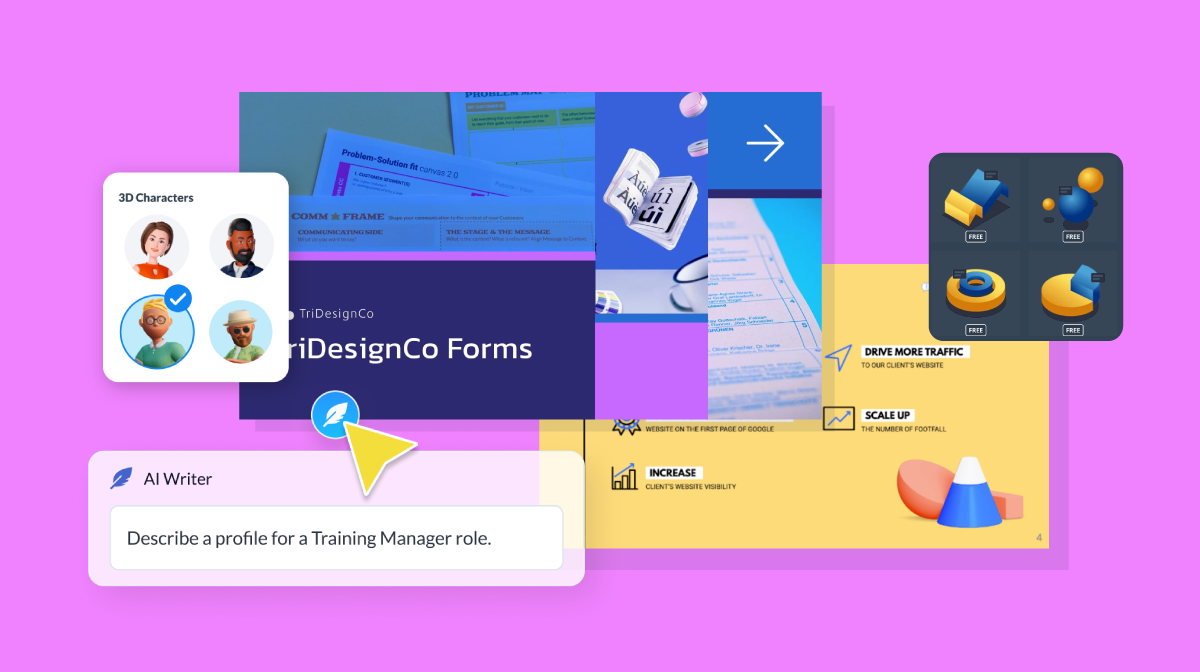
To save time, draft your script with Visme's AI Writer, then turn it into narration with AI Text to Speech, covered in Step 5.
You can also compare other options in our list of the 11 best AI voice generators.
Pro Tip: Visme has a library of free music tracks inside the editor, and you can record your voiceover right in your browser.
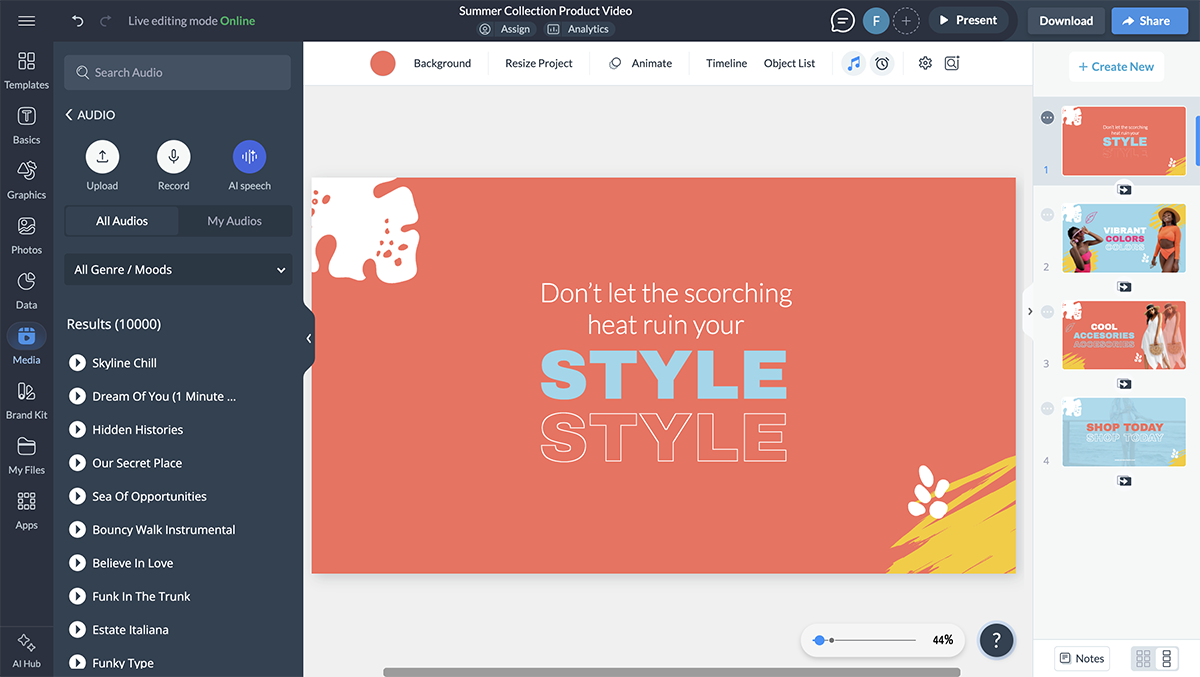
Next, turn your script into an outline or storyboard. An outline lists the script and visuals for each part. A storyboard goes further and sketches each scene, the way professional video production teams plan. It's easier to build once your outline is done.
A storyboard shows what appears on screen during each part of the script, so you can plan your visuals and timing in detail for each slide (scene). It also gives stakeholders a preview of the video early on. Your Visme library includes several storyboard templates to help you get started.
If your video doesn't have distinct sections, choose a storytelling structure that moves the story forward, such as chronological order, problem and solution, before and after, or the hero's journey.
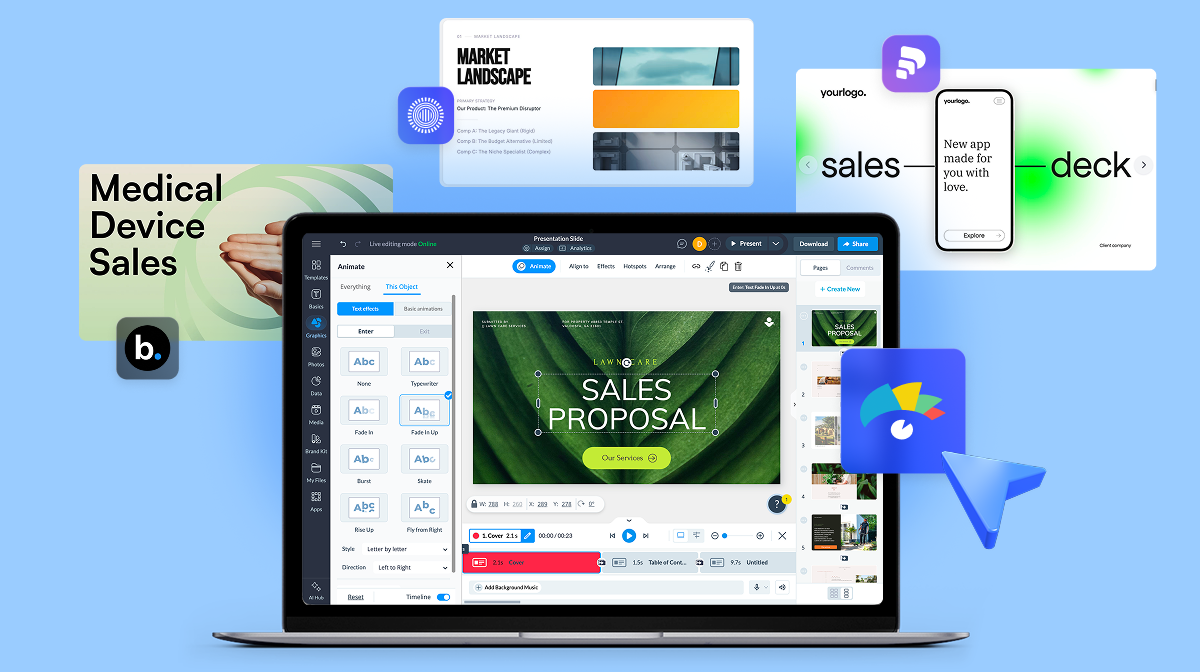
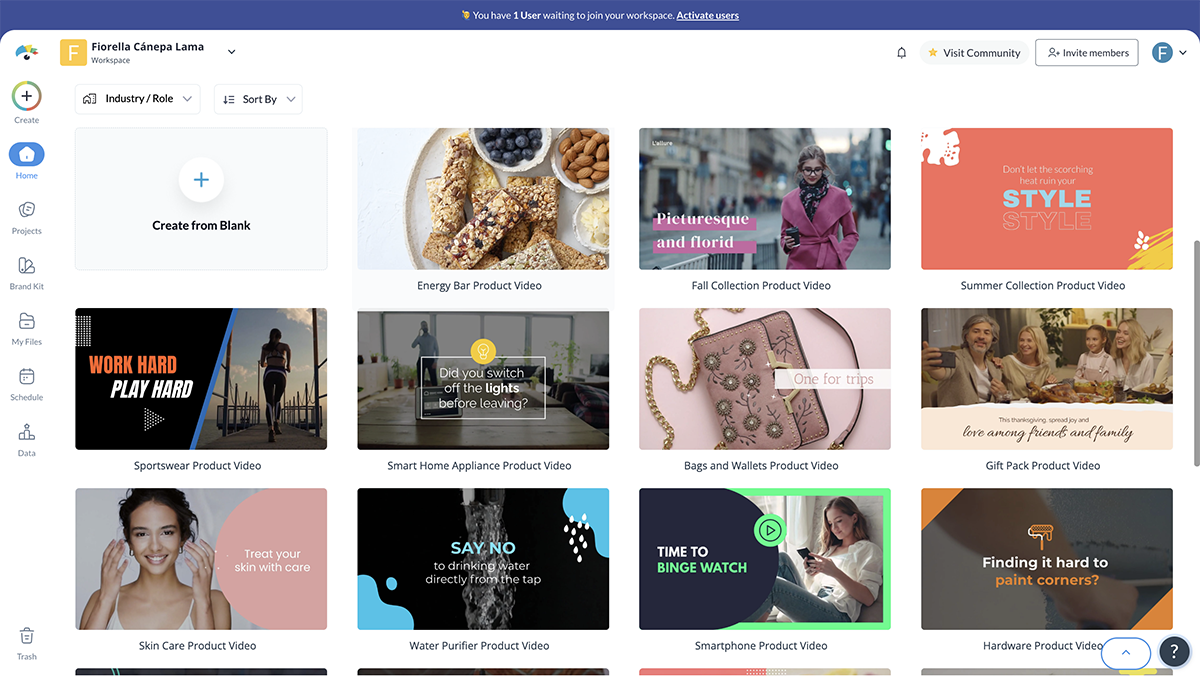
Turn your storyboard into slides that function as scenes in the video. There are many video presentation makers that cover the options in the table below. Visme includes all of them.
Here's what each one is best for and what to do next.
| Starting Point | Best For | What to Do Next |
|---|---|---|
| A video template | A finished look fast, with animation already set up | Swap the placeholder text with your previously prepared content, and replace images and footage with your own or stock visuals. Then add motion and audio and download as an MP4. |
| A presentation template | Full control over layout and branding | Replace the sample content with your previously prepared content. Then add motion and audio and download as an MP4. |
| The AI Presentation Maker | Turning your script or a document into slides quickly | Check every slide against your script, fix the wording and swap any images that don't fit. Then add motion and audio and download as an MP4. |
| A PowerPoint you import into Visme | Reusing a deck you already have | Check fonts, spacing and images after the import. Then add motion and audio and download as an MP4. |
| A Visme Presentation You've Already Made | Turning a live deck into a video with narration or added audio | Add narration, background music or audio to each slide. |
| A Blank Canvas | A fully custom design | Use content blocks to arrange text and images in balanced layouts. Insert your previously prepared content, add your own images and footage or use stock visuals. Then add motion and audio and download as an MP4. |
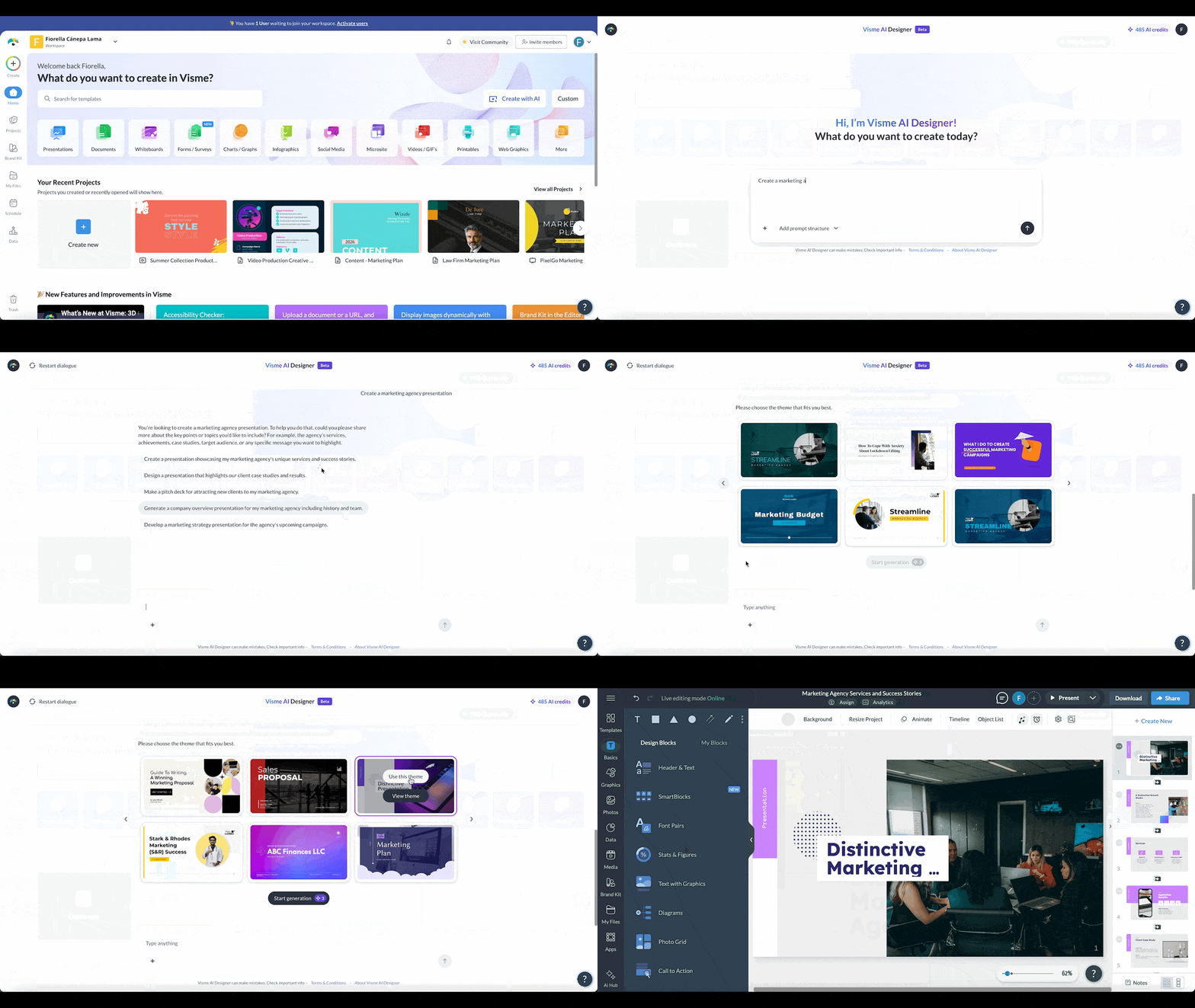
With the AI Presentation Maker, describe your video in a prompt or upload the script from Step 2, and you get a first draft of your slides to edit. It creates up to 10 slides at a time, so duplicate a slide to add more scenes in the same style.
Whichever starting point you choose, set the slide order from your outline or storyboard and make sure every part of your script has a slide.
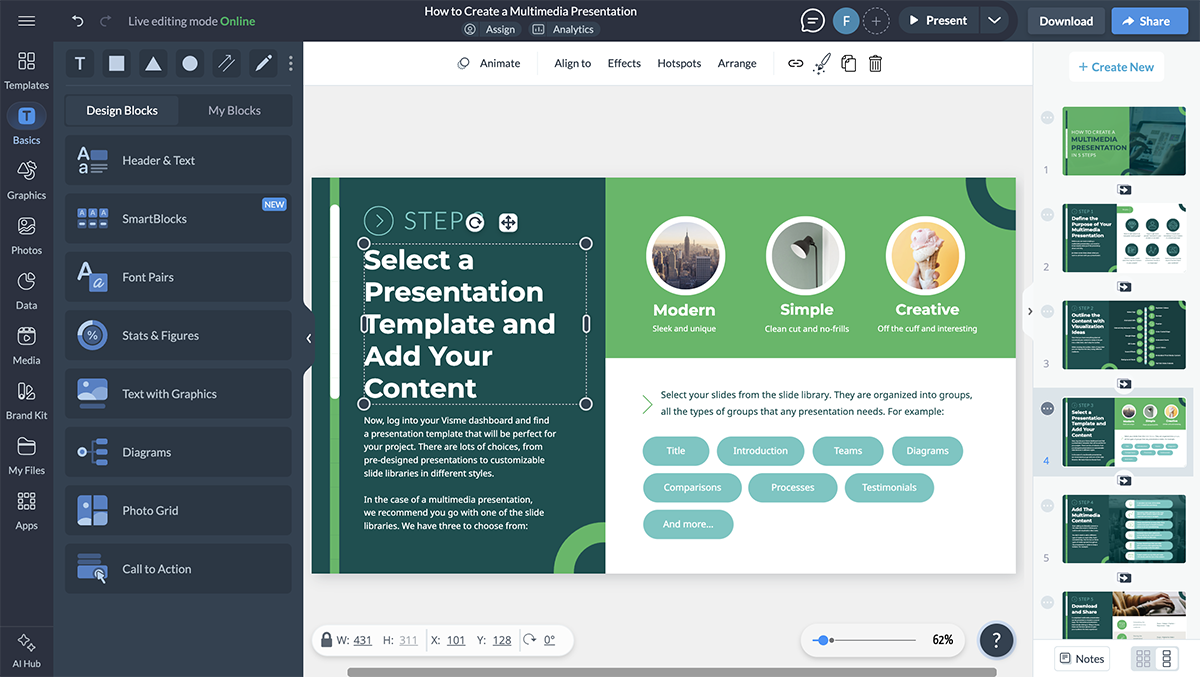
As you add content, remember that people watch a video presentation. They don't stop to read it. Keep text to a minimum and let visuals carry the message. With a voiceover, slide titles and section titles are usually all the text you need.
In a Stanford GSB interview, Nancy Duarte, CEO of Duarte explains :
"Slides are not for you as a presenter. Slides are for the audience."
Choose images, icons and clips that support what you're saying, and keep them consistent from slide to slide. Visme's library has stock photos and videos and icons, or you can upload your company's own. Frames and crops help images fit the layout, and your Brand Kit keeps fonts and colors on brand.
Keep backgrounds quiet so they don't compete with your content. A filtered photo, a soft gradient or a subtle animated background works well.
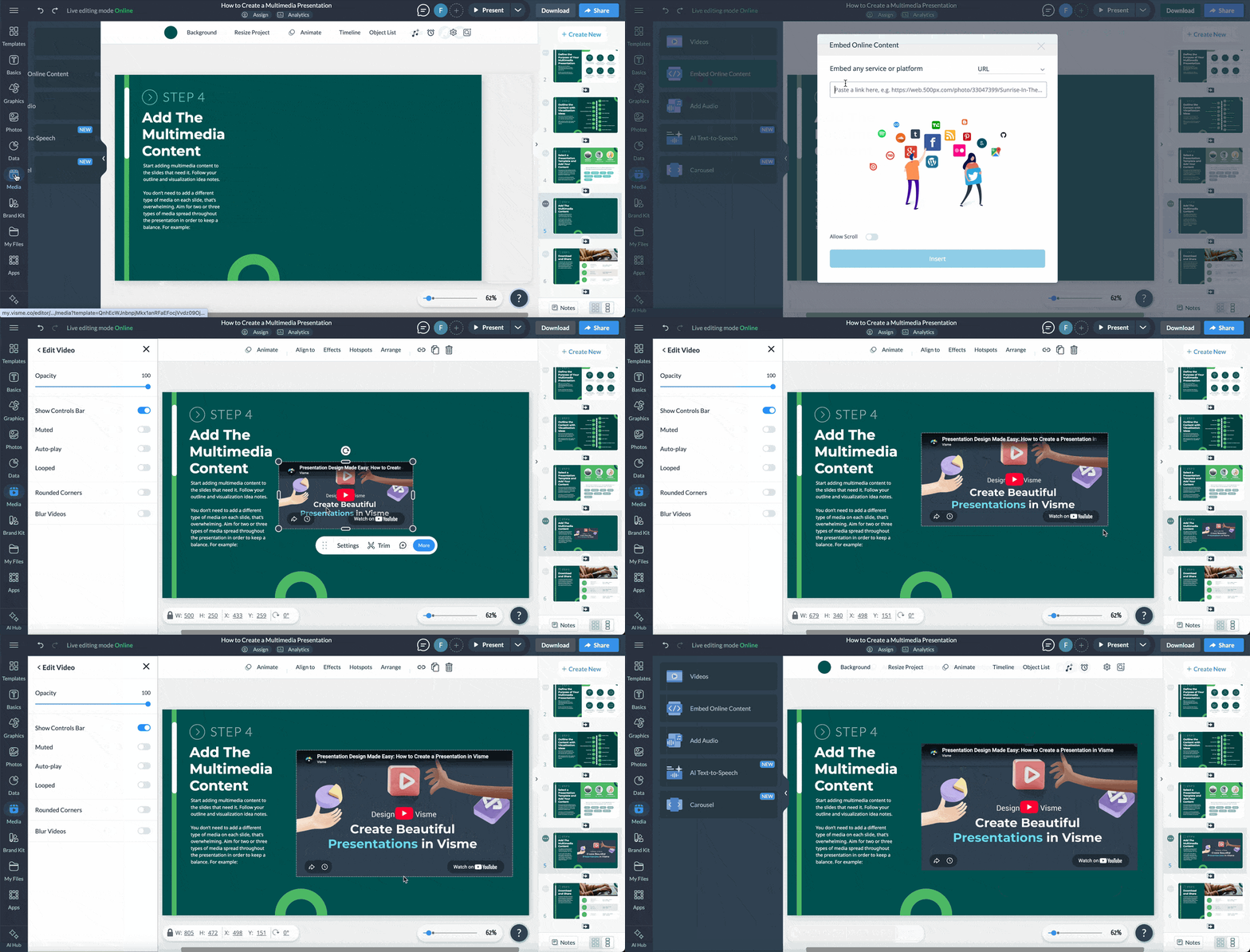
You can also add video clips, uploaded or linked from YouTube, Vimeo or Wistia. Keep them short so your final video doesn't run long.
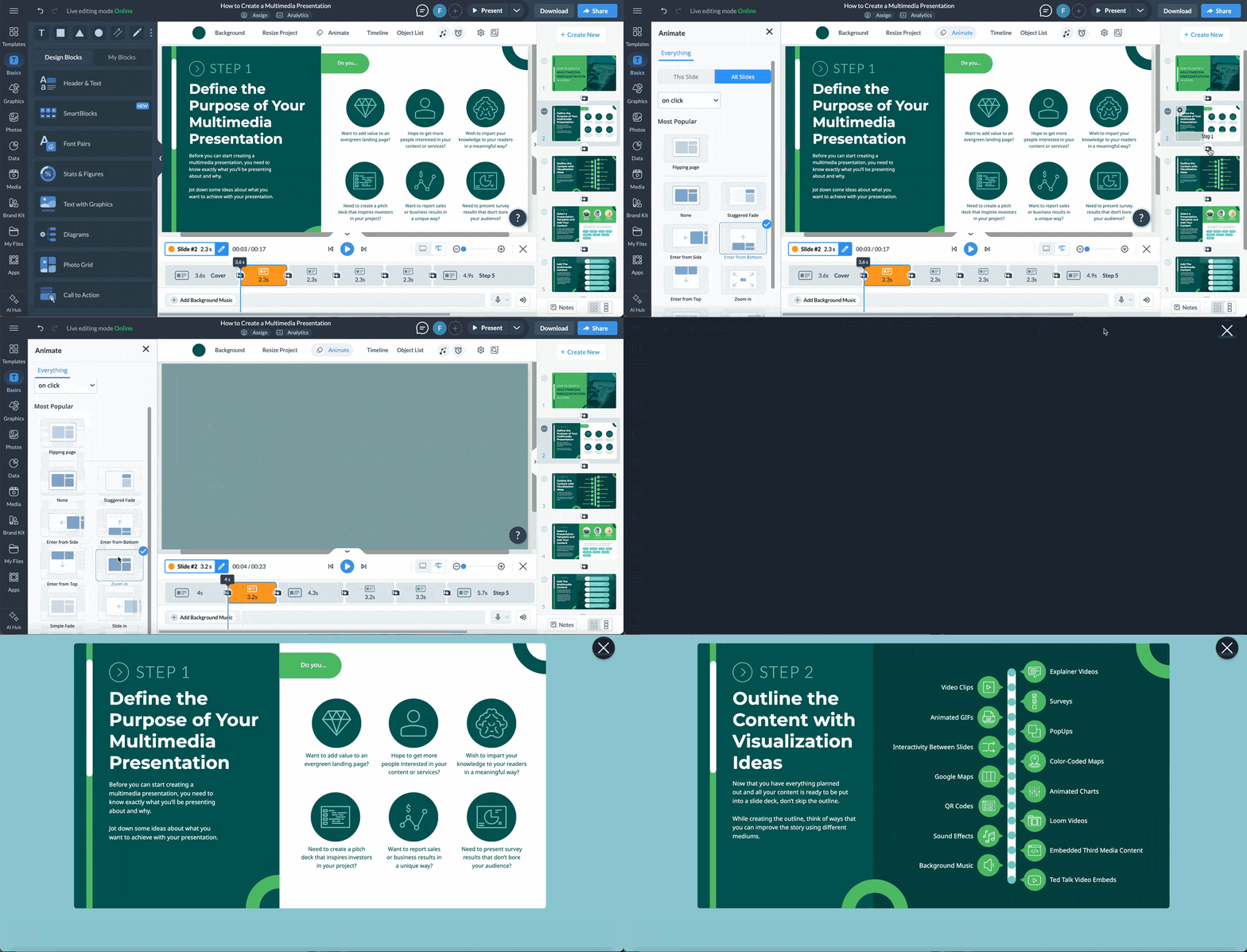
Motion guides your viewer's eye and sets the pace of your video. Animate the elements on each slide, then set how each slide moves to the next. Plan the two together: every animation, video clip and audio track on a slide has to finish before the slide moves on.
Visme includes these ready-made animated assets:
Use animated elements to point to one idea at a time. A moving icon or character next to a key point tells viewers where to look.
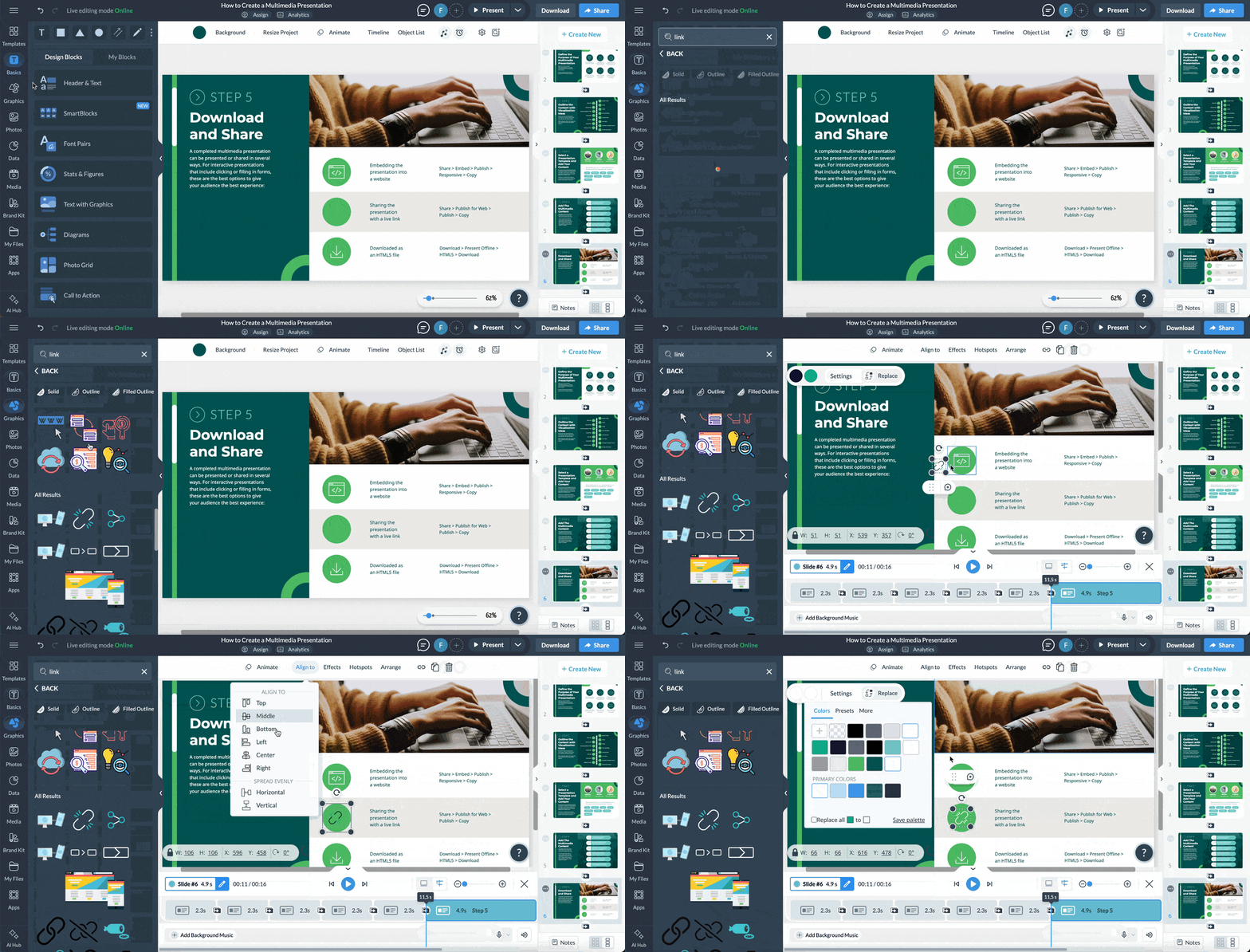
Visme's graphics library has animated icons, illustrations, characters and 3D graphics such as arrows, shapes and hands. Set how many times each one repeats and how fast it plays. A slide won't advance until its animations finish, so more repeats make the slide last longer.
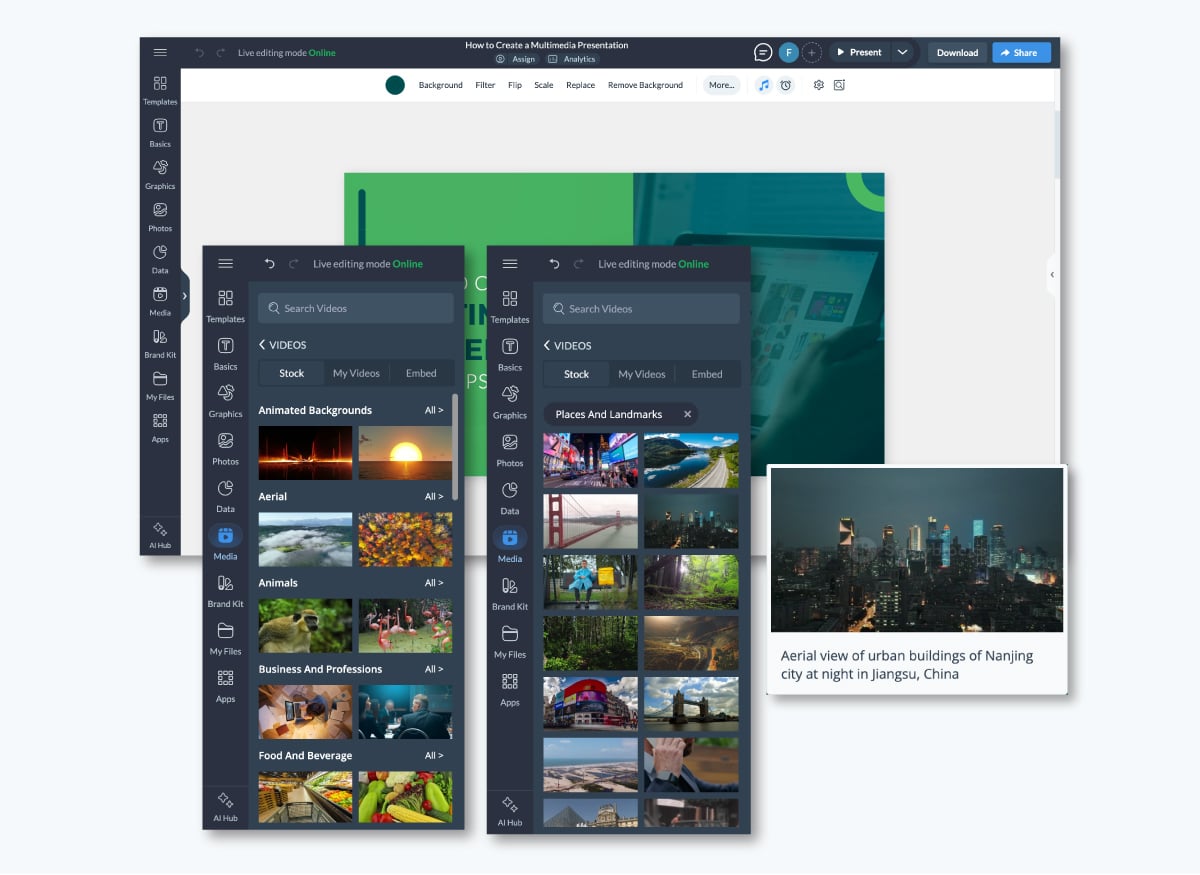
Video clips add real footage and movement that still images can't.
Add clips from Visme's stock video library or upload your own, and trim them so they show only what you need. Set each slide with a clip to advance when the clip ends, so it plays in full. If the clip has its own audio, mute it when your narration or music should take over.
To use a video as a background, stretch it to fill the slide, send it behind your other content and lock it so it stays put while you edit.
Design Tip: if the video is full color, add a subtle color overlay that matches your design so the background stays in the background.
Animated backgrounds loop on their own and follow your transition settings. Use elaborate ones on title slides and section breaks, where there's little text. On content-heavy slides, choose a still or subtle motion background so it doesn't compete with what you're sharing.

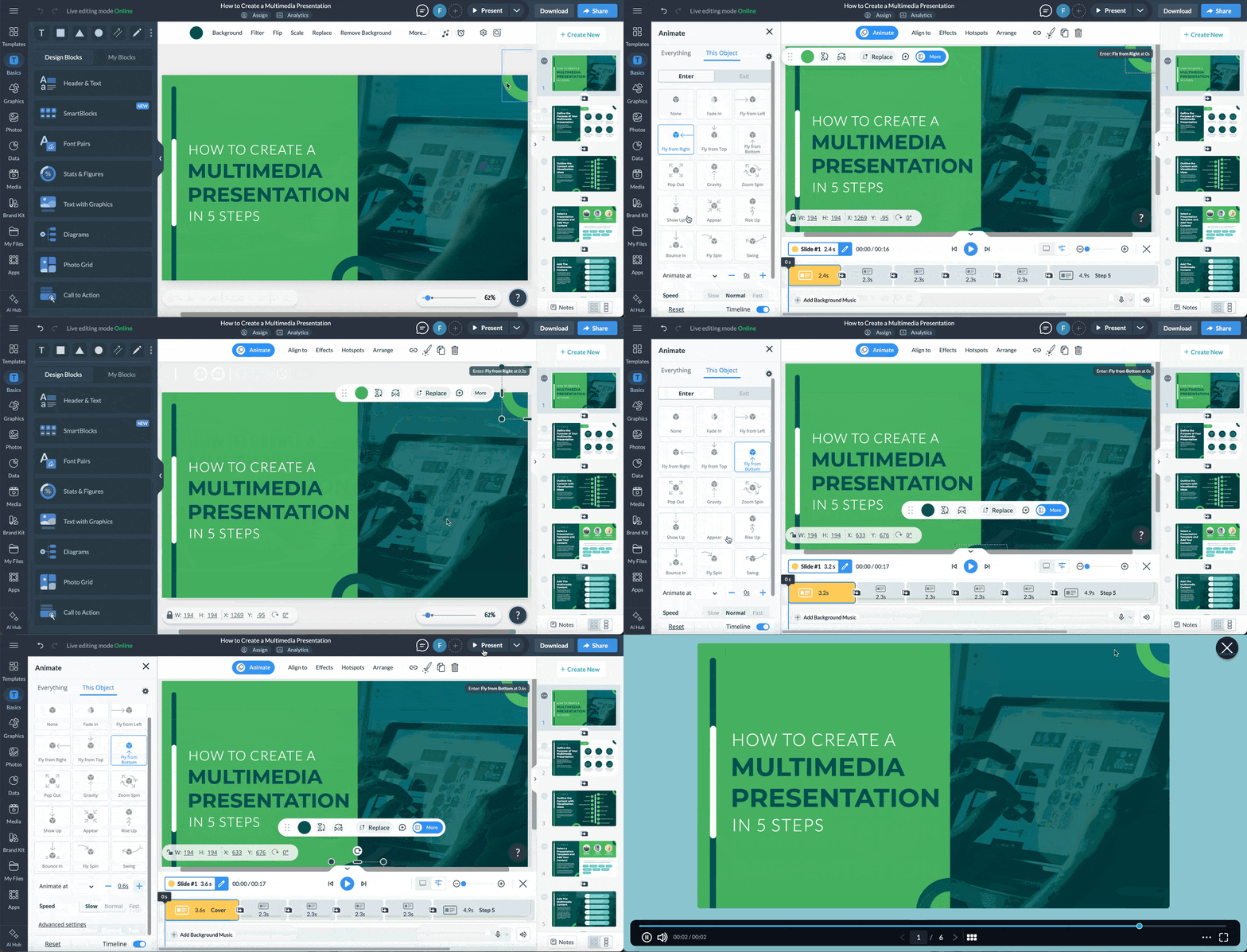
Animations decide what your viewer sees first, next and last by creating focus points. Have each element enter as your narration reaches it, and keep it to a few per slide so motion doesn't pull attention from your message.
You can animate any element's entrance and exit in Visme, animate text letter by letter or word by word, and build custom animations that combine fly, fade, rotate and grow with easing such as bounce. The Timeline shows every animation on a slide so you can line them up with your audio.
Skip on-click animations for video presentations. They don't carry over to MP4 downloads.
Transitions connect your scenes. Use one style throughout for a polished look, or change it on purpose to mark a new section, without going overboard. For a video, set every slide to advance on its own, after a set time or when its video ends, not on click.
Visme has styles such as Simple Fade, Zoom In and Flipping Page, and you can apply one to every slide at once. On the Timeline, you can change how long each slide stays on screen and preview the whole sequence. You'll review all the timing together in Step 7.
Give your video a sound that carries the message as clearly as the visuals do. Audio can keep viewers watching or make them leave. According to TechSmith's 2024 report, 35% of viewers say clear, easy-to-hear narration is one of the things that keeps them watching instructional and informational videos. Among viewers who stopped a video because of poor quality, bad audio was the top reason, tied with blurry footage.
Plan audio alongside your animations and transitions, and use any of these, alone or combined:
Whichever audio you use, check that it lines up with your transitions. A slide stays on screen until its audio finishes, so a long clip on a short slide will stretch it.
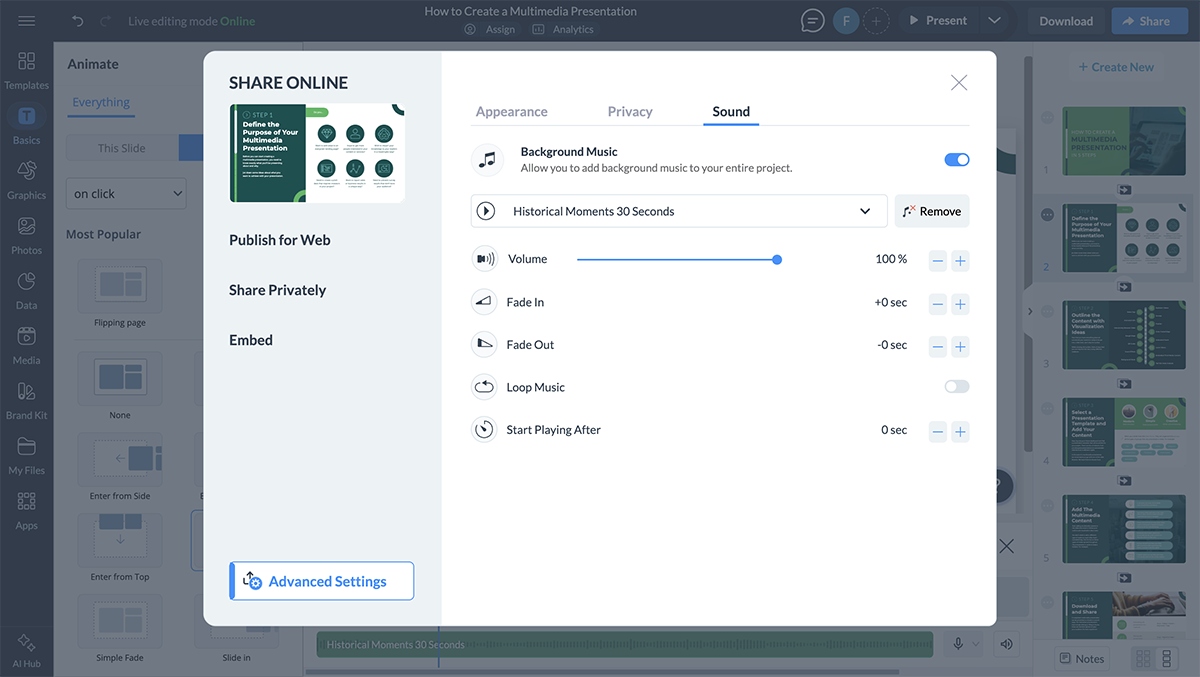
Background music sets the mood and fills the gaps between narration. Keep it low and steady so it never competes with a voice.
Pick a free track from Visme's audio library or upload your own, then set the volume, fade it in and out, loop it and choose when it starts. It plays under all your other audio and video for the whole presentation.
Use slide-level audio for a sound effect or music that belongs to one scene. Pick a clip from the library or upload an MP3 or WAV file, then trim it, set the volume, loop or fade it, and choose when it starts on the slide.
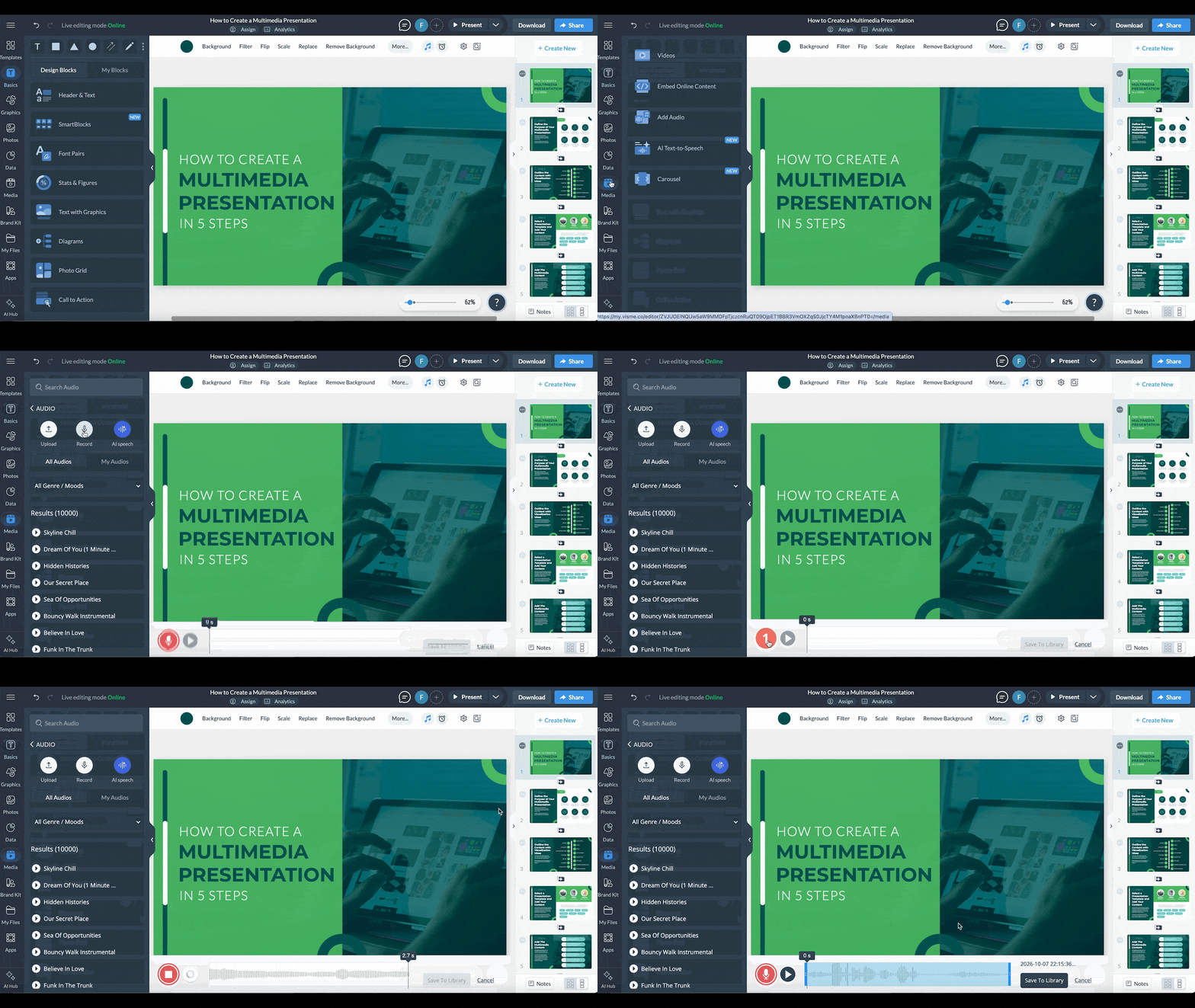
A voiceover is the most direct way to explain what's on screen. Read from the script you wrote in Step 2, and record one slide at a time so you can redo a single part without starting over. You can record right in your browser in Visme, or upload narration you recorded elsewhere.
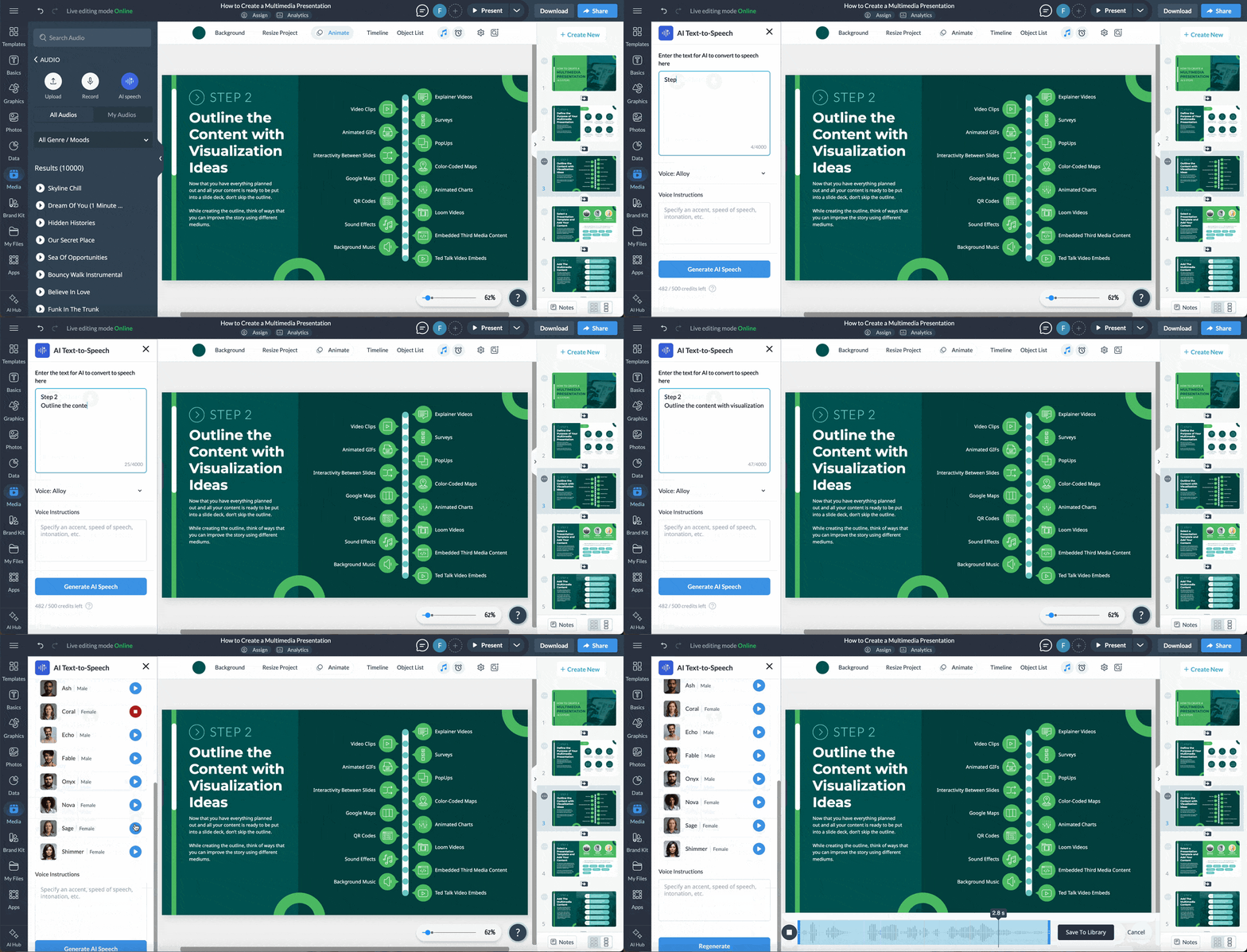
If you'd rather not record your own voice, turn your script into narration with Visme's AI Text to Speech. Choose one of six voices and describe the pace, accent or mood you want.
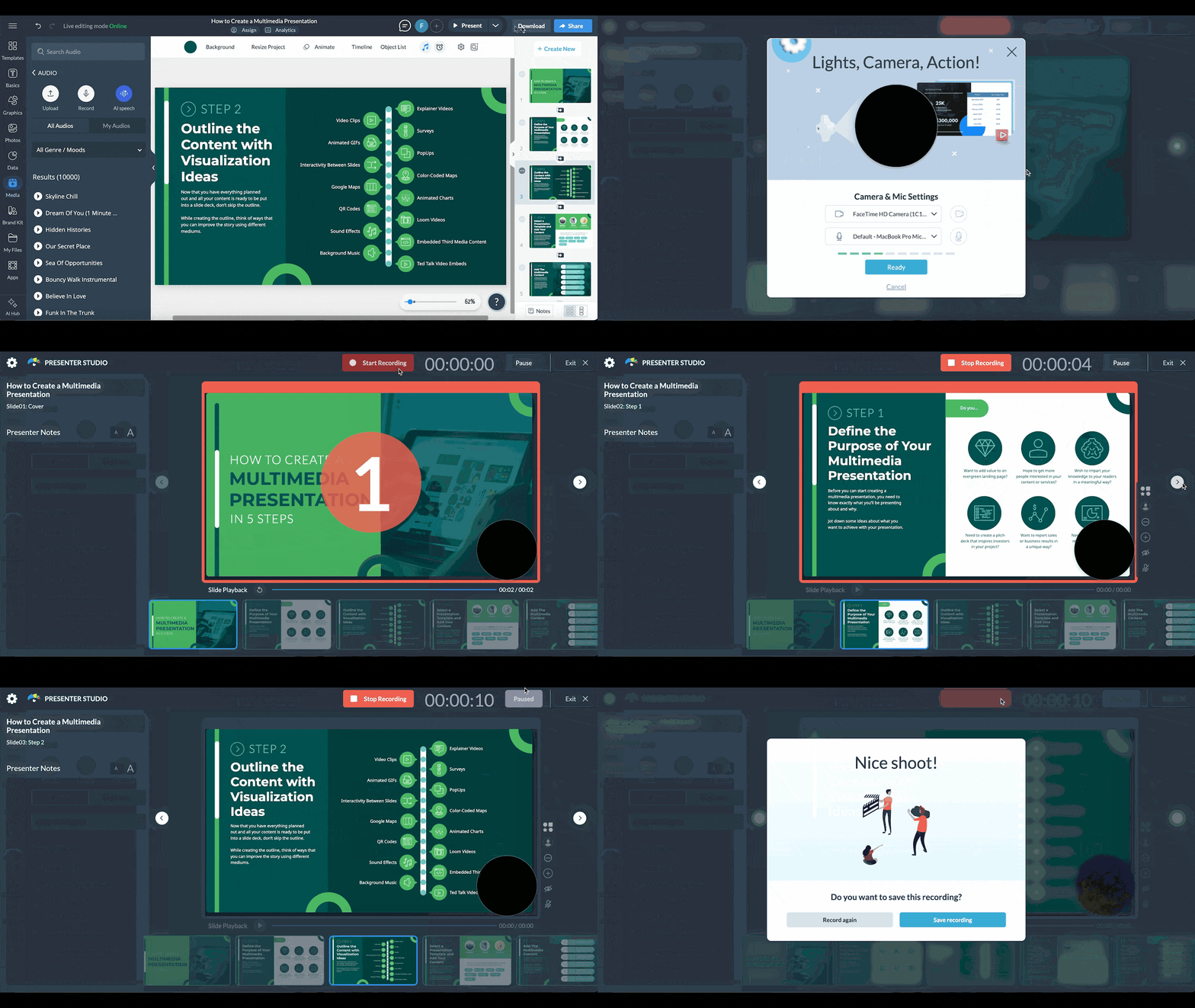
Record yourself presenting when your message needs a human voice and face, such as a pitch, a training module or an update from a leader. You present over your slides the way you would in a meeting, and the recording becomes your video.
Showing your face makes the video feel more personal. According to TechSmith's 2024 report, 87% of viewers prefer to see a real person on screen over an animated character or an AI avatar.
Choose the format that best suits the content on your video and your messaging and tone objectives:
A few things will make your self-recorded video look and sound professional:
Eye contact matters when presenting. Matt Abrahams, a lecturer at Stanford Graduate School of Business and host of the Think Fast, Talk Smart podcast, gives this advice in a Stanford GSB guide to presenting online:
"Make sure you raise your camera up so it’s right at your eye level. So it looks like we’re looking directly at you when you’re speaking to us and make sure you look at that camera so it looks like you’re looking at us as we’re watching you."
To record yourself in Visme, open Presenter Studio from the dropdown next to Present. Drag and resize your camera bubble so it doesn't cover important content, or turn the camera off to record audio only. Your presenter notes stay visible only to you. You can pause and resume as you go, and re-record before you save.
Review your video to make sure everyone can follow along and comprehend the information while also staying engaged. Start with the basics:
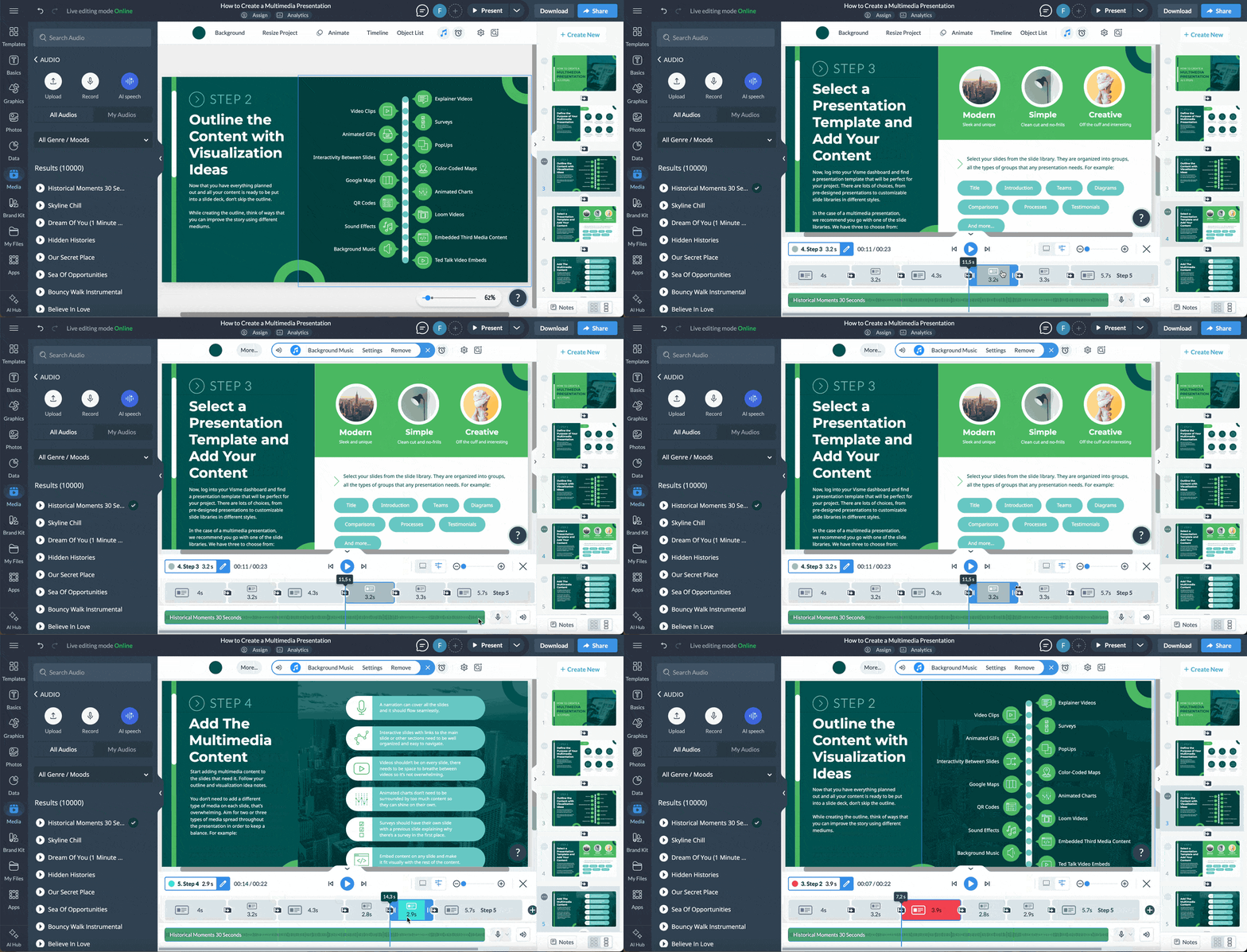
Pacing problems are easiest to spot when you see everything together. Look for slides that end before their narration does, transitions that cut off a clip, and scenes that drag.
Visme's Timeline shows each slide's length, animations and audio in one view. Drag to adjust timing, then play the whole sequence again to check the flow.
You must also check for accessibility. An accessible video works for viewers who watch without sound, use a screen reader or see color differently. Check these before you export:
Visme's accessibility tools help with each of these. The Accessibility Checker flags issues in your design; you can add captions to audio and video, and the Visual Simulator shows your slides as people with color blindness, cataracts, or glaucoma see them. If you also share the presentation as an interactive link, add alt text and set the reading order for screen readers. For more detail, see our guide to accessible presentations.
Export your video in a format your audience can play anywhere, at a length they'll watch to the end.
Keep your video as short as the content allows. According to TechSmith, nearly two-thirds of viewers say videos over 20 minutes are too long. Visme exports MP4 videos of up to 10 minutes, so split longer content into a short series. Presenter Studio recordings run up to 3 minutes on the Free plan and 45 minutes on paid plans.
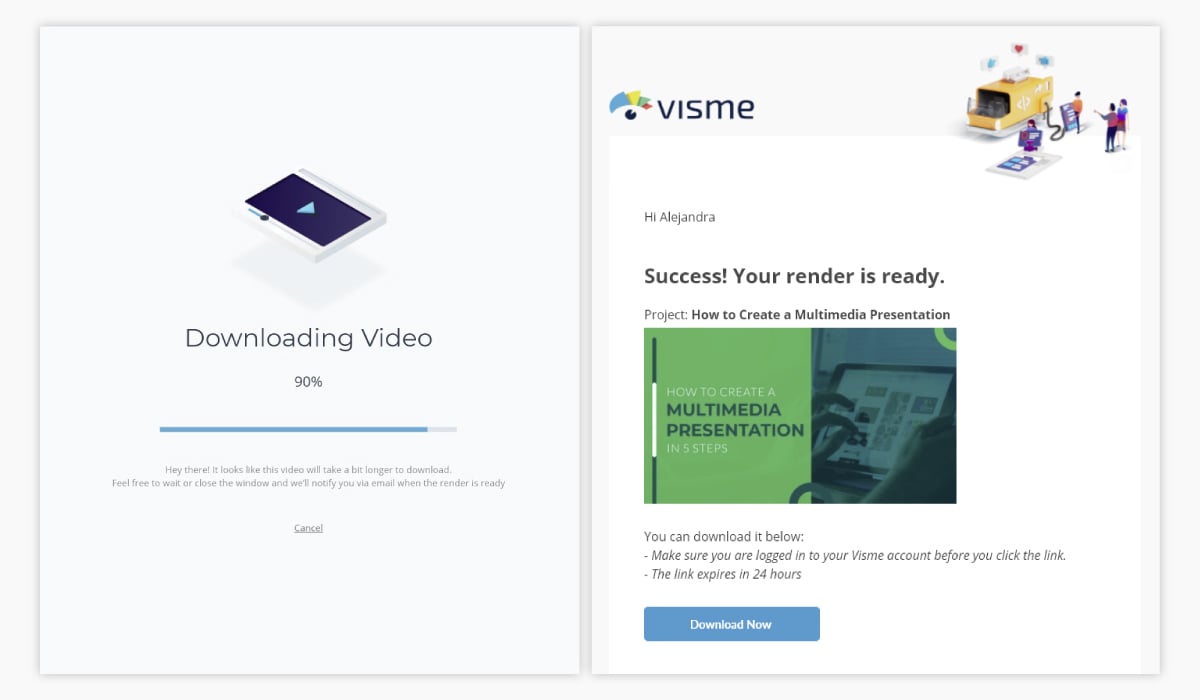
From your Visme editor, download the project as an MP4 from the Video/GIF options. You can export the whole presentation or only the slides you choose. Long videos with lots of animation take a little longer to render.
Before you export, check these:
Share your video where your audience needs it or can access it. Upload it to YouTube, Vimeo or your social channels, or schedule the posts from Visme with the Social Media Scheduler.
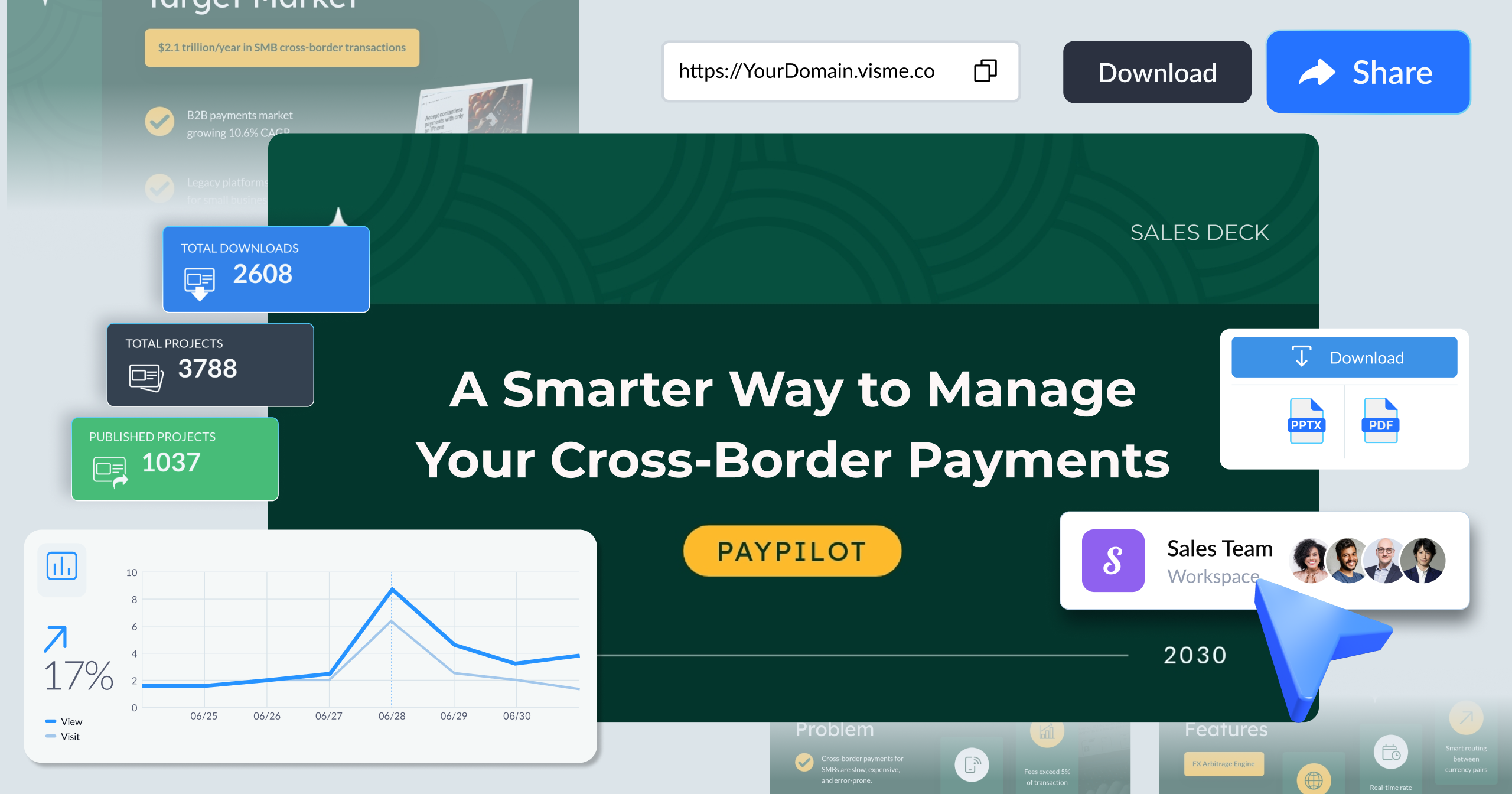
You can also reuse the video in other projects, such as an interactive report, your website, a landing page or an email campaign. To share the presentation itself, publish it as a link and track views with Visme Analytics. For training, export it as SCORM to upload to your LMS.
You can turn a PowerPoint presentation into a video inside PowerPoint itself. But you can also import it into Visme to add motion, audio and narration, before you export it as an MP4. Of course, you also get access to the design tools to make your slides more professional.
PowerPoint's built-in export turns your slides, animations, transitions and any recorded narration into a video file. On Windows:
Find all options and more details in Microsoft's support documentation.
You don’t need to rebuild a deck you’ve already made in PowerPoint. Import it into Visme and your slides open in the editor, where you can add animated elements, background music, AI narration or a Presenter Studio recording. Check the layout and content placement, then follow Steps 4 to 8 above and download the result as an MP4.
The best program depends on what you need to add to your slides. Visme lets you build slides, add animation, music, AI narration and a webcam recording, and export an MP4 in one browser-based tool. Compare more options in our list of the best video presentation software.
Start with a short hook that tells viewers what they’ll learn and why it matters, in the first few seconds. A question, a surprising fact or a quick preview of the result all work well.
Record yourself over your slides with a webcam tool such as Visme’s Presenter Studio, which shows your camera in a small bubble over the slides. Set your camera at eye level, use soft light and look into the lens as you speak.
Add timing, transitions and audio to your slides, then export them as an MP4 file. In Visme, set each slide to advance on its own and download the project as an MP4.
To play a video inside your slides, insert the video file on a slide in PowerPoint, or embed a video from YouTube or Vimeo. To show yourself on camera while you present, record over your slides with PowerPoint’s Record feature or Visme’s Presenter Studio.
Common examples include product demos, training modules,explainer videos, recorded sales pitches and company year-in-review videos. Visme’s 2025 Year in Review, shown earlier in this article, is one example.
A video presentation carries your message to people when and where it suits them. Use one for annual reports, sales pitches, e-learning courses, onboarding, explainer videos andpitch decks.
Visme gives you ready-made presentation templates, animation, music, AI narration and webcam recording in one tool that runs in your browser on Mac or PC.
Sign up for Visme's presentation software and make your first video presentation with audio right away.

Design visual brand experiences for your business whether you are a seasoned designer or a total novice.
Try Visme for free