Visme Forms Walkthrough: Build a Form That Routes, Syncs and Converts

![How to Create an Impressive Case Study One Pager [Including Templates]](https://visme.co/blog/wp-content/uploads/2023/09/How-to-Create-an-Impressive-Case-Study-One-Pager-Header.jpg)
Case studies are a powerful tool for increasing sales and driving revenue. They share real-life proof of how your company has helped clients solve their pain points.
With shrinking customer attention spans, a case study one pager is a great way to quickly communicate the value of your product or service. That’s because they distill the key points of the customer's story into a concise and compelling narrative.
The best part? Readers can quickly grasp the essence of the case study and take action without getting bogged down in unnecessary details.
Ready to create yours? In this article, we’ll show you how to create high-converting case studies that build trust and credibility and ultimately drive business results. We’ve also rounded up professionally-designed case study templates to get you started on the right foot.
Before you jump in, take a look at this video. It shares the secrets to crafting awesome one pagers that will blow your readers away and convey your message in the most compelling way.
A case study one pager is a summarized document that shares the success existing clients have had with your product, service or solution. Not only are case studies one pager valuable sales collateral, but they also demonstrate:
The beauty of case study one pagers is that they are concise and less overwhelming. They're single-page documents, typically one page long. Compared to multi-paged case studies, prospects who are short on time can quickly grasp the main takeaways and take action.
If you already have a multi-page case study, you can condense key points and highlights into this one pager. With Visme’s interactive tools, you can link to the full case study document or your company’s case study landing page.
A case study one-pager is not a deep dive into every technical detail of your product, nor is it a lengthy narrative of your company's history. It is not a generic brochure or a dense whitepaper. It is also not a sprawling document that buries your most impressive results in fluff or forces prospects to hunt for the bottom-line value.
Here’s what a one pager case study looks like.

A high-converting case study one-pager is a carefully structured visual story. And to capture attention and drive action, your one-pager needs to include all these essential elements.
Here are the key components that make up a winning layout:
Made with Visme Infographic Maker
There’s no doubt that case studies work. When it comes to proving the value and quality of your product, case studies are an invaluable asset.
In fact, according to a recent Content Marketing Institute report, 75% of B2B marketers believe in the persuasive power of case studies and actively use them in their marketing strategies.
But why condense that power into a single page?
Because modern buyers are overwhelmed with information and short on time.
A one-pager strips away the fluff, delivering the bottom-line value and hard proof your prospects need to make decisions fast.
Here’s why you need them in your marketing arsenal:
There is no better selling point to prospects than proof of real-world examples of challenges your company has helped solve. That’s why case study one-pagers can be a catalyst for lead generation.
They provide strong, immediate proof that your product or service works, increasing your prospect’s confidence in choosing your brand over competitors. According to a 2025 DemandGen report, 78% of B2B buyers rely heavily on case studies to evaluate their options during the middle of the sales funnel. This highlights the value of case study one-pagers in lead generation.
During a case study presentation, you can leave your case study one-pagers with prospects so they can refer back to them.
Additionally, they're perfect for nurturing and re-engaging leads. Share them as part of a drip campaign to pique interest and encourage prospects to learn more.
Writing a one-pager is a chance to showcase your expertise in your field. It proves your company's ability to deliver results and solve real-world problems efficiently.
As Chris Baylis, founder of The Sponsorship Collective, puts it: "A good case study doesn't just show that you did the work; it proves that you understand the client's underlying business problem better than anyone else."
By clearly articulating the problem and your specific solution, you position your brand as a thought leader and build the trust necessary for prospects to make informed buying decisions.
Your job isn’t done once a customer makes their first purchase. Customer success teams can share case studies to nurture existing accounts and encourage upsells or cross-sells.
When existing customers read about the success of their peers, they gain deeper insight into your company's full capabilities. It validates why they chose you in the first place and why they should continue the partnership.
Furthermore, highlighting your best customers in your case studies builds a deeper connection and fosters long-term brand loyalty.
Case studies are hard-hitting sales enablement content.
By providing your sales and marketing teams with compelling, data-driven one-pagers, you equip them with the exact collateral they need to overcome objections. This helps sales representatives build stronger relationships with potential customers, maximize conversions and close deals faster.
The impact of one pagers for sales outreach is undeniable. According to 2025 data from KoMarketing, B2B companies that use case studies effectively are 67% more likely to close deals.
Case studies naturally include customer testimonials. And research shows that 72% of people develop more trust for brands that feature positive reviews and testimonials.
With case studies, you’re able to showcase your client's genuine satisfaction and appreciation. This element provides social proof and an extra layer of authenticity.
Case studies also have great referral value. Satisfied customers featured in case studies are more likely to recommend your business, as they feel proud to be associated with your brand and want to share their positive experiences with others.
In this section, we’ve rounded up ten customizable case study templates to get you started, each covering a wide range of case study topics.
As you go through this section, don’t forget that one pager case studies can be combined with other marketing materials, such as whitepapers, webinars, or demos, to create a comprehensive marketing strategy.
This modern and sleek case Study template is perfect for showcasing your company's success stories in a visually appealing way.
The template has a clean design and a minimalist layout structure. Key sections, including objectives, program overview, revenue impact, key metrics and findings, are neatly arranged into two columns.
Notice how the ratings and total sales revenue breakdown are captured using engaging charts and graphs. With Visme’s data visualization tool, you get unlimited access to different types of charts, graphs, maps and widgets to easily capture results and financial data.

Whether you're looking to demonstrate the expertise and credibility of your fintech company, this template has everything you need.
The template features a striking, deep navy blue background design. This dark theme sharply contrasts the white and yellow text and gray visuals, making them stand out and grab the viewer's attention.
The case study format is carefully crafted to guide the reader's eye through the page, with clear section headers and visually appealing icons and graphics. With Visme’s intuitive editor, you can change the color of the background, text or charts to match your branding.

Are you an educator, trainer and learning professional? This one pager case study template is not just great sales material; it’s perfect for showing social proof. It’s designed to help you communicate the effectiveness of your training methods.
The template can be adapted to any industry or project. It begins with a bold header, company logo, followed by key sections—introduction, innovation, KPIs, key takeaways and more. The stunning image aligned at the top right draws attention, captivates readers and leaves a lasting impression.

Feel free to tap into Visme’s rich library of stock photos, icons, widgets and other design elements to make your document shine.
And if you can’t find your preferred graphics, Visme has your back. With the AI image generator, you whip up unique and professional-quality photos, paintings, pencil drawings, 3D graphics, icons, abstract art, and more.
Make your success stories stand out with this engaging case study template. Featuring a unique layout, colorful text and eye-catching visuals, this template is sure to capture readers' attention and keep them engaged until the very end.
The logo and social media icons highlight your company’s branding. You can link these icons to your social media accounts using Visme’s interactive and animation tool.
But that’s just the tip of the iceberg regarding what you can do with the animation and interactive features. Users can create animated graphics or hotspots that reveal additional information when clicked or hovered over. This helps to keep your one pager from getting cluttered with information.

If you sell physical or industrial products, this template is for you. With plenty of space for showcasing your study, solution and results, this template is the ideal tool to build trust and establish your reputation.
The template includes a variety of sections, such as key performance indicators, findings and outcomes, decision and more. Each section is designed to be easily customizable. You can easily swap them with your own text, images and graphics to make the template truly yours.
The design elements in this case study make it a head turner. The left bar has an incredible blend of a logo and title on a white and sky-blue background. The right bar houses most of the information and has a bold blue background.
The white and light blue fonts and purple icons complement each other with great visual contrast. To top it off, the impactful visuals and multimedia elements provide more context for your readers.

If you have multiple people on your team using this template, you can use Visme’s User permissions to control who can view it or what changes are made. Each Visme project allows you to control user permissions, which can be assigned by the creator or workspace admin.
You can assign various levels of access to your case study one pager, such as view-only, edit or comment directly on projects. Additionally, you have the option to make it password-protected, limiting access to those who truly need it.
With a strong emphasis on outcomes and achievements, this template is the perfect way to demonstrate the value of your real estate business and showcase your successes.
The template is split into six main blocks, each housing a different section. Each section has a different background color theme with light-colored text for better visual contrast. With its user-friendly design and pre-built sections, this template saves you time and effort.
With the dynamic fields feature, you can easily customize this template for multiple clients. When designing it, add custom dynamic fields for sections like the title, client name, contact, etc. And then simply swap the text in the custom fields and your changes will reflect in a matter of seconds.

Take your case studies to the next level with this e-commerce one pager case study template. Featuring engaging visuals like charts, widgets and icons, this template brings your success stories to life and engages readers in a whole new way.
The template includes sections for introducing the problem, outlining the solution and showcasing the results. With the customizable charts, you can add a professional touch and enhance your case study’s narrative.
Not sure what to write in your case study, or perhaps you need help proofreading your copy before you send it off to a client? Visme’s AI writer is a powerful assistant for crafting killer content. You can even use it to proofread your content.

Whether you're preparing a case study for publication, presentation, or educational purposes, this captivating nutritional case study template can help you communicate your findings effectively and engage your audience.
The template includes a range of colorful, eye-catching graphics, illustrations and visualizations that help break up the text and highlight key findings.
In addition to its visual appeal, this template is also highly customizable. Our user-friendly interface allows you to easily modify the layout, colors and fonts to suit your needs and branding preferences. You can even collaborate with colleagues and co-authors in real time. Team members can tag each other, leave feedback, resolve comments and more.

If you're looking to highlight your training agency's capabilities and achievements, this template is an excellent starting point. Having amassed impressive results, you can even share them with new trainees to showcase the outcomes you expect.
With its flexible design and customizable elements, this template helps you tailor your message to any audience and make a lasting impression.
The template features two backgrounds—one with white and the other with different shades of red. With data visualization, you’re able to easily convey the results and help readers understand key insights.
Keep your branding consistent across multiple projects with Visme’s brand wizard. Simply input your URL and the tool will pull up your logo, colors and fonts from your website. You can easily add branding to your project with a single click.

The modern and sleek design of the template is ideal for companies that want to showcase their innovative and forward-thinking approach.

The template includes a variety of fonts, colors and graphics that can be easily customized to match your brand identity. Easily find anything you need in Visme’s editor using the shortcut feature. Once you tap the forward-slash (/) on your keyboard, you’ll find a search bar where you can type the feature you’re looking for.
Additionally, the template is fully responsive, meaning that it can be easily viewed on a variety of devices, including laptops, tablets and smartphones. You can easily share your case study with others, regardless of how they prefer to access information.
A great one-pager starts with content that tells the right story about your customer’s success. Here's how to gather the right information, shape it into a story and use AI to speed up the process.
The interview is where you gather all the essential information for your on-pager. Come prepared with focused questions that map directly to the sections of your one-pager: the challenge, the solution and the results.
Here are the core questions you should ask:
Record the conversation (with permission) so you can focus on listening rather than taking notes. Aim for 20–30 minutes. If the interview is happening over a call, AI tools like Otter.ai, Fireflies.ai, or Fathom can automatically record, transcribe and summarize the conversation for you, so nothing gets lost and you have clean, searchable text ready to work with.
Before writing the full text, use a case study outline to help you map out all the content. A great way to start is with a three-act storytelling framework like the one below:
Once you have your interview notes turned into a narrative outline, tools like Claude andChatGPT can help you shape into a structured outline.
Another option worth trying is the Case Study Generator by Oyekunle Damola, a custom GPT built for this exact use case. Feed it your client's info, their goal, the challenge they faced, the solution you provided and your results, and it will generate a structured draft to build from.
Using the outline as a base, write each section of the one-pager in order: headline, challenge, solution, results, testimonial and CTA. Keep sentences short and direct. For example, don't let the challenge bleed into the solution, and don't bury your results in the middle of a paragraph.
A few things to keep in mind as you write:
Before handing off to your designer or doing it yourself with Visme, do one final pass focused on three things:
Share the draft with your sales team too. They'll quickly flag anything that doesn't address real objections they hear in the field.
Then, when you bring that draft into Visme and start customizing in the editor, Visme's AI Writer is right there to help you polish individual sections as you go: tightening a headline, punching up a results callout or refining a client quote until it lands just right.
Don't let design delays hold up your sales collateral and become a bottleneck for your marketing team. Here's exactly how you can use Visme AI to streamline your production workflow from a plain document to a published digital asset, fast.
Keep in mind that you can also follow these steps to create an AI marketing case study, company one pager or startup one pager.
Here’s what one of our customers has to say about Visme’s design software
“Visme saves time and is a whole lot more affordable than most other content development programs out there now. It makes it easy to develop professional, polished content.”
- Kendra Bradley, Graphic Content Developer at WOW! Read the full case study.
When building your one-pager in Visme, you have two fast, intuitive ways to get started:
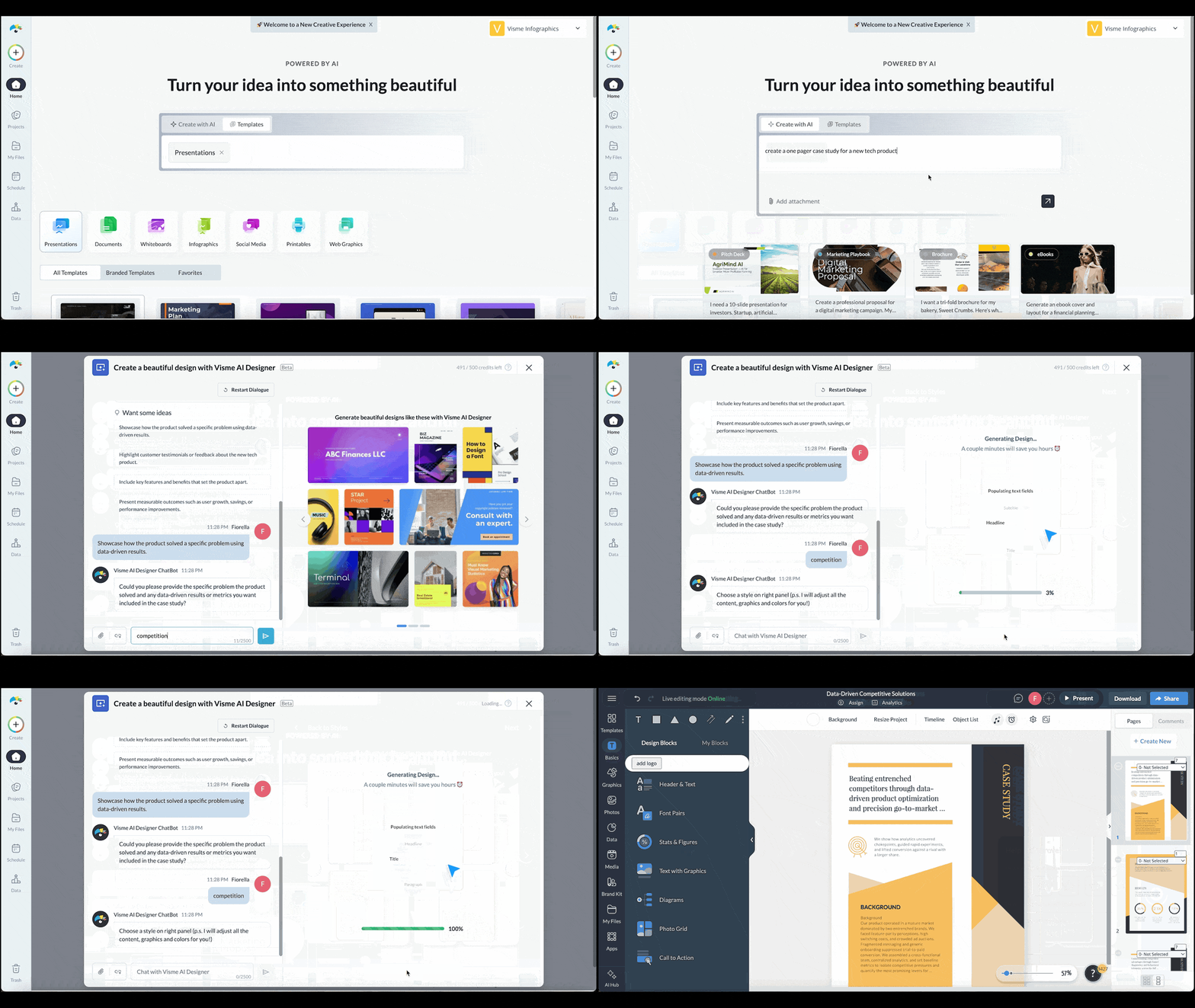
If you need a head start, let the AI Document Generator do the heavy lifting. In the dashboard, click Create New and choose Generate with AI. When the chatbot opens up, write a prompt explaining that you need a case study one pager and include the essential details about it.
Then, it'll ask for a bit more context and some details. Type in your answers, or save even more precious time by uploading an existing document or pasting a URL for the AI to pull information from.
Select one of the provided styles and within minutes, the AI will generate a visually appealing layout tailored to your prompt and content. If you like it, click Edit to start customizing your document. Or click Regenerate to see other variations and ideas.
If you prefer to start with a structure instead, browse our extensive library of professionally designed case study templates for fresh one pager ideas.
Once you find a layout that fits your vision, hover over it, click "Preview," and select "Edit with AI" to use our editing features.
A chatbot will appear and ask you a few questions to customize the template's copy to fit your specific case study. Just like the AI Designer, you can upload your own content for the AI to use. Once it generates the design, go back into the editor to finalize the details.
A great case study needs both compelling storytelling and eye-catching visuals.
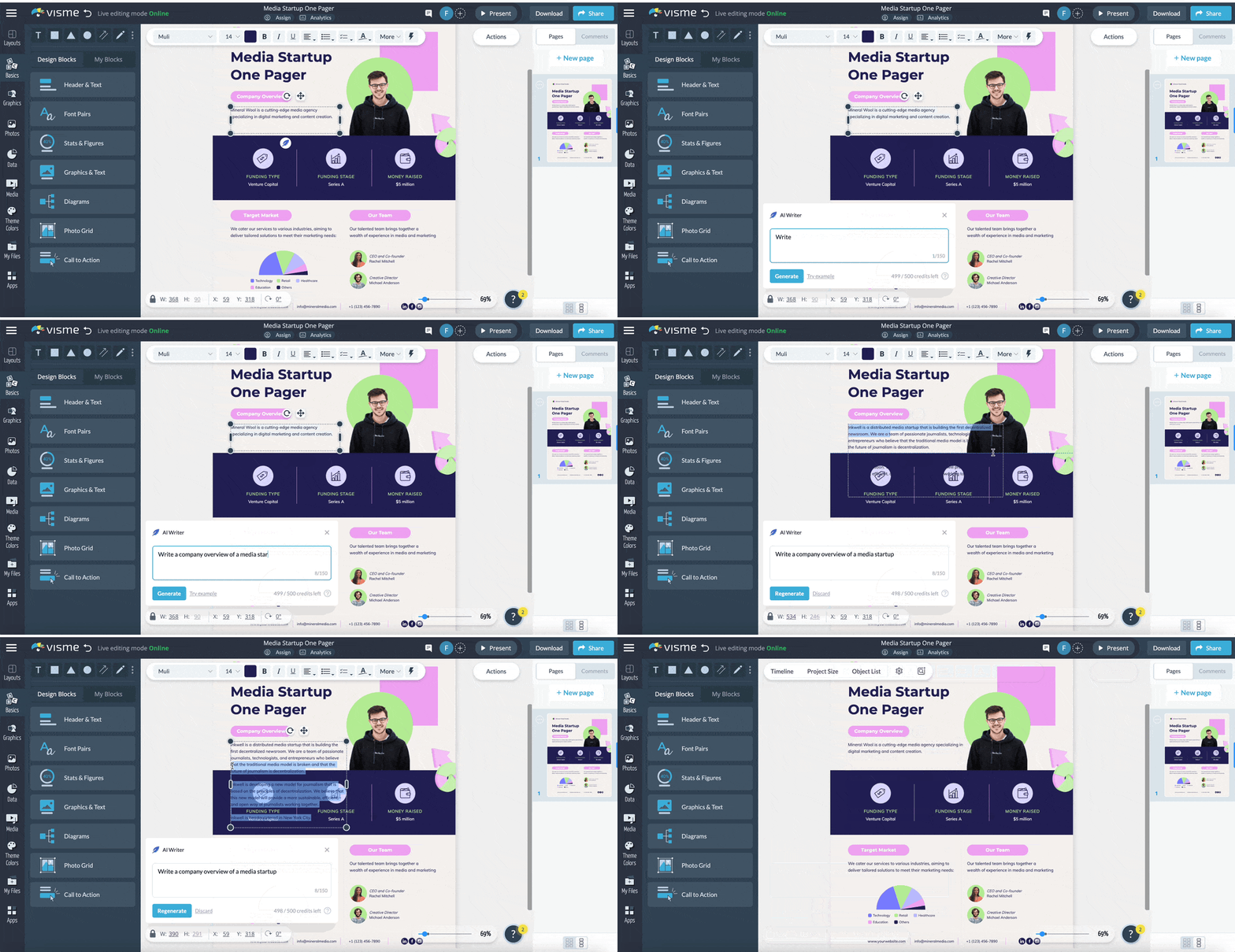
If your initial draft feels a bit flat, highlight the text and use the AI Writer to instantly rewrite it.
Ask the AI to make the tone more persuasive, summarize a lengthy paragraph into punchy bullet points or fix grammatical errors.
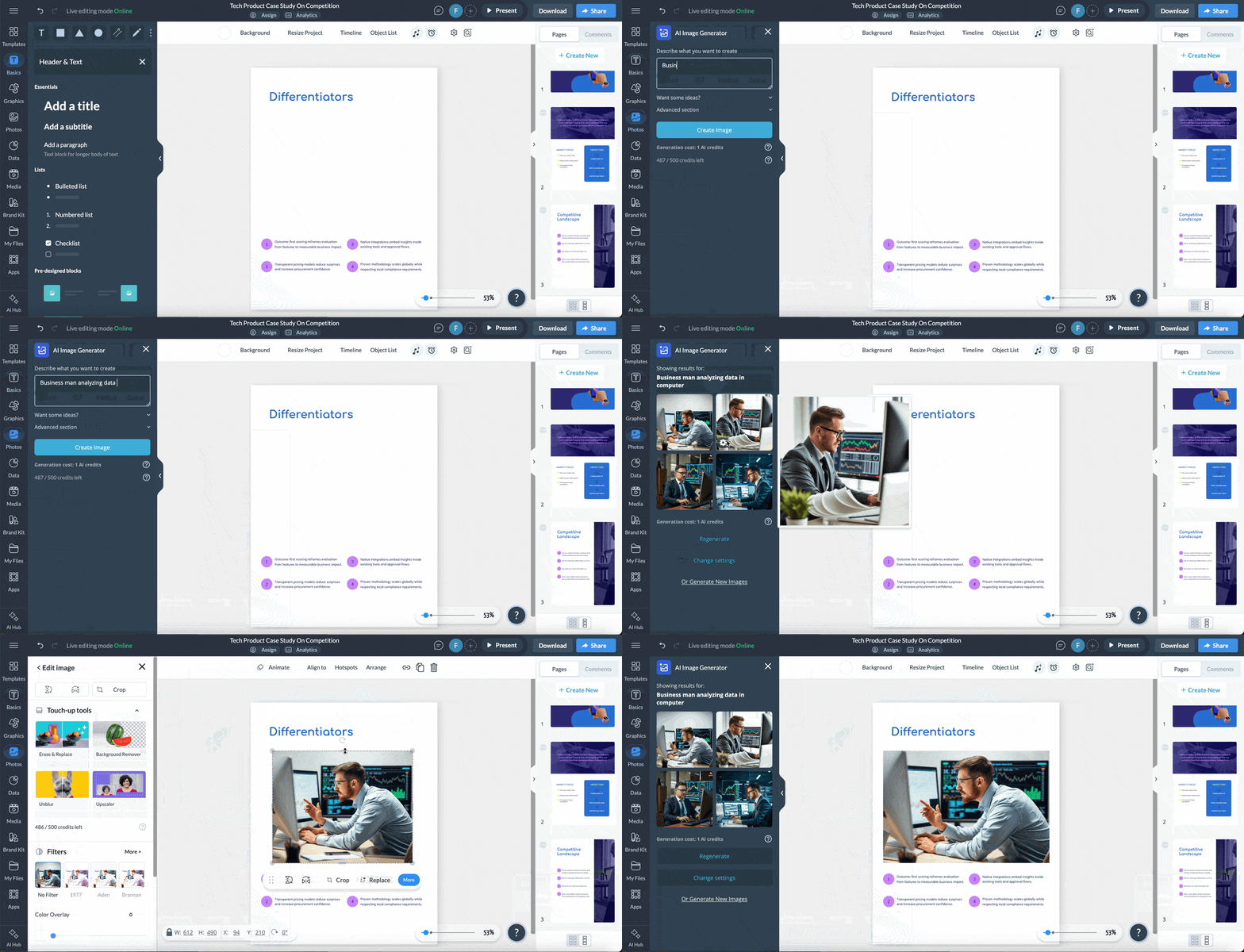
When it comes to visuals, there’s no need to hunt for the perfect stock photo. If you lack specific client images, simply describe what you need to the AI Image Generator.
For example, you can prompt it to create a "modern 3D illustration of a team collaborating on a software dashboard," and it will generate a unique, high-quality graphic in seconds that perfectly matches your narrative.
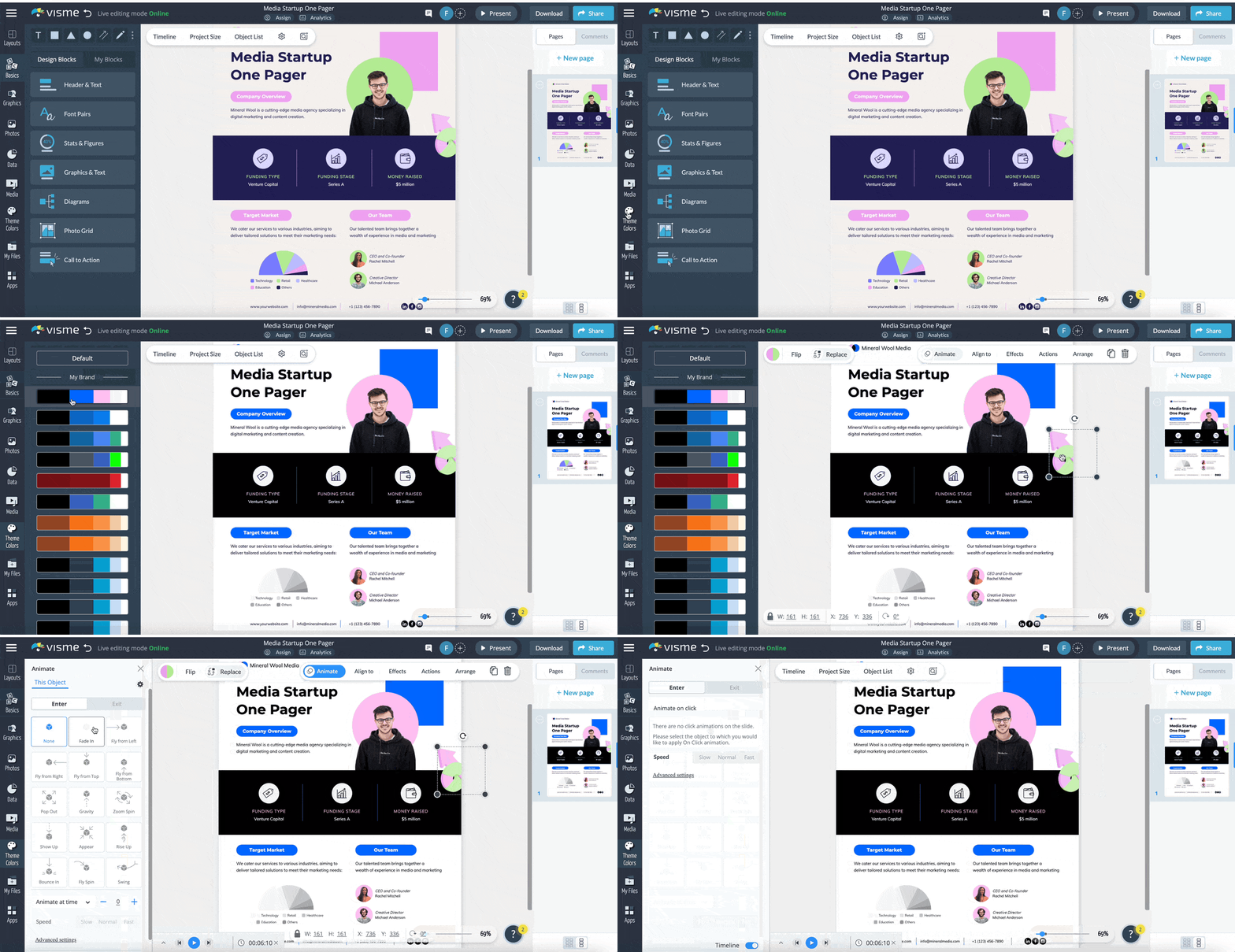
Use interactive elements, such as pop-ups, hover effects, clickable menus, hotspots and the flipbook effect to captivate your readers and keep them engaged throughout your proposal. You can also embed videos and incorporate animated icons, illustrations and special effects to make your proposal even more compelling.
Easily communicate findings and outcomes with Visme’s data visualization software. The tool has a rich variety of charts, graphs, maps and data widgets to get you on the right track.
Let’s say your client saw a 45% increase in revenue.
Don't just place the number; drag and drop a radial dial, a progress bar or a sleek bar chart onto the canvas. These widgets make your client's ROI and key metrics instantly digestible and the data easier to grasp.
A cohesive visual identity instantly elevates your case study's credibility and builds trust with prospects.
To ensure every piece of collateral (including this one pager) looks professionally designed and on-brand, use Visme's Brand Design Tool.
Just input your website URL, and the wizard will automatically extract your company’s exact colors, fonts, and logos. When the Brand Kit is ready, apply all the assets to your one-pager.
Once your one-pager is perfectly branded, you can maximize your team's efficiency by saving the finished design as a custom template in your workspace.
To make future updates even faster, add dynamic fields. Add them to text that covers core information, like the client's name, industry metrics or dates. Your sales and marketing teams can then instantly generate new, brand-compliant case studies without manually editing any details.
Now, choose from multiple distribution options for your case study.
Download it as a high-resolution PDF to hand out at conferences or generate a trackable online link to include in your email outreach.

To maximize visibility, embed the one-pager directly on your website or a dedicated landing page with a simple snippet of code.

When sharing via a live link or embed, use Visme's built-in Analytics to monitor its performance. Track exactly how many prospects viewed the document, how much time they spent reading it and whether they clicked on your Call to Action (CTA).
Leverage this data to follow up with warm leads at the right moment.
Ready to squeeze the most value out of your next case study? Here are some best practices for creating effective case studies:
Position the customer at the absolute center of the narrative. Take into consideration these famous words from Donald Miller, author of Building a StoryBrand:
"The customer is the hero of our story, not your brand."
It’s important to understand exactly who your ideal buyer is and tailor the story to their specific industry and pain points. For instance, if your target accounts are in the tech industry, share a case study about a SaaS client.
And as Joel Klettke, founder of Case Study Buddy, explains: "A great case study isn't about what you did; it's about what the client achieved."
So, set the scene by providing relevant background information: company size, industry, and the severe challenges faced before your intervention. Also, highlight their goals and achievements before you stepped in. This will help readers understand the severity of the problem and why the case study matters.
When writing a case study, make it persuasive and show undeniable results. Explain how your product or service helped customers achieve their objectives and improve their business outcomes. Think of it as showing a “before” and “after” transformation!
However, make sure to focus on outcomes that matter most to the customer. This could include cost savings, revenue growth, or improved customer satisfaction.
Include quotes and testimonials from customers, stakeholders or experts. This can add credibility and depth to the case study. They can also provide insight into the customer's perspective and experience.
Storytelling never goes out of fashion. Tell a story that engages the reader and makes them want to keep reading. Start with a captivating title and an introduction to draw the reader in. Lace the middle with persuasive words, vivid visuals, data visualizations and detailed examples to bring the case study to life.
End with an action-oriented conclusion. Let your prospects know what to do next and how to do it.
Avoid generalizations and vague statements. Instead, use specific details and metrics to demonstrate the impact of your product or service.
For example, instead of saying, "Our software increased efficiency," say, "Our software reduced processing time by 50%."
Support your descriptive content with visuals like charts, radial dials and infographics that break up the text. They are also useful for illustrating key concepts, showcasing products or services and highlighting benefits and outcomes.
Deploy a predictable case study outline that makes your case study easy to read. Follow this structure to guide readers smoothly from the initial problem to the resolution.
Keep in mind that this is a suggested structure and your one-pager might be a little different depending on your specific organization and story.
Finally, edit and proofread the copy rigorously. Gather feedback from your sales team to ensure the narrative directly addresses common prospect objections.
Got some questions about case studies? Find the answers to some of the frequently asked questions here:
Follow this step-by-step guide to write a compelling case study:
Publish and promote: Distribute the completed case study on your website and social media channels. Drive traffic through email marketing and paid advertising.
There are various formats for presenting a case study, such as one-pagers and multi-paged documents, videos, infographics and more.
Typically, the case study structure and format are straightforward. A case study usually describes a problem faced by the customer, along with how the product or service provided a solution, the outcomes and an analysis of the data. The study may also highlight any limitations or challenges that were encountered and conclude with key takeaways.
Yes, a case study can be on one page. Sales and marketing departments use case study one-pagers to attract or warm up potential leads who are short on time and require quick, high-impact engagement.
The text below outlines the key elements that should be included when studying a product or service:
Additionally, you can include a well-crafted title and introduction that grabs the reader’s attention and sets the tone for the rest study.
Use a case study one-pager when prospects need quick, digestible proof of your value without reading a lengthy document.
Deploy them as physical leave-behinds at trade shows, attach them to cold outreach emails or use them as quick reference guides during sales calls. They work perfectly for top-of-funnel lead generation and re-engaging stalled prospects because they deliver high-impact results at a glance.
There you have it. Case studies are valuable assets for driving sales and conversions.
In this article, we’ve shared stunning templates and best practices for creating a winning case study one-pager. We also discussed the advantages of a case study.
Now it’s time to get to work. Visme has everything you need to create stunning case study one-pagers. With our intuitive and user-friendly interface, editable template and cutting-edge features, you can easily create different types of marketing, sales and product one-pagers. Access interactive features, visuals, charts and other design elements to drive engagement over the top.
Ready to take Visme for a test drive? Sign up to discover how Visme can help you drive maximum results for your business.

Design visual brand experiences for your business whether you are a seasoned designer or a total novice.
Try Visme for free