

The Best Beautiful.ai Alternatives to Create AI-Powered Presentations

It feels like every day there's a new AI model, a new agent or a new connector, and each launch promises more content in less time. I follow these releases closely and test several of them. Yet I keep having the same conversation with teams that adopted AI. Most of them still rewrite and reformat most of what it produces.
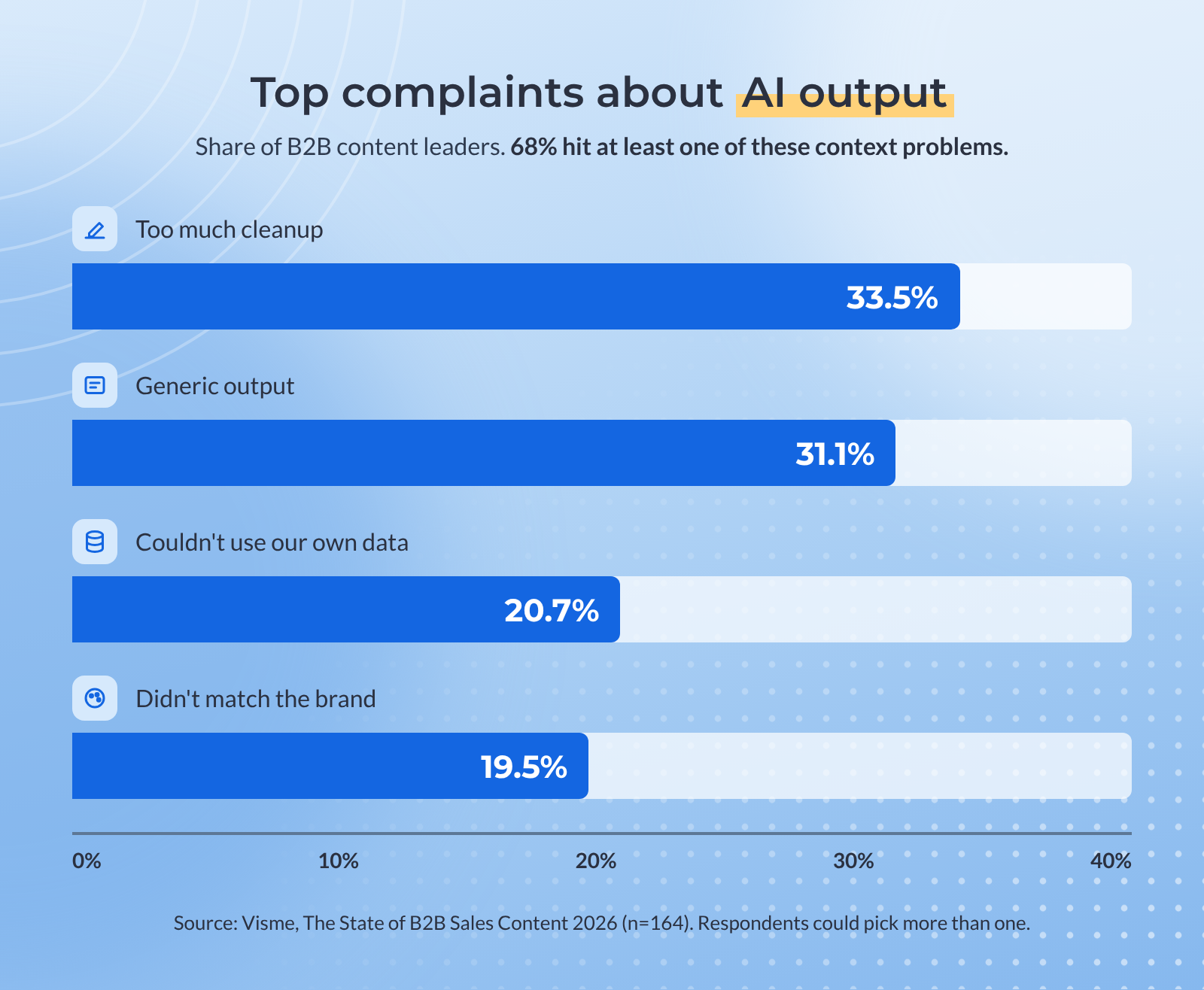
Why do AI drafts need so much editing? Because the tool doesn't know your business. According to Visme's State of B2B Sales Content 2026 survey of 164 managers, directors and senior executives responsible for customer-facing content, 68% hit that context problem when they used AI.
I see AI adoption as two thresholds. The first is individual: does AI make my job easier? The second is organizational: can the business use what AI produces with confidence?
The two don't always arrive in order. An employee can find a tool useful long before IT, legal or brand teams approve it for customer-facing work. Closing that gap takes accurate copy, on-brand layouts and safe data. That's where AI content governance comes in, and it's where the payoff is for any team that produces content at volume.
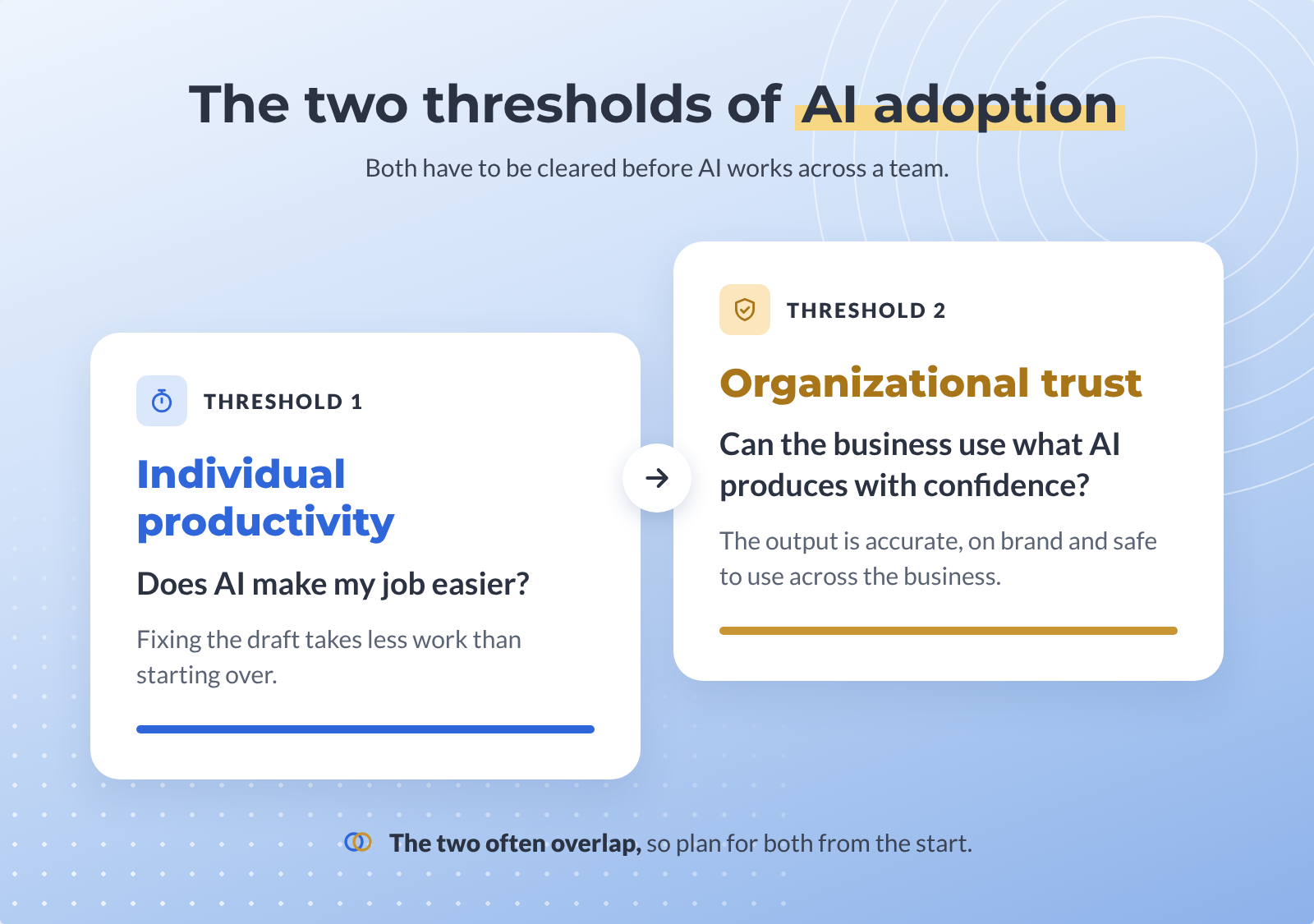
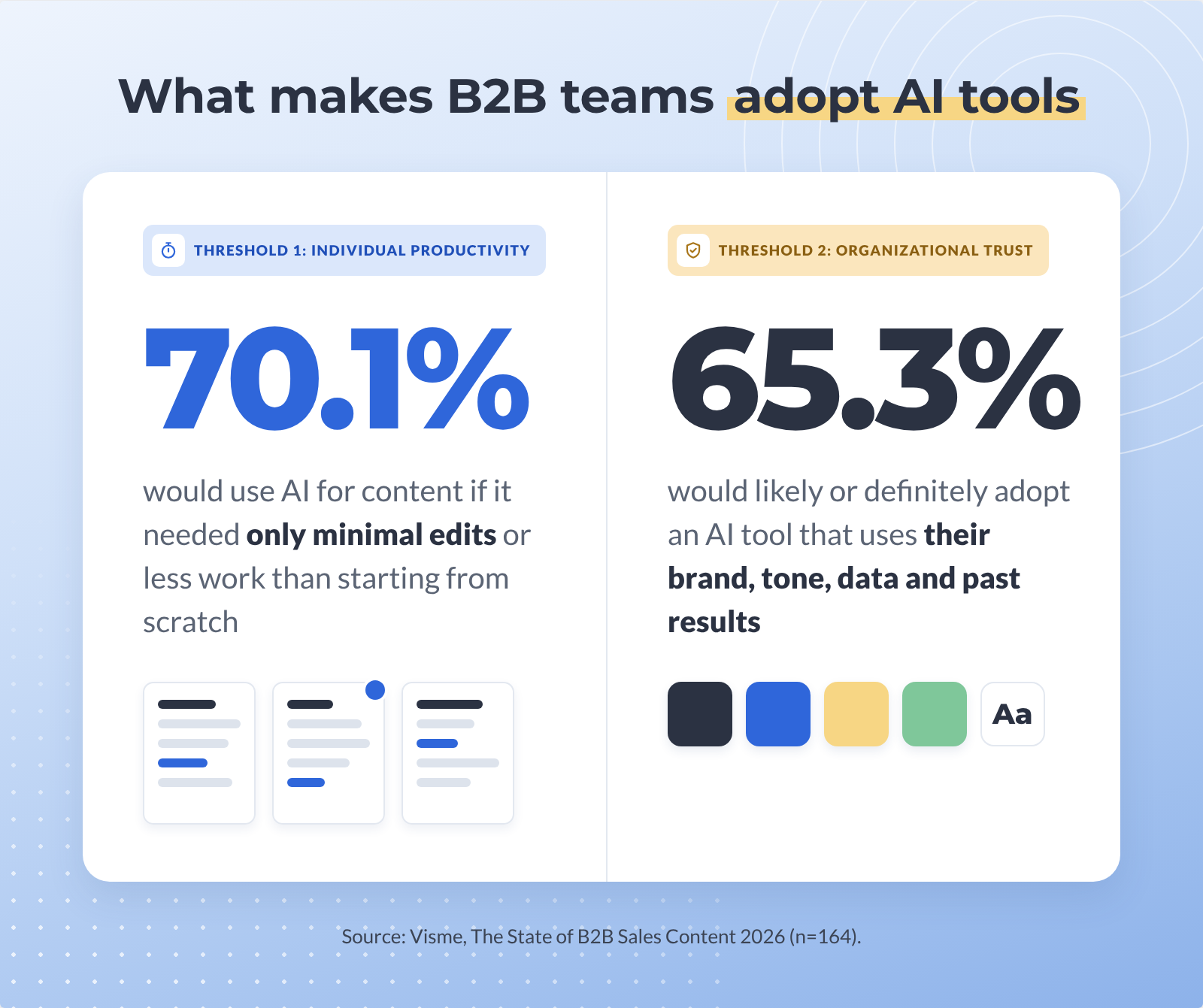
A team adopts AI once it clears two thresholds. Threshold 1 is individual productivity: fixing the draft, both copy and layout, takes less work than starting over. Threshold 2 is organizational trust: the output is accurate, on brand and safe to use across the business. The two often overlap.
Individual productivity is the lower bar. In Visme's 2026 survey, 70.1% of respondents would use AI for content if it needed only minimal edits or less work than starting from scratch.
Organizational trust decides whether a tool spreads past the people who first tried it. The same survey found 65.3% would likely or definitely adopt an AI tool that uses their brand, tone, data and past results.
Neither threshold removes human review. Someone still has to decide whether a document is right before it goes out. What changes is the size of that job: checking a draft that's 90% there takes minutes, while rebuilding one takes the afternoon.
Faster employees don't always mean a stronger business. McKinsey's August 2026 State of AI research found 80% of respondents reported gains in individual productivity from AI, but only 37% reported a positive contribution to their organization's EBIT.
The two numbers measure different things, and the research doesn't explain the gap. Still, making individual employees faster doesn't add up to business results on its own.
For teams producing customer-facing content, that raises two questions. Does AI cut the work involved? And can the organization use what it creates with confidence?
AI drafts need cleanup because a general model has never seen your product specs, approved claims, brand voice, templates or last quarter's numbers. It fills those gaps with plausible, generic copy and default design, and your team pays for it in edits.
Visme's State of B2B Sales Content 2026 survey found four top complaints about AI output:
I hear the same four complaints from very different teams. A sales proposal with last year's pricing or a claim legal never approved. A quarterly business review with the wrong customer metrics or an outdated account story. A training course that misses the latest internal policy.
Then there's the layout. Text that overflows the slide, charts in default colors, a one-pager that ignores the template your designers spent weeks on. If the design is wrong, someone still rebuilds the page.
A longer prompt can patch one document. It can't carry your whole company's context into the next hundred.
Independent research points the same way. In November 2026, the Content Marketing Institute published B2B research where 78% of marketers selected speed as one of AI's contributions to content creation. Only 17% selected quality.
The same study named ensuring accuracy (54%), maintaining quality control (54%) and maintaining brand voice and authenticity (52%) as top challenges. The two surveys asked different people different questions, so the numbers don't compare directly. Both show AI speeds up creation, while accurate, ready-to-send content is still a separate job.
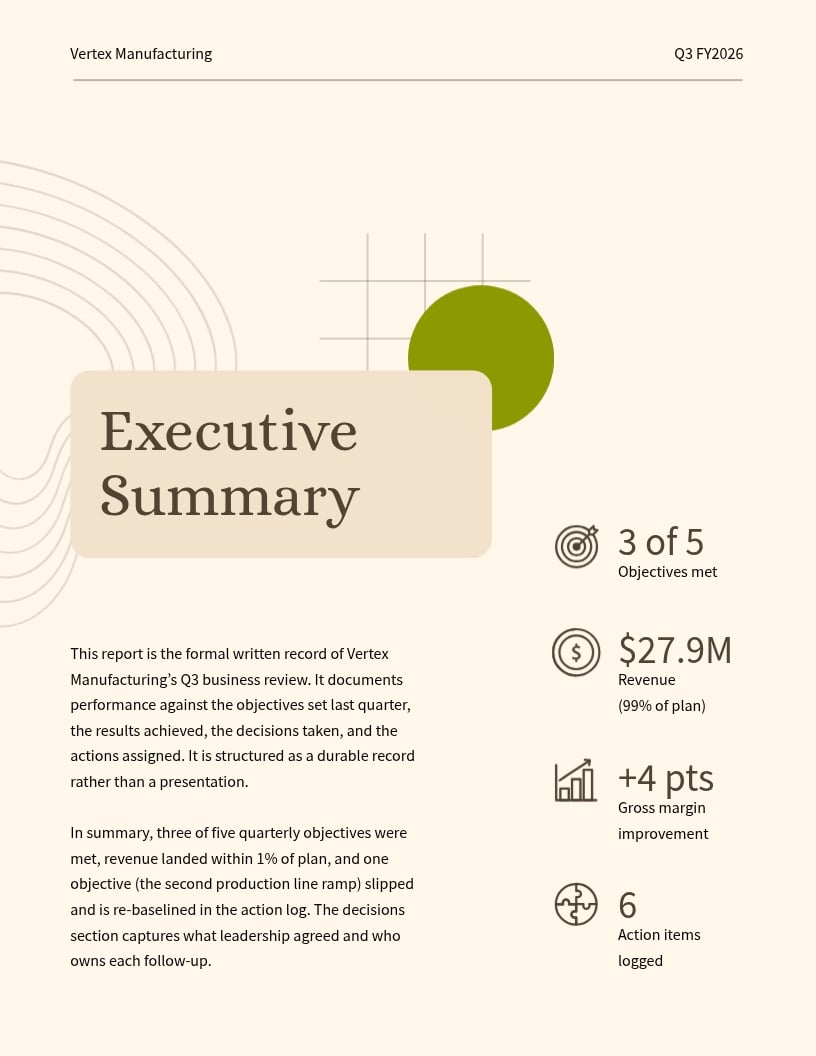
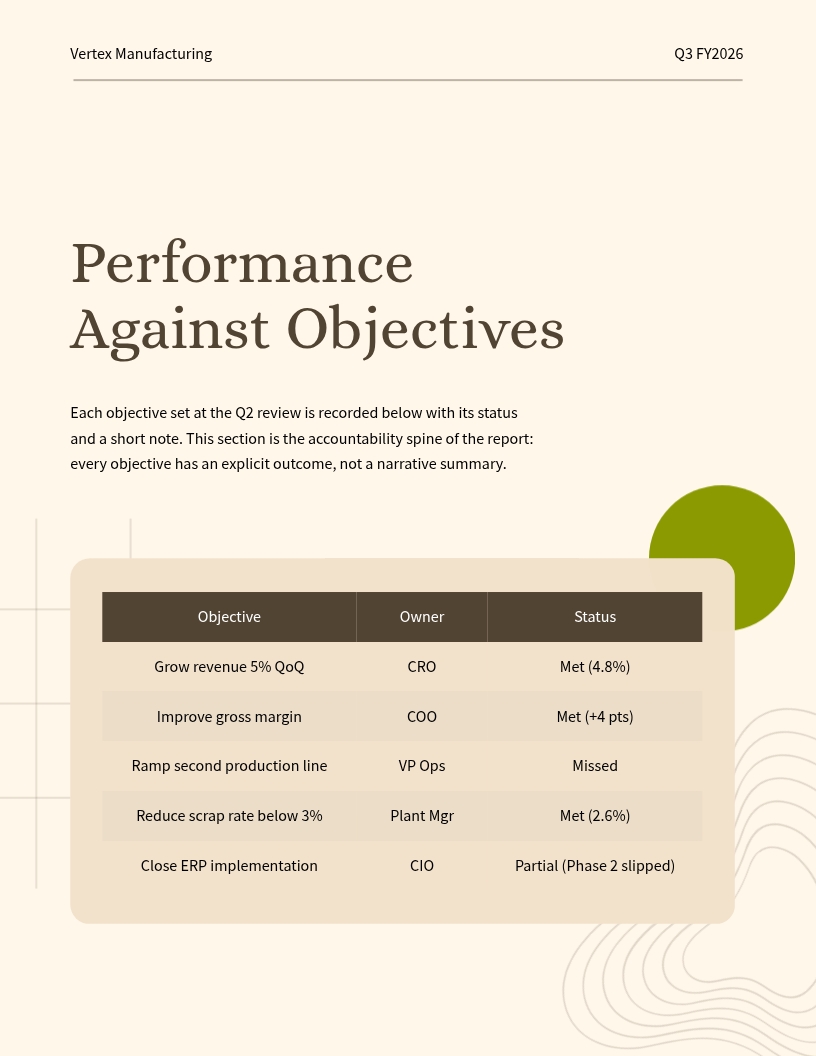
If QBRs are where your cleanup piles up, start every account from the same structure. The QBR Report Template gives account teams a seven-page report built for each client's own results. Lock the cover, agenda and brand elements so reps only change the numbers and commentary, then share it as a link or a PDF.
Cleanup gets expensive because the volume never stops. A five-minute fix means nothing on one document and costs a day across fifty, and most of that content still has to fit one customer, site or audience.
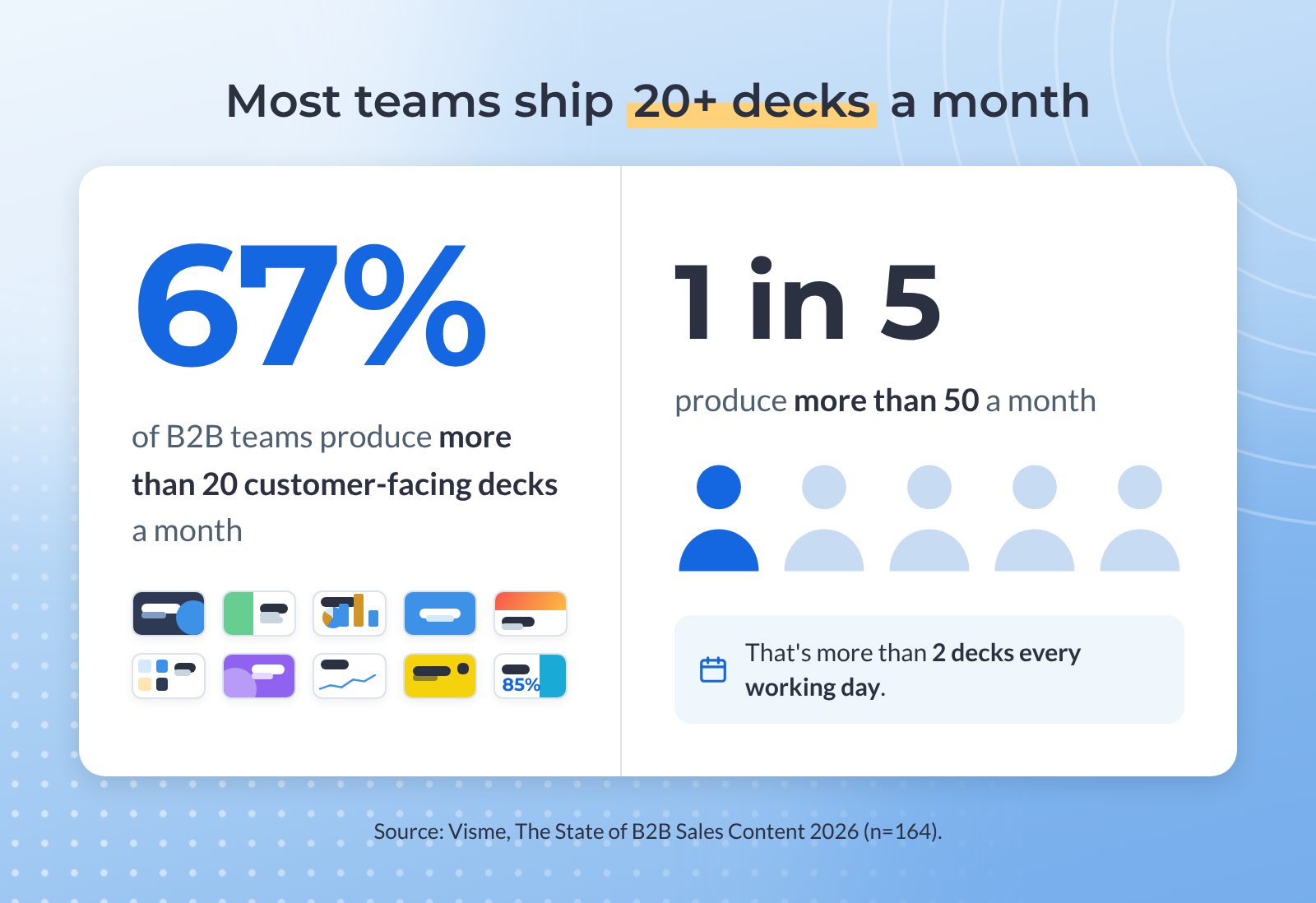
According to Visme's 2026 survey, 67% of teams produce more than 20 customer-facing decks a month, and about one in five produce more than 50. L&D and operations teams also maintain SOPs, onboarding guides and training materials on top of that.
Ask teams what a workable AI tool looks like and their answers rarely start with speed. One manager in the survey said that, “A truly practical AI content tool would need to produce accurate, brand-consistent content with minimal editing, while integrating smoothly into our existing workflow and collaboration tools.”
Accuracy comes first on that list for good reason. A slow draft costs an afternoon. A wrong customer metric, an outdated policy in a training course or last year's pricing in front of a customer costs far more. Our breakdown of how teams speed up sales content production covers the volume data in more depth.
AI content governance matters because it lets a whole organization use AI output, not only the person who made it. It covers five areas: approved data and messaging, brand consistency, access and permissions, review and approval, and version control with visibility into what was shared.
I follow the new AI connectors closely, and they make it easier to plug AI into company data. That helps with context. It also raises the stakes, because the AI can now reach contracts, customer records and HR files.
Take a Customer Success team preparing QBRs for 50 accounts. AI can help one account manager build a deck faster. The organization still needs every deck to use the right customer data, approved claims and consistent branding, and it needs to know which version each client saw.
That's the gap between individual productivity and organizational adoption. The account manager clears the first threshold on day one. The company only clears the second when governance covers all 50 accounts.
A written policy closes part of that gap. Use this Policy One Pager Template to put your AI content rules on one page: which tools are approved, which data they can use, which templates are locked and who signs off before anything reaches a customer. Share it as a link so everyone works from the current version.
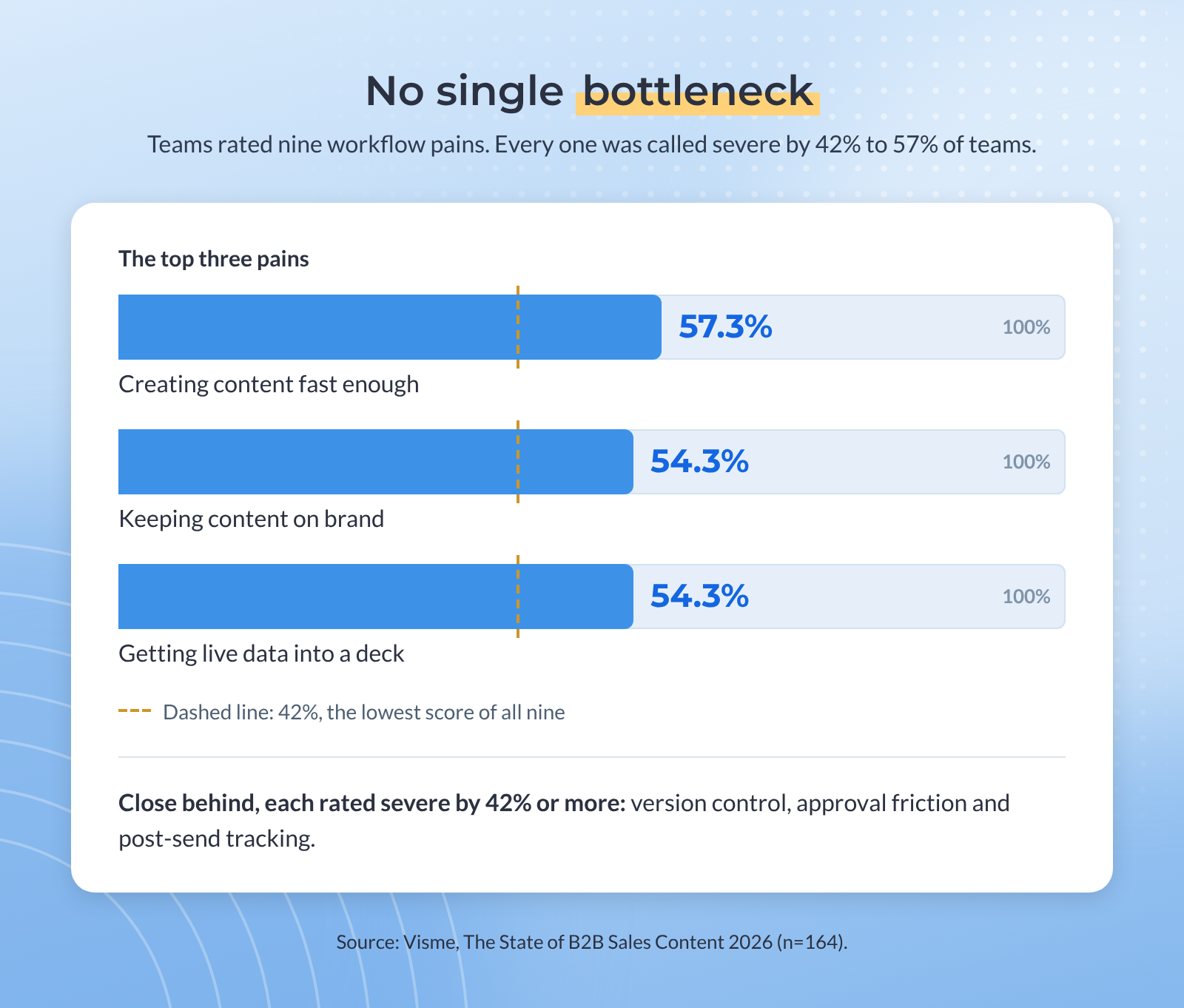
Visme's survey shows why speed alone won't fix this. Teams rated nine workflow pains, and between 42% and 57% called each one severe. Creating content fast enough led at 57.3%, but governance pains such as version control, approval friction and post-send tracking sat close behind.
Whether the asset is sales enablement content, a QBR or a training course, the team needs to know which version is current and where it went. Version control, approvals and tracking are governance problems, and a faster draft doesn't solve them.
Test it on a document your team produces every week, then score the result against these five questions.
For the last two questions, the Compliance Audit Checklist Template is a two-page checklist you can adapt to your AI content review: approved sources used, brand check done, final version logged. Duplicate it for each review cycle so the record stays in one place.
General assistants like ChatGPT or Claude are great for research and first drafts, and many teams use them every day. For content a whole team sends every week, you also need locked templates that keep layouts on brand, a shared library, access controls and a record of which version went out. [VERIFY]
That's what we're building at Visme: one place where teams create, brand, share and track customer-facing content, from sales decks and QBRs to training and process documents. It works alongside the AI tools your team already uses.
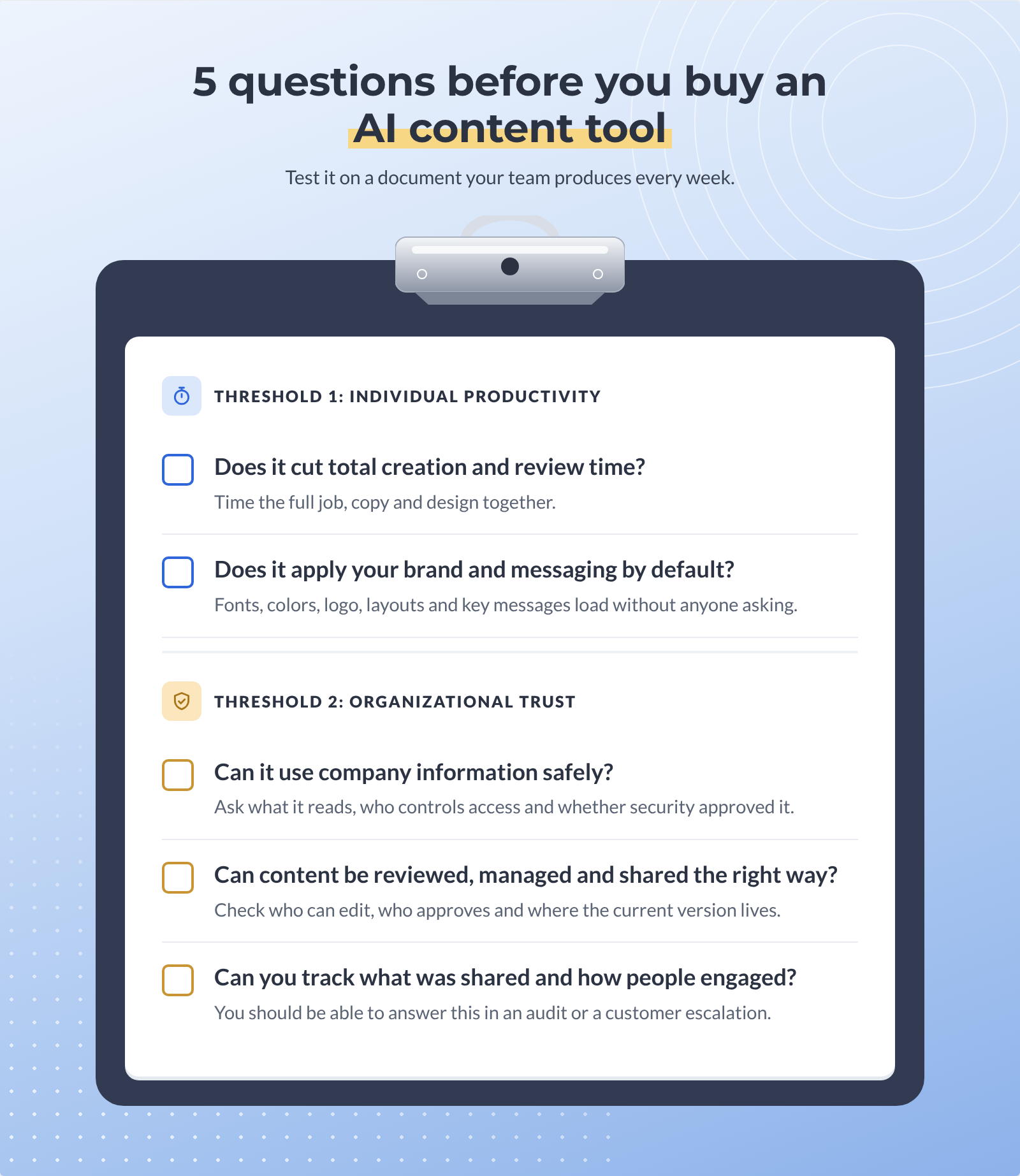
Here's how it maps to the checklist:
Your brand can only load by default if it's written down first. Start with a Brand Guidelines Template to help you get it all documented. This one gives you 11 pages for logos, colors, fonts and icons. Fill it in once, then add the same colors and fonts to your Brand Kit so templates and AI drafts pull from one source.


ChatGPT and Claude work well for one-off decks. For decks a whole team sends every week, you also need locked brand templates, a shared library and a way to see which version went out. Visme’s Claude connector lets teams that draft in Claude finish and share those decks in Visme with their brand applied.
It can be, if the tool runs inside your company’s security rules. Check what data it can access, who controls permissions and whether your security team has approved it.
AI content governance is the set of rules and tools that control what AI produces for your team. It covers approved brand elements and templates, approved facts, data access, version control and who can send what to customers.
Individuals adopt AI tools that save them time. Organizations adopt them when they trust the output. Visme’s 2026 survey found 65.3% of B2B content leaders would likely or definitely adopt an AI tool that uses their brand, tone, data and past results.
Individual adoption is when an employee uses AI because it makes their own work faster. Organizational adoption is when the company trusts AI output enough to use it across teams and customer-facing work. That takes accurate data, consistent branding, permissions, approvals and version control.
AI has made it easier than ever for one person to produce content fast. But individual productivity and organizational adoption aren't the same thing. For businesses producing customer-facing content at scale, the work goes past the first draft. Every piece has to be accurate, consistent, approved and ready to share.
Productivity makes AI useful to an individual. Trust, built on AI content governance, makes it practical across an organization. Businesses need both to get the value AI promises.
Want the full data? Download the State of B2B Sales Content 2026 report to see how 164 teams create, personalize and track customer-facing content.
Supercharge your content creation and designs in minutes with the power of the AI Designer.
Try for Free