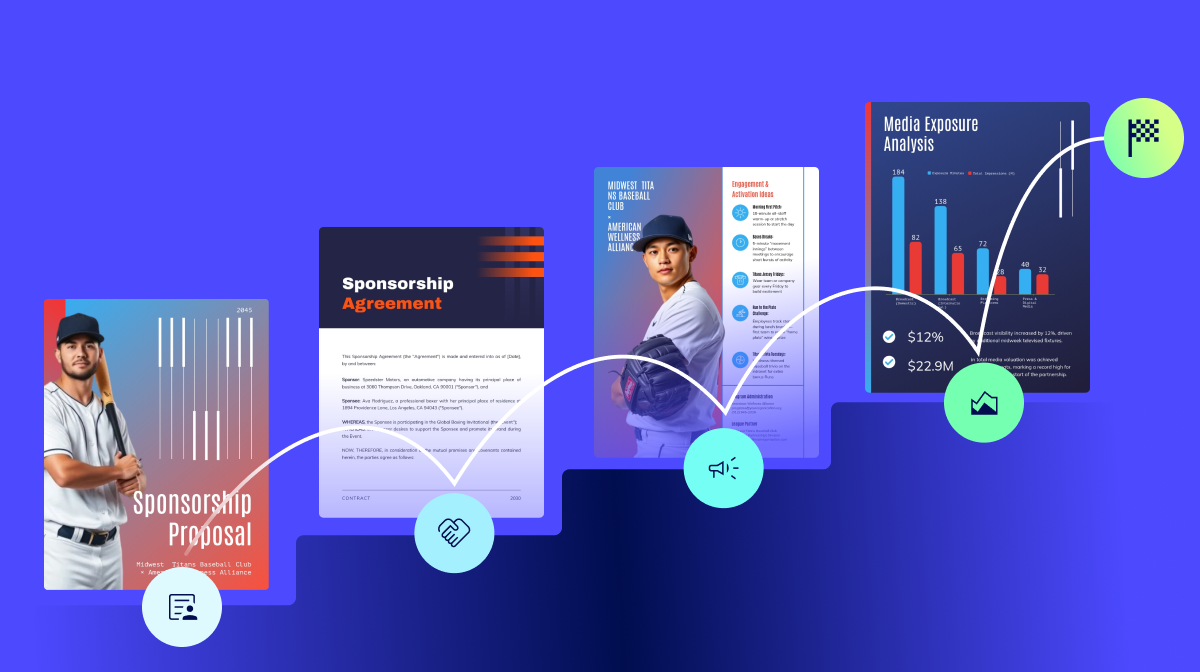


A Quick Guide on Sponsorship Marketing: Best Framework, Examples & Tools


A sponsorship package can make or break your next deal.
It’s the first thing a potential partner evaluates before committing, and if it doesn’t communicate the value, audience fit and ROI, there’s a high chance you might not even get a callback.
Sponsors are willing to spend more than ever right now, but they also expect more. And what they expect most is clarity: what they’re getting, who they’ll reach, how they’ll activate and why the investment is worth it.
For event organizers and event planners running in-person or hybrid events, the easier it is for them to understand all this, the easier it’ll be for them to justify the investment.
In this article, I’ll round up five sponsorship package examples across different industries and break down what makes each one a hit. I’ll also walk you through a clear framework for structuring your own packages and show you how you can create, customize and scale sponsorship packages using tools like Visme.
Let’s get started.
Before we get into the examples, let’s talk about what separates a winning sponsorship package from a losing one. Here are the ingredients you’ll find in most successful sponsorship packages used by experienced event management teams:
Sponsorship packages that open with the company’s backstory (mission, vision, values, leadership bios, timelines) are starting on the wrong foot. Sure, sponsors need to know who you are, but they don’t need your origin story on the first three pages.
A successful sponsorship package flips the script. It speaks directly to sponsors about how the partnership will reach their target audience, hit their KPIs and justify the investment back to their leadership team.
Who’s attending? What do they care about? What’s their purchasing behavior?
A package that says “we reach a diverse audience” means nothing, but the one that says “68% of our attendees are decision-makers in B2B tech with an average annual budget of $500K+” gives a sponsor something to work with.
As Chris Baylis, founder of The Sponsorship Collective, puts it: “Everything has to start with audience data and experiences focused on creating value for audiences. Most people think of sponsorship as simple logo placement, which could not be further from the truth.”
Sponsors shouldn’t have to decode your package to figure out what they’re getting. Each tier needs clearly defined deliverables, pricing and a logical step-up in value.
If someone can’t glance at your tiers and immediately understand the difference between them, the structure needs reworking.
In fact, the best sponsorship packages don’t lock sponsors into rigid tiers at all. They give sponsors the freedom to choose what matters to them.
As Chris Baylis also notes, “Your sponsorship package should be designed more like a menu. If they want a little bit of Column A and a tad more of Column B, that should be their right.”
Larry Weil, also known as The Sponsorship Guy, echoes this: “Do not send out the same ‘Platinum, Gold, Silver’ levels to everyone. Customize. If you have spent time understanding their needs, you probably won’t need different levels.”
Here’s a quick side-by-side look at a well-structured sponsorship package and one that’s much harder for sponsors to scan.
The good:
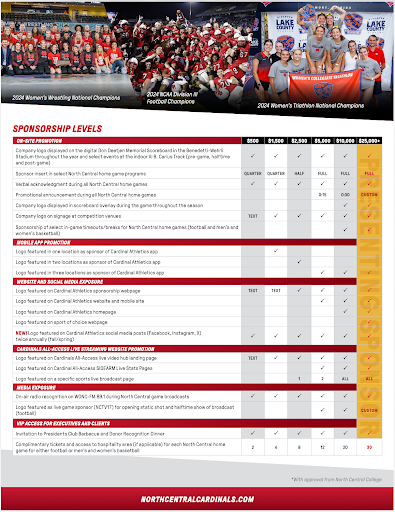
The North Central Cardinals sponsorship package makes the tiers easy to scan and compare. Each column clearly shows what perks sponsors get at different investment levels, and the checkmarks make it easy to spot which benefits are included.
A sponsor can glance at the table and immediately see what they’re paying for and how the value increases.
The bad:
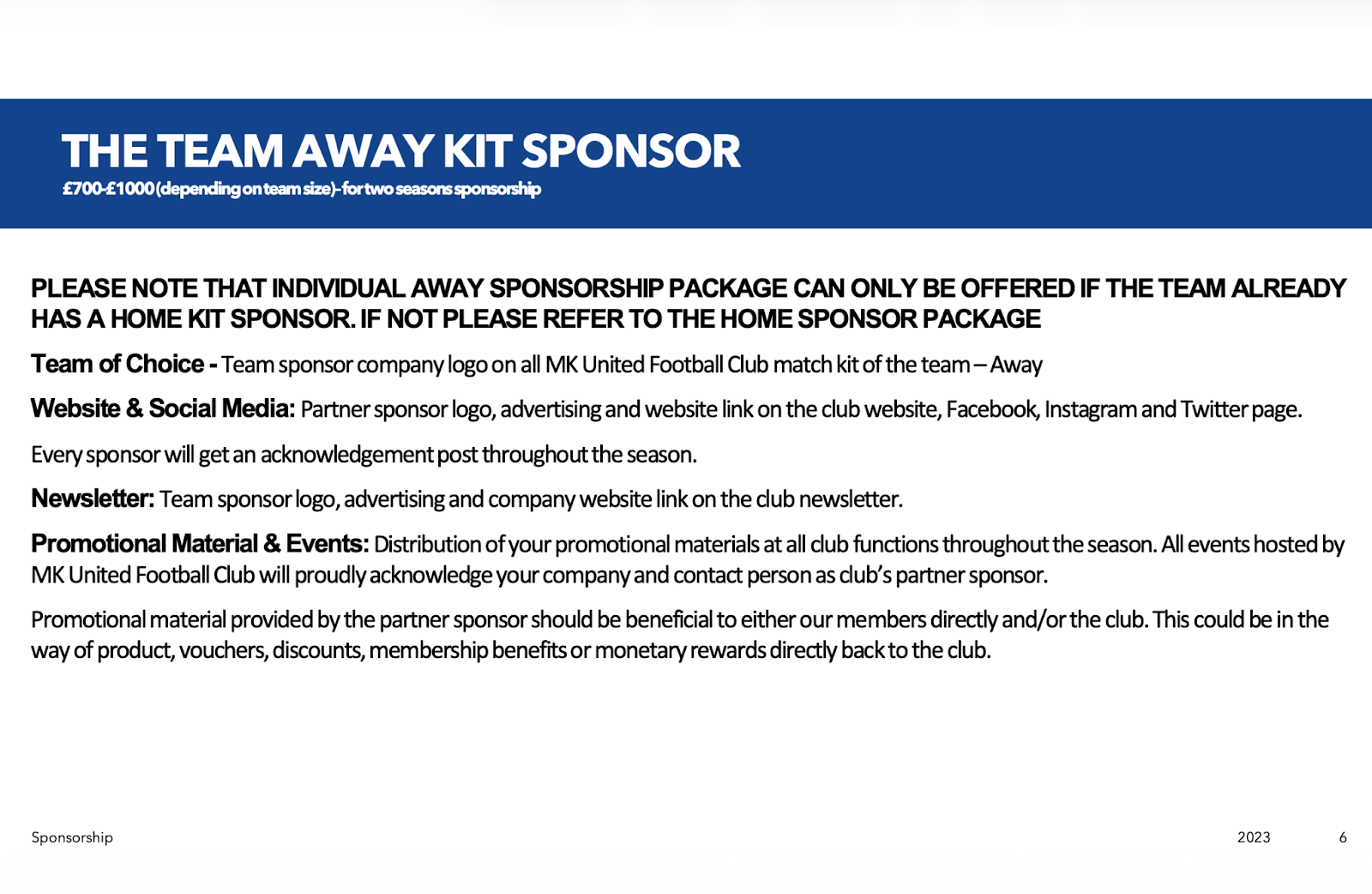
The MK United sponsorship package is much harder to evaluate at a glance. There are no tables, icons or visual cues; just walls of text that sponsors have to read through to understand what they’re getting.
And to compare different tiers, they have to go through the entire document.
An event sponsor's logo on a banner is table stakes. What sponsors really want to see is how they can activate. Can they host a branded lounge? Run a co-branded content series? Get a speaking slot, host a live streaming segment or gain exclusive access to attendees?
The more you can show what the partnership looks like in action, the easier it is for a sponsor to picture themselves in it.
This one sounds obvious, but it matters more than people give it credit for.
A sponsorship package is inherently a sales document. If it’s a messy PDF with inconsistent fonts and pixelated logos, it’s going to deter any potential sponsor from seriously considering your opportunity, no matter how good your offering is.
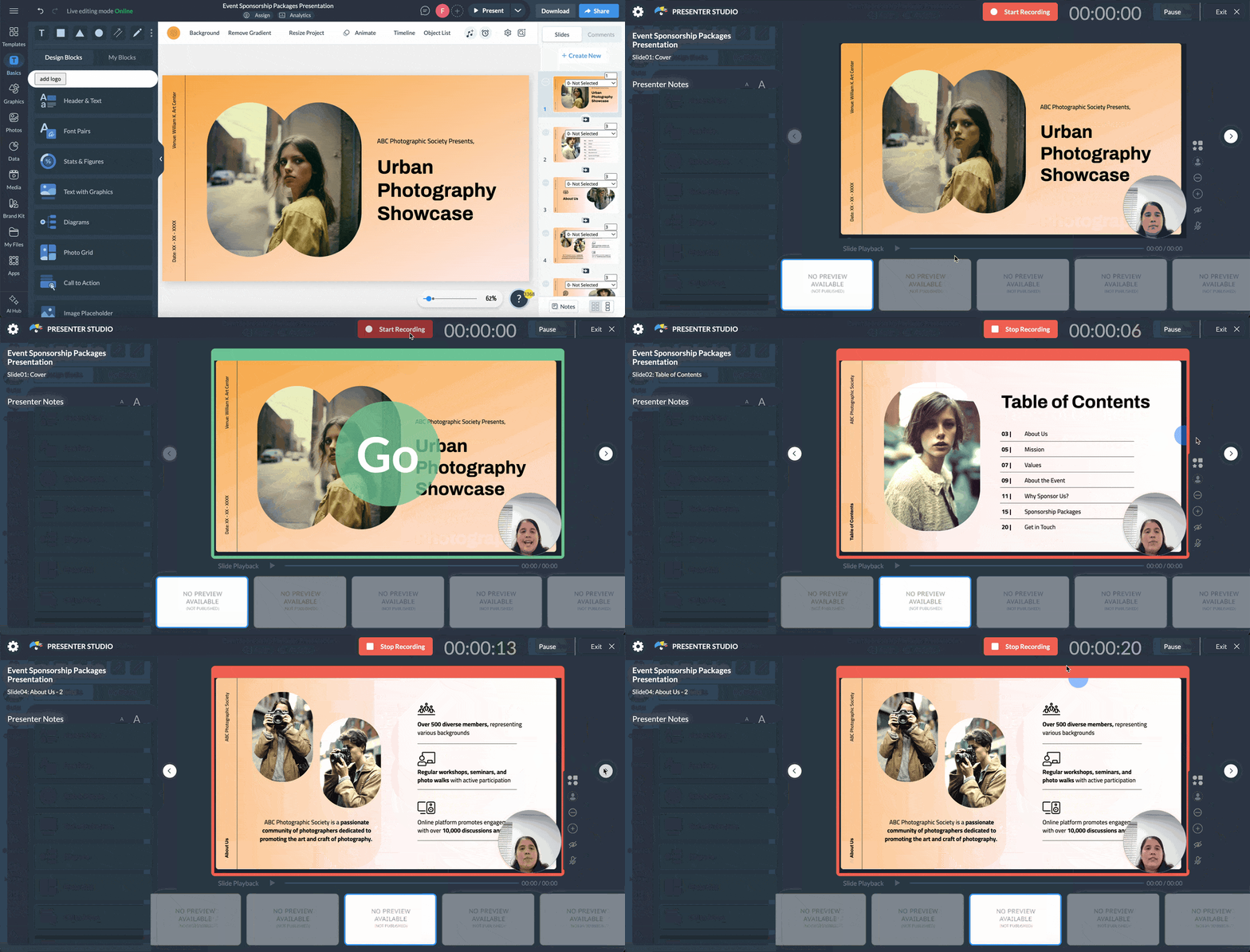
Clean, simple design, consistent branding and an easy-to-navigate content layout will win over any prospect before you even get on a call. And if you’re pitching remotely, use Visme’s presentation recording feature to walk sponsors through the package asynchronously. This adds context and personality to the proposal in a way a static file simply can’t.
In short, don’t give them any reason to lose confidence in your professionalism before the conversation starts.
Pro Tip: When organizing and promoting your events, share the sponsorship deck as a trackable link so you can see who’s engaging before you follow up. It’s also a good idea to promote sponsorship opportunities on LinkedIn, where many event planners, brands and potential sponsors actively look for partnership opportunities.
Now let’s see how these principles show up in real sponsorship packages across different industries.
From global trade shows to nonprofit fundraisers to music festivals, here are five sponsorship packages and case studies that get it right and what you can learn from each one.
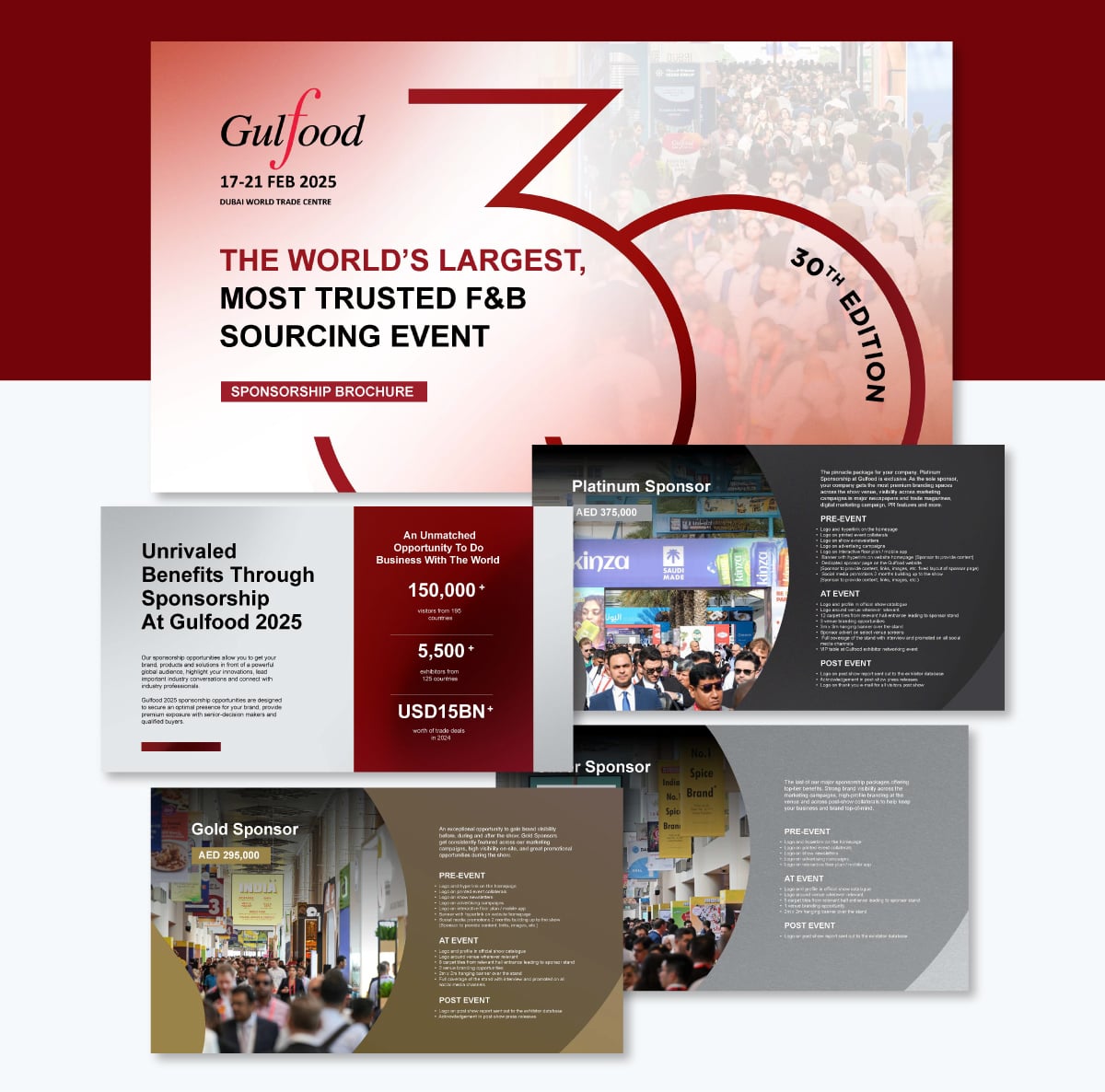
Gulfood is the world’s largest annual food and beverage sourcing event, held at the Dubai World Trade Centre. The 2025 edition (its 30th) brought together 5500+ exhibitors from over 125 countries and 150,000+ visitors from 195 countries. The event generated an estimated $15 billion+ in trade deals in 2024 alone.
Why it works
It opens with hard audience numbers right up front, then rolls into a layered sponsorship menu with a wide range of options.
Beyond the tiered packages (Platinum, Gold, Silver, Category Sponsor), it covers everything from an AED 500,000 Country Partner package down to standalone sponsorships for specific touchpoints: registration areas, visitor badge lanyards, carrier bags, mobile app branding, website banners and in-hall promoter staff.
The tiers are designed so a brand doesn’t have to commit to premium tiers to get visibility; it just has to find the touchpoint that makes sense.
Most tiers also break deliverables into three clear phases: pre-event, at event and post-event. This structure gives sponsors a clear picture of how their investment unfolds over time.
Content aside, the design holds up too.
Bold imagery, clean color blocking, consistent layout across every page and clear visual hierarchy make the brochure easy to scan. It closes with direct contact details for the sales team, making the next step obvious.
When building your sponsorship packages, don’t just offer premade tiers and hope one fits. Build a menu of sponsorship touchpoints at different price points so sponsors of all sizes, from global companies to growing startups, can find something that matches their goals and budget. And structure every package around a timeline so sponsors can see exactly when and where their brand fits.
The International Mass Timber Conference (IMTC) is the world’s largest gathering of mass timber professionals. It covers the full industry supply chain from manufacturing to design to construction and is a strong example of an event built around sustainability.
The 2025 edition drew 3,100+ attendees from 29 countries to Portland, Oregon, with 60+ expert presentations across five focused tracks and an extensive exhibit hall.
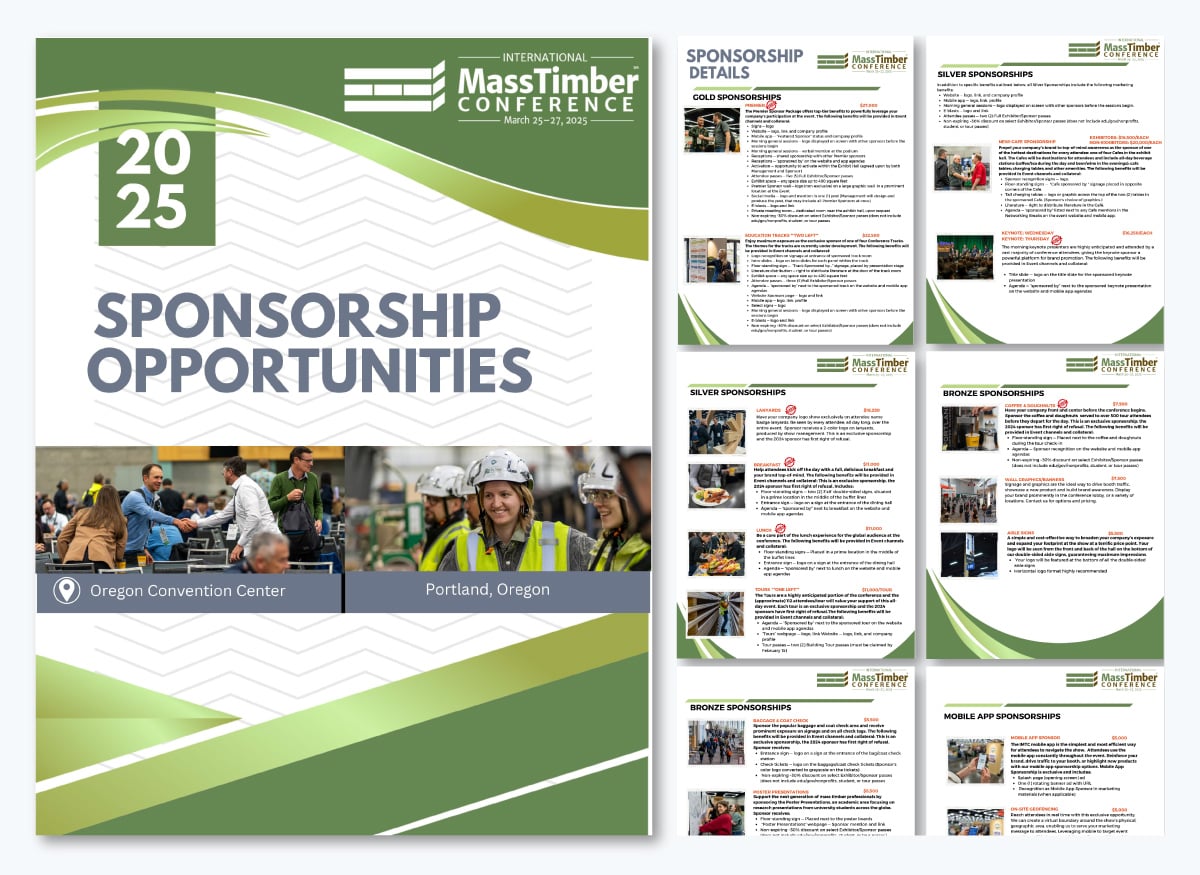
The brochure opens with a full-page spread of data visualizations that represent the previous event’s performance (registered attendees, exhibitor count, industry sectors represented and annual sales of participating companies). This does two things: shows potential sponsors the scale of what they’re signing up for and makes it easier to understand.
The sponsorship options are structured around specific event touchpoints rather than abstract tier labels. Sponsors can choose from education track sponsorship, cafe sponsorship, keynote brand exposure, swag, lanyards, aisle signs, escalator clings and even coffee and doughnut branding.
So there’s something for everyone, and each listing spells out exactly what the sponsor gets and whether the opportunity is exclusive.
It also helps that the conference audience is deeply niche. A room full of architects, engineers, developers, manufacturers and construction firms means very little wasted reach.
One last detail worth calling out is that the brochure closes with a two-page index table listing every option, its category, exclusivity and price. A small addition, but it makes it easy for sponsors to compare everything side by side without flipping back through the full document.
Wherever possible, use data visualizations to break down otherwise complex or number-heavy information. Paragraphs are fine, but if all your brochure contains is blocks of text, you’re making sponsors work harder than they need to.
And while it may not work for every sponsorship package, it’s worth considering rounding up all your offerings in a summary table so sponsors can compare everything in one view.
South by Southwest (SXSW) is one of the world’s most recognized annual festivals. Stars from film, TV, music and comedy descend on Austin, Texas every March for nine days of panels, premieres, performances and parties.
The 2025 edition alone drew 309,000+ participants from 95 countries and 50+ industries, with 3,400+ conference speakers, 1,100+ music acts, 500+ film and TV screenings and 175+ participating brands.
Their 2026 marketing deck is unlike others on this list, but it’s a strong example of how to structure sponsorship offerings for an exclusive, large-scale, multi-audience event.
The deck opens with credibility. Before it gets into any sponsorship details, it dedicates several pages to audience data:
For a sponsor evaluating whether this audience is worth the investment, the answer is right there on the page.
What sets SXSW’s approach apart is how it segments sponsorship opportunities by audience and format rather than just by price. In fact, there’s no mention of pricing anywhere in the deck. Interested sponsors must reach out to the SXSW sales team directly, which makes sense given the level of customization each package entails and the scale of the event.
Premium sponsorships are broken into distinct categories: headlining sponsorship, major innovation sponsorship, major film & TV sponsorship, major music sponsorship etc. Each one targets a specific community within the broader SXSW ecosystem, so sponsors aren’t paying for blanket exposure across an audience that may not be relevant.
Beyond premium tiers, the deck lays out a wide range of promotional opportunities to showcase the sponsor’s brand, organized into four clear categories: brand visibility, events and activations, programming and exhibitions. This gives sponsors of all sizes a clear menu of options based on their goals and budgets.
Each package is also explicitly positioned as customizable. The deck emphasizes that brands can work with the SXSW team to build a program tailored to their specific marketing goals, which is a smart move for a festival of this size.
Content and sponsorship details aside, the design of this deck is brilliant too. Data widgets, icons, high-resolution photography (it helps that many feature recognizable faces), clean content structure and clickable links throughout all make it one of the best sponsorship documents you’ll come across.
This may not apply to every event, but if yours spans multiple audiences and verticals, consider segmenting your sponsorship packages by audience type rather than just by price.
And don’t tie value to cost alone. Lead with audience data, purchasing power and activation potential so sponsors can see what they’re getting before they ever see a number.
Plus, when it comes to design, stay up to date with current trends. Use color psychology, play with layout, add clickable links and data widgets where they make sense. At the very least, your sponsorship deck should be an experience in itself, one that compels sponsors to reach out before they’ve even finished reading.
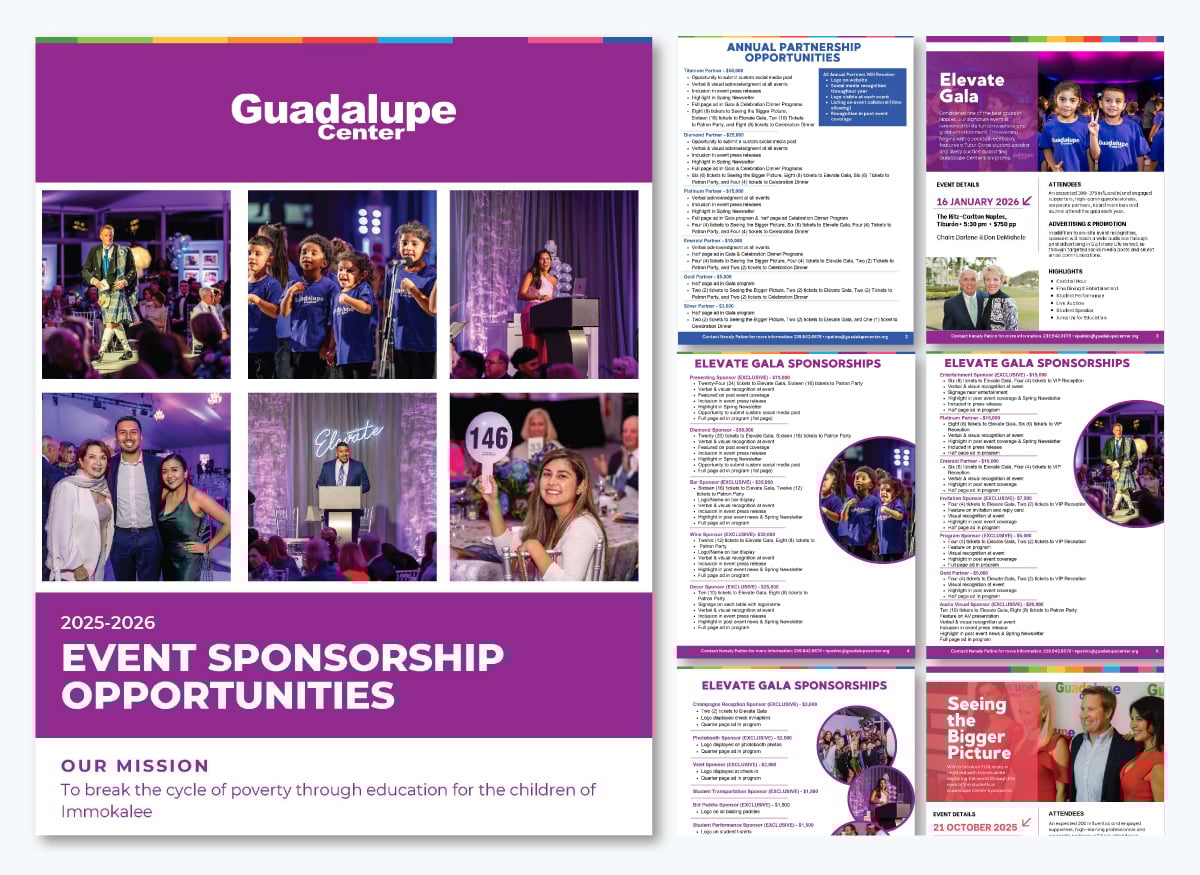
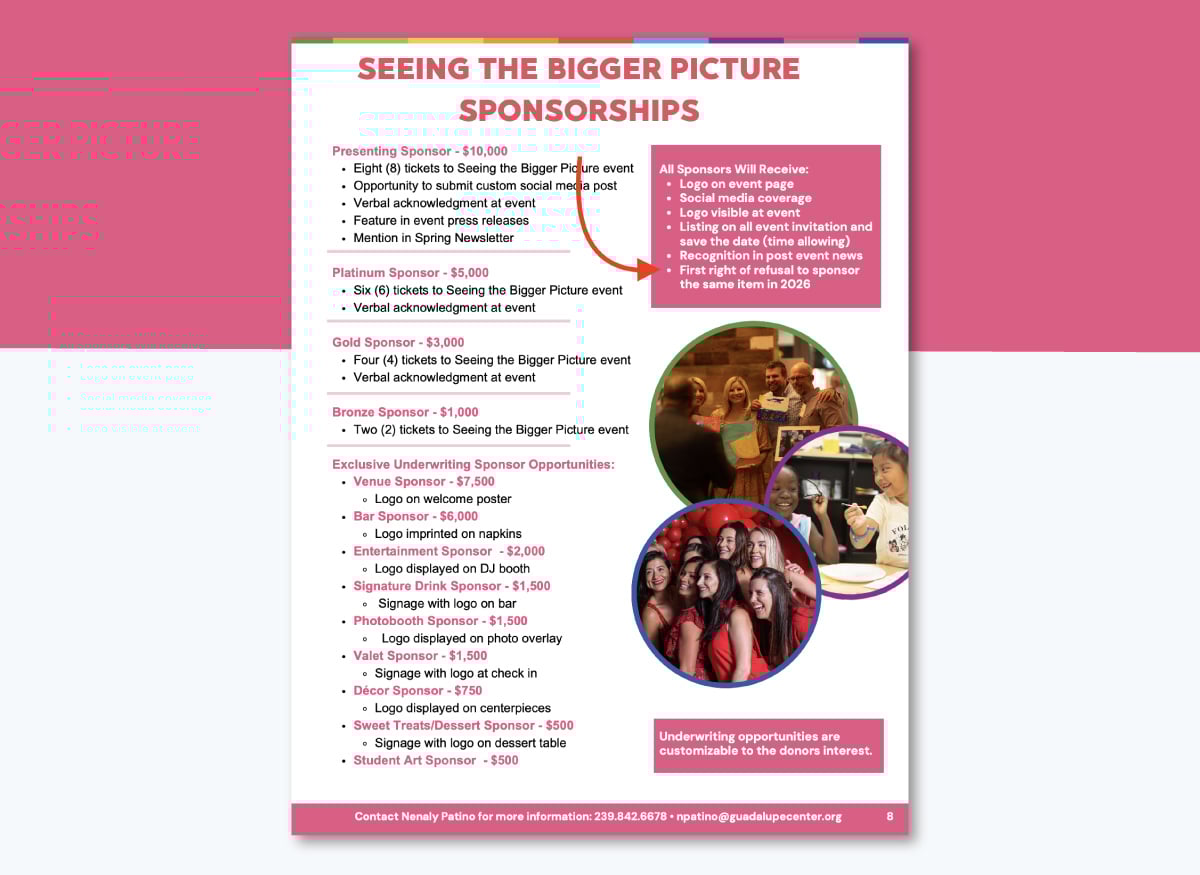
Guadalupe Center is a nonprofit in Immokalee, Florida, with a mission to break the cycle of poverty through education.
It serves 2,000+ students across 5 locations and employs 300+ staff members. Their 2025-2026 event sponsorship packet focuses heavily on impact, community engagement and social responsibility. This deck is a strong example of how smaller nonprofits can structure sponsorship packages across multiple events with limited resources.
Why it works
The packet opens with a clear mission statement and a short overview of the organization’s impact, then moves straight into sponsorship opportunities.
One quick thing to note here is that, unlike many sponsorship packages that lead with community and reach numbers, Guadalupe Center saves those for the end. Could they have worked at the beginning? Maybe. But they definitely close strong.
I like how the packet structures sponsorship at two levels. First, there are annual partnership tiers that give sponsors visibility across all events throughout the year. Then, each individual event has its own tiers and types of sponsorship and exclusive underwriting opportunities.
Since this is a year-round sponsorship packet covering multiple events, the team has broken it down into clearly defined sections. Each event gets its own pages with individual dates, venue, expected attendees, a brief overview and specific sponsorship tiers.
Lastly, the design works well for a nonprofit of this size. Relevant images from past events bring the mission to life; you get clickable email links and QR links, the color palette is consistent and the layout keeps things easy to scan without feeling cluttered.
Recommended for you: 10 Real-Life Event Sponsorship Examples & How to Win Sponsors.
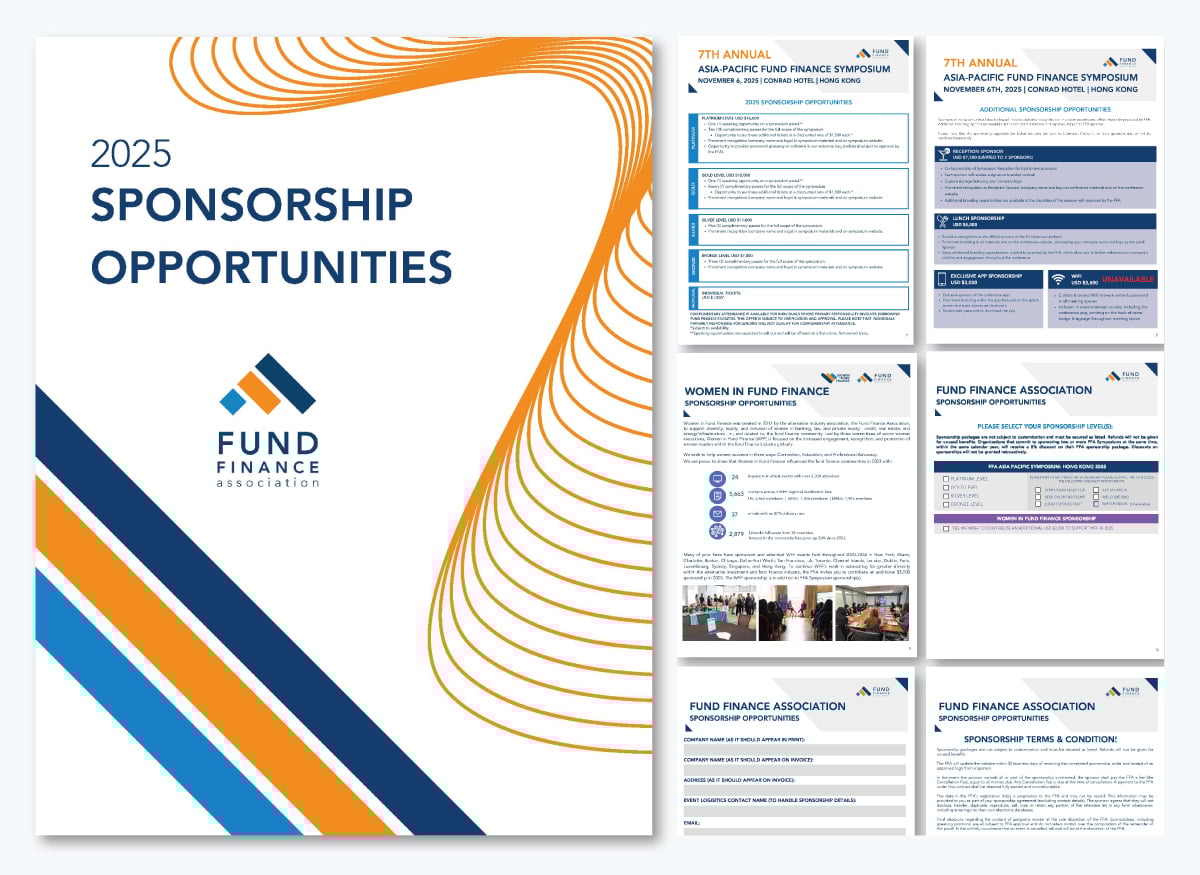
The Fund Finance Association (FFA) is a nonprofit industry association in the fund finance market. It runs annual symposiums across three regions: Global, European and Asia-Pacific. Their 2025 sponsorship brochure covers the 7th Annual Asia-Pacific Fund Finance Symposium, held at the Conrad Hotel in Hong Kong.
This brochure doesn’t waste time. There’s no lengthy preamble about the organization or the event’s history. It opens with the symposium name, date and venue, then goes straight into the sponsorship tiers. Each tier spells out exactly what’s included: number of complimentary passes, speaking opportunities, logo recognition and discounted ticket options.
Apart from the standard tiers, sponsors also get an additional layer of touchpoint-specific add-ons: reception, lunch and event app sponsorship.
A cool detail here is that these add-ons are restricted to Diamond, Platinum or Gold sponsors only. They can’t be purchased separately. That’s a smart incentive to commit at a higher level if you want access to the more visible branding opportunities.
My favorite part, though, is how the brochure closes. There’s a sign-up form where sponsors can tick boxes to select their tier, check off any specialty add-ons and fill in their company details and contact information right on the page. Terms and conditions get a dedicated page too.
There’s also an abundance of icons throughout the brochure, making the content easy to scan.
Not every sponsorship brochure needs to be 20 pages. If your audience is niche and already understands the value of your event, keep it tight.
Lead with clear tiers, add touchpoint-specific opportunities for higher-level sponsors and make the sign-up process as frictionless as possible.
The examples above cover different industries, budgets and formats, but they all share a common thread: they make it easy for a sponsor to say yes. So what exactly should go into yours?
Whether you’re building a sponsorship package template from scratch or refining one you already have, here are the core sections every package should include.
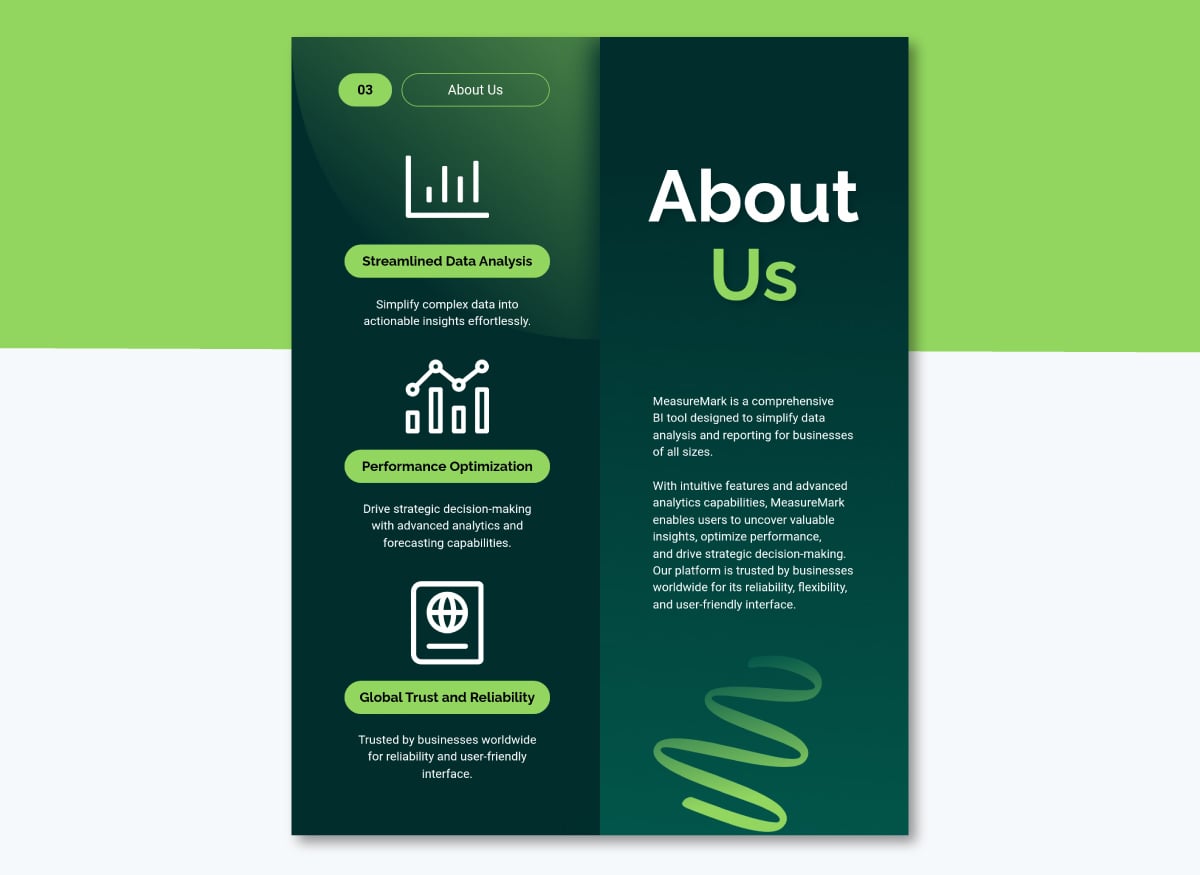
Yes, we said don’t lead with your origin story. But that doesn’t mean you skip it entirely. Sponsors still need to understand who you are, what the event is about and why it exists.
Keep it short and sweet: a brief introduction to your organization, the event’s purpose, a few lines on your mission and what makes this partnership opportunity unique. One page, maybe two. Then move on.
Check out how this Visme sponsorship proposal template does it:
READ MORE: 12 Impressive Sponsorship Proposal Templates + A Writing Guide.
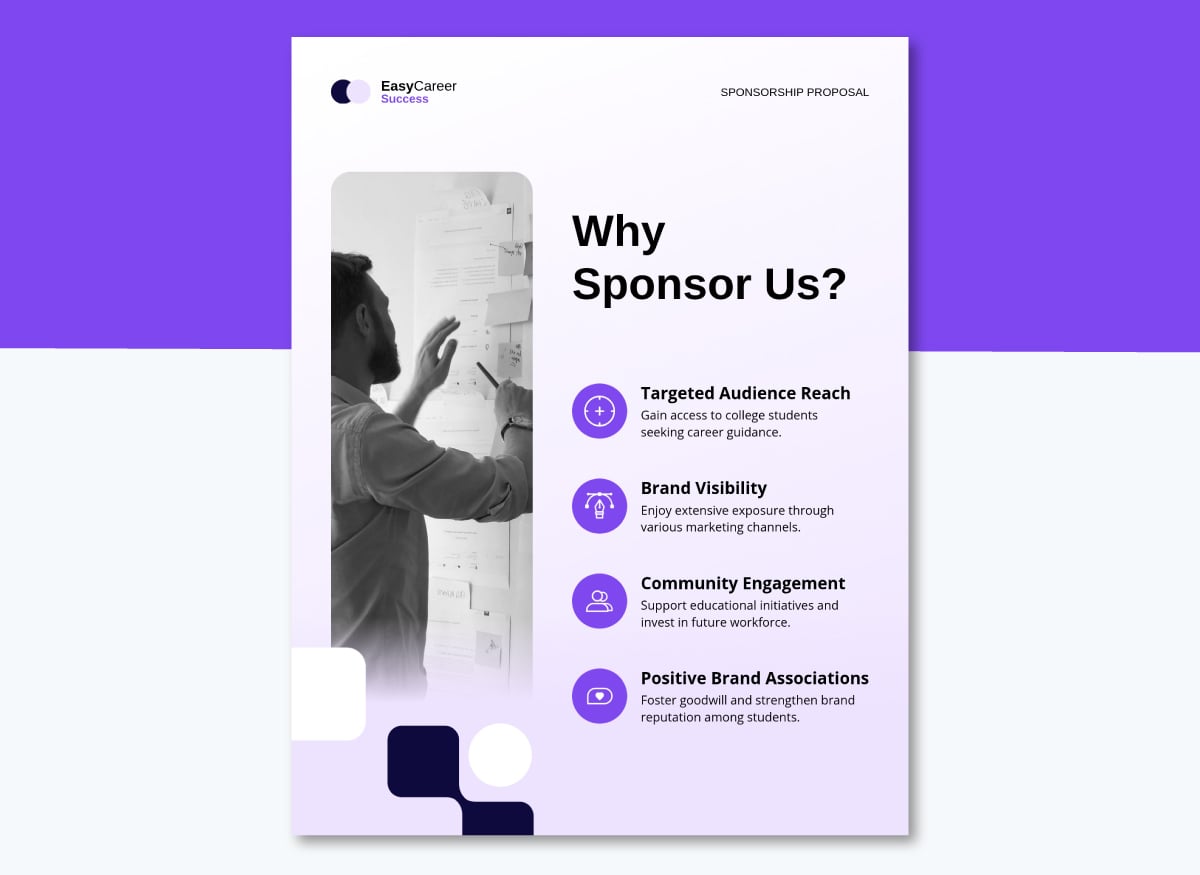
This is the foundation. Sponsors want to know exactly who they’ll be in front of: demographics, job titles, purchasing power, geographic reach, industry breakdown. The more specific, the better.
Don’t just say “our audience is engaged.” Show them the numbers. If you saw how SXSW and IMTC structured their demographic pages, you already know what good looks like.
Here’s another example of how you can add this to your sponsorship proposals:
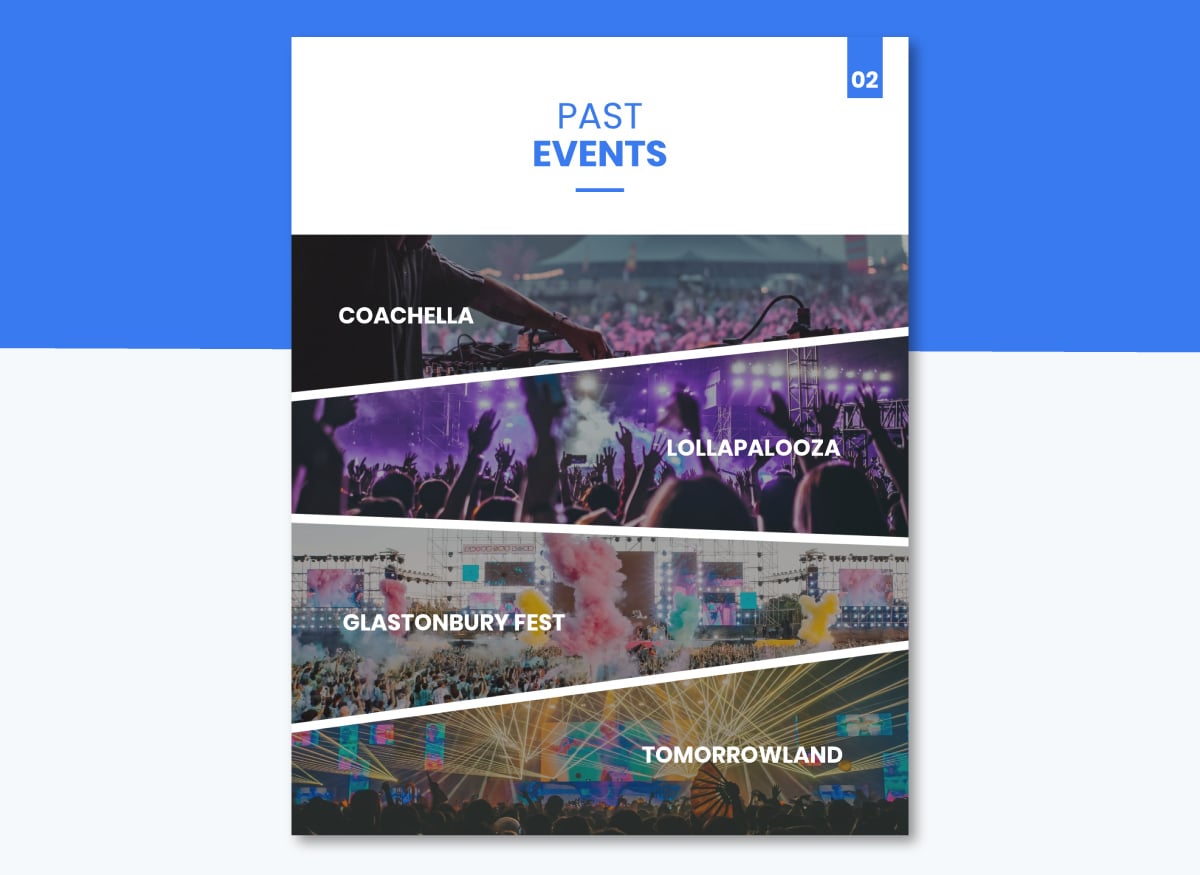
If this isn’t your first event, show what happened last time. Attendance figures, media impressions, social media reach, revenue generated and notable sponsors who participated.
Past performance is one of the strongest signals a sponsor can use to evaluate your event’s credibility.
Here’s a sample of how you can easily add your past events to the proposal:
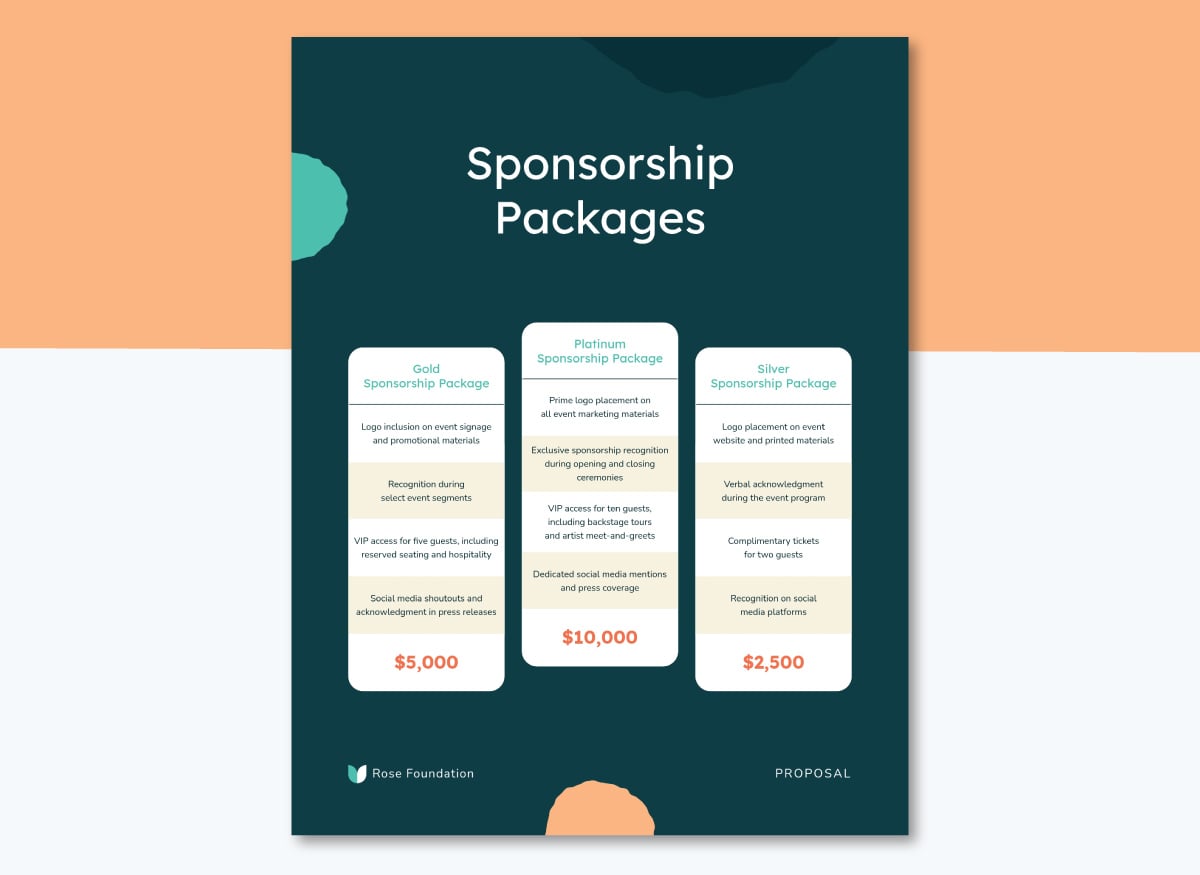
Whether you use tiered sponsorship packages (Platinum, Gold, Silver) or an à la carte menu, make the options clear.
Each sponsorship level should spell out exactly what’s included: number of tickets, logo placement, speaking opportunities, digital branding, exclusivity and anything else that differentiates one tier from the next. If you offer customization, say so upfront.
Here’s a simple way to highlight your sponsorship packages:
Branding options are becoming increasingly creative. Beyond logos on banners and badges, sponsors are now looking for ways to actively engage with attendees.
Think outside the box and consider offering branded lounges, co-hosted events, interactive attendee experiences, product sampling, speaking slots, networking events, photo booths, exclusive promotional materials, signage, app integrations or even gated virtual events. What you can offer will obviously depend on your event’s size, format and budget, but the point is to give sponsors something more tangible than a logo.
Outline what the sponsorship activation looks like at your event so sponsors can picture how they’ll show up.
Sponsorships increasingly extend beyond the event itself. Can sponsors contribute a guest blog post, co-create a video series, feature in a podcast episode or be highlighted in post-event content?
If your package includes content collaboration, detail it. This is especially valuable for sponsors focused on thought leadership and brand awareness.
When does branding go live? When do materials need to be submitted? When will the sponsor see their logo on the website, in email campaigns or on printed materials?
A clear timeline builds confidence and reduces back-and-forth. The best packages (like Gulfood’s) break deliverables into pre-event, at-event and post-event planning phases so sponsors know exactly what happens and when.
Sponsors need to justify their spend. Include what kind of reporting you'll provide after the event: impressions, reach, engagement metrics, attendance data, lead generation numbers, social media mentions. Even a simple post-event recap can go a long way and actually drive renewals.
How do sponsors continue the partnership beyond one event? Include information about multi-year discounts, first right of refusal, loyalty incentives or expanded packages for returning sponsors. Guadalupe Center’s first-right-of-refusal approach and the FFA’s 5% multi-symposium discount are both good examples of this in action.
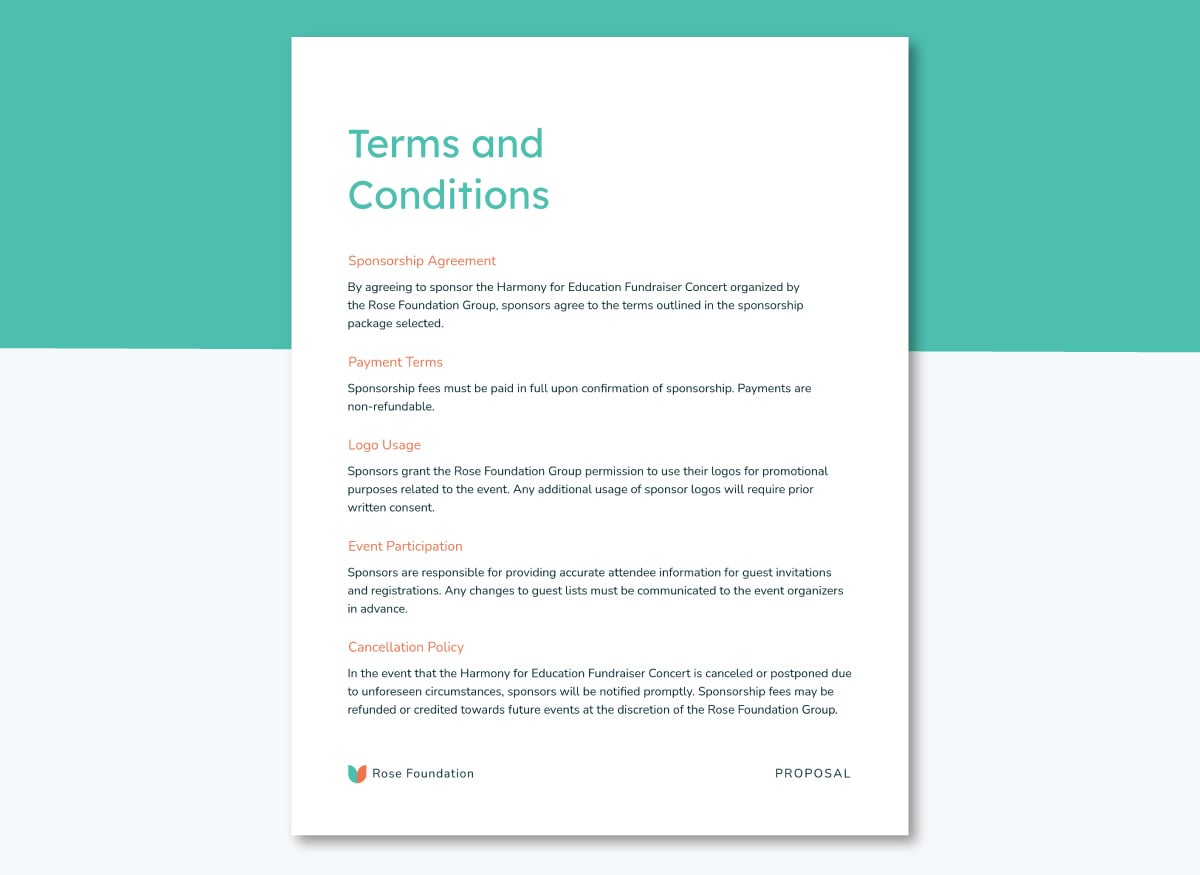
The next important section you should consider adding to your sponsorship package is the terms and conditions. The purpose of this is not to leave logistics to a follow-up email.
Include a section that covers cancellation policies, payment terms, deadlines, usage rights and any other relevant conditions. The FFA’s brochure does this well, closing with clear terms and a built-in sign-up form that turns the document from something sponsors read into something they act on.
Here’s an example of an agreement page you can draw inspiration from:
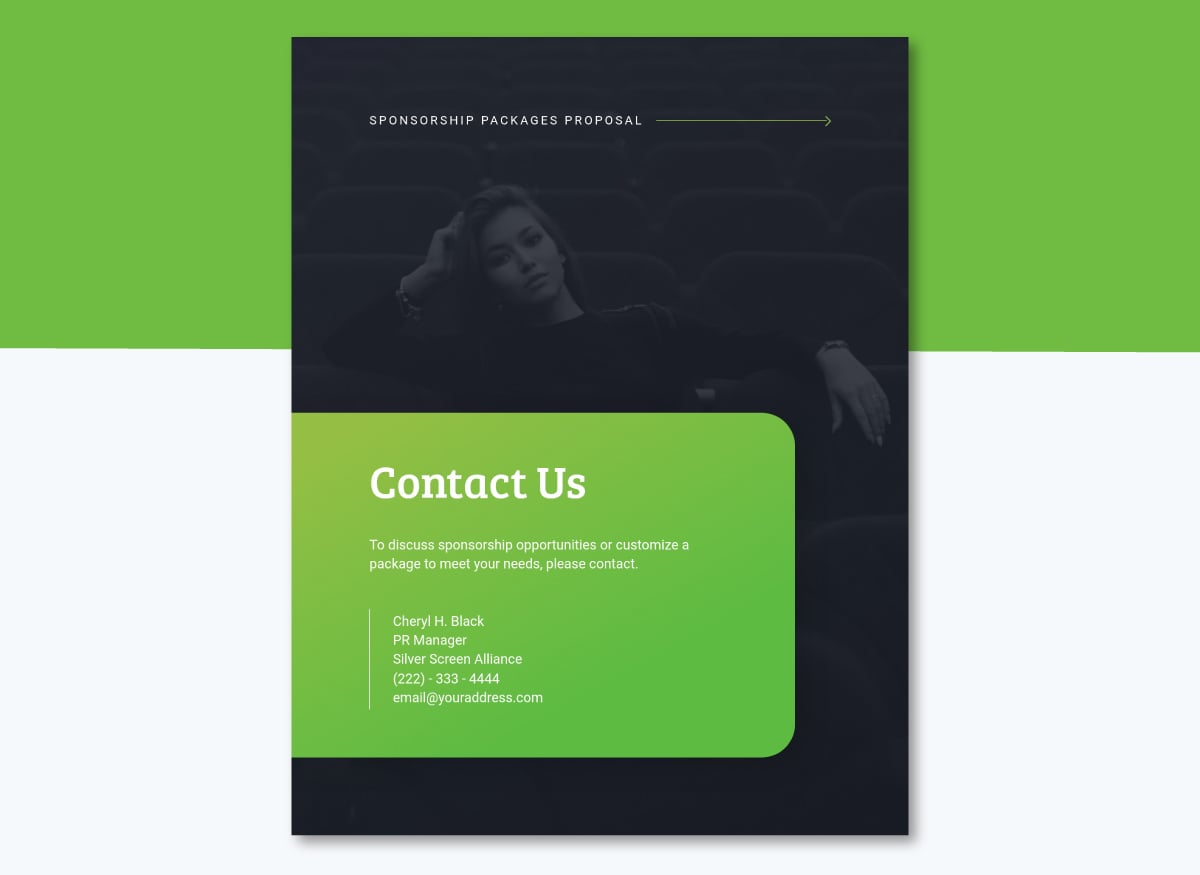
This sounds obvious, but you’d be surprised how many sponsorship packages bury (or completely skip) a clear next step or CTA.
Include a named contact, phone number, email address and, where possible, a direct link or QR code for sign-up. You can even add this to the footer of every page of your sponsorship proposal package.
Here’s a Visme template that uses the contact information to close the proposal:
Need a starting point? Browse Visme’s sponsorship deck templates to see how these sections can come together in real life.
Check out this video to learn everything you need to know about structuring an event sponsorship package deck:
Building one great sponsorship package is hard enough. Now imagine customizing it for every prospect, keeping the branding consistent across departments, getting sign-off from multiple stakeholders and doing it all on a deadline.
If your partnership or marketing team faces the same challenges, Visme is exactly what you need.
Here’s how you can create and scale sponsorship packages using Visme:
Every sponsorship package doesn’t need to be built from scratch. Teams sending out dozens of proposals a season need a professionally designed template that inspires them and gives them a head start.
Visme offers nearly 200 sponsorship templates across various industries, from sports to nonprofit to corporate events, so you can find one that fits your use case and customize from there.
For teams that prefer starting with a blank canvas, that’s an option too. And if scrolling through templates feels overwhelming, you can also use Visme’s AI Designer to generate a fully structured sponsorship deck from a simple text prompt.
Here’s an example of what I made in less than two minutes:
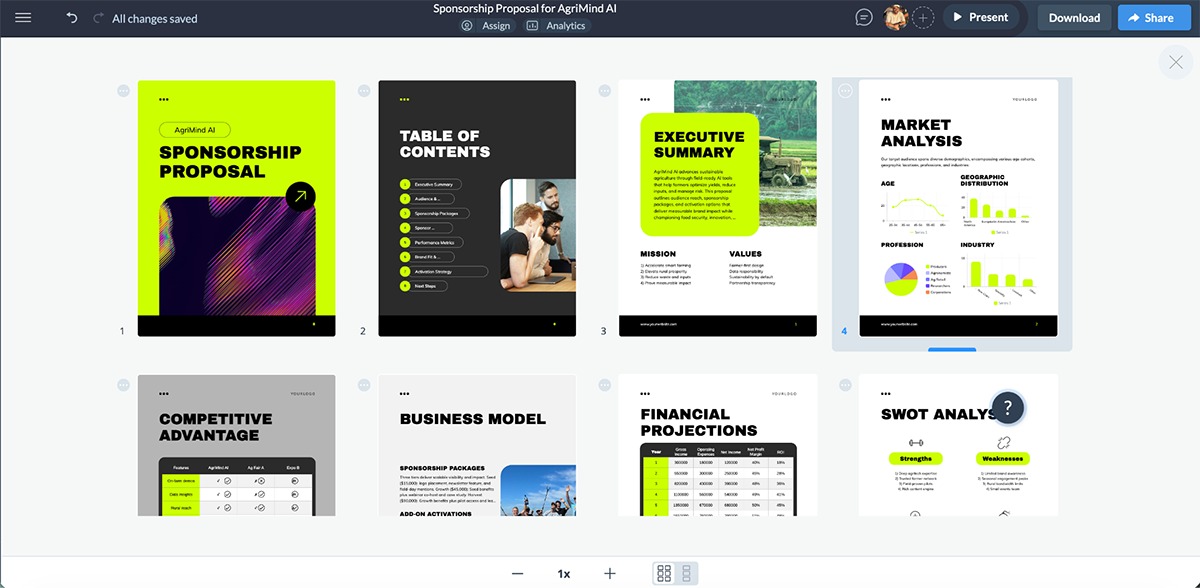
The design and content layout you get from AI is solid on its own, but what makes it better than starting from scratch or even a template is that it writes the copy for you, adds relevant imagery and builds out a logical slide structure in seconds. Plus, the better you get at writing AI presentation prompts, the better your output becomes.
Once you’ve got your template or AI-generated deck, it’s time to make it yours. That means swapping in the right copy, images, data and branding to match each prospect. Here’s how Visme makes each of those easy.
Images/videos: Upload your own event photos or videos if you have them or browse through Visme’s built-in stock photo and video library for high-quality visuals.
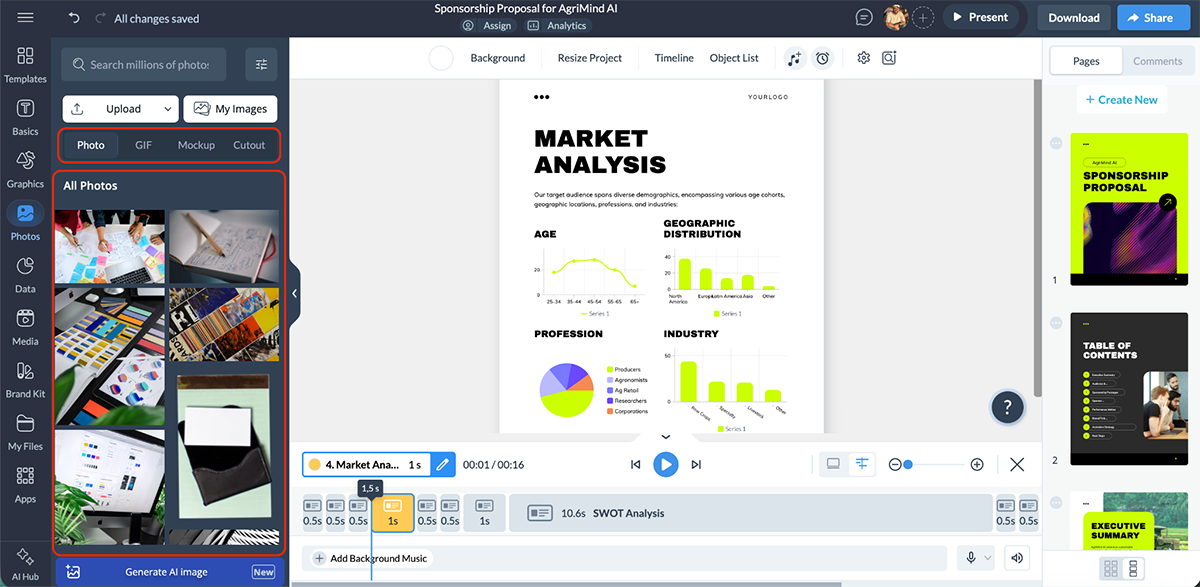
If you can’t find anything you’re looking for, use Visme’s AI Image Generator to create custom graphics from a simple text prompt.
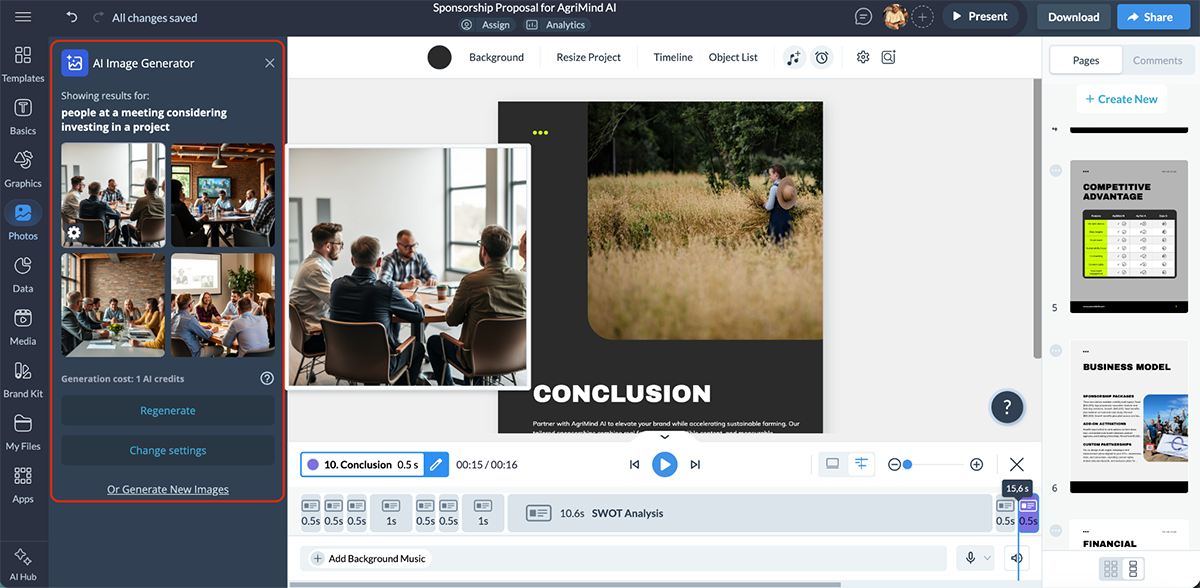
Data: Visme’s data visualization tools offer 40+ chart and graph options to bring your numbers to life.
You can use this to present past event attendees, demographic breakdowns, sponsor ROI metrics, geographic reach and audience purchasing power as clean, visual callouts instead of dense paragraphs.
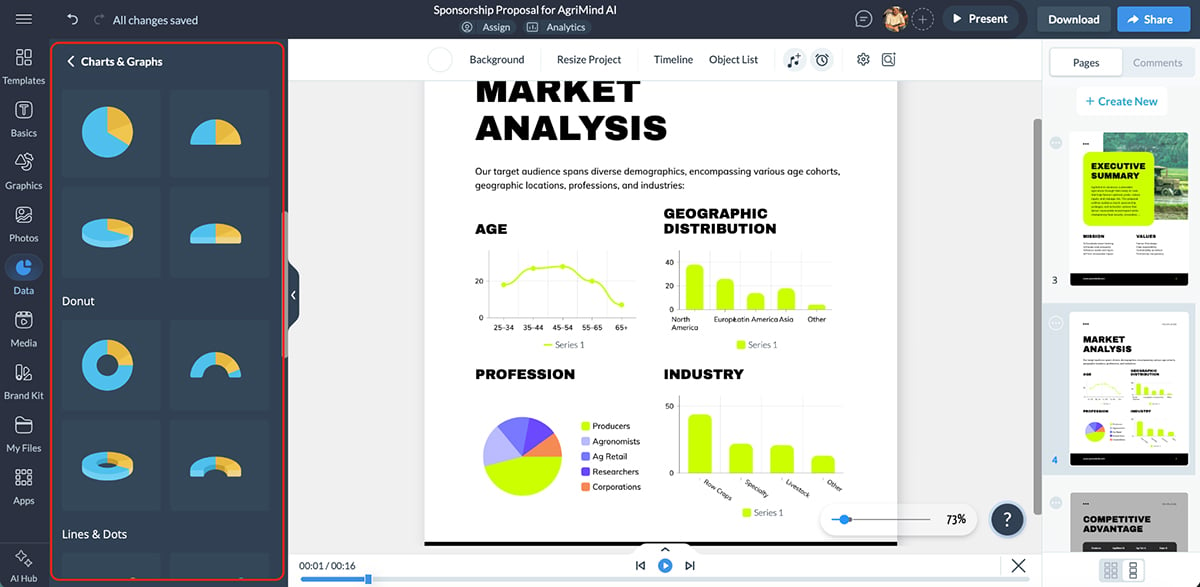
There’s even a 3D chart maker if you want to add an extra layer of depth to your data slides.
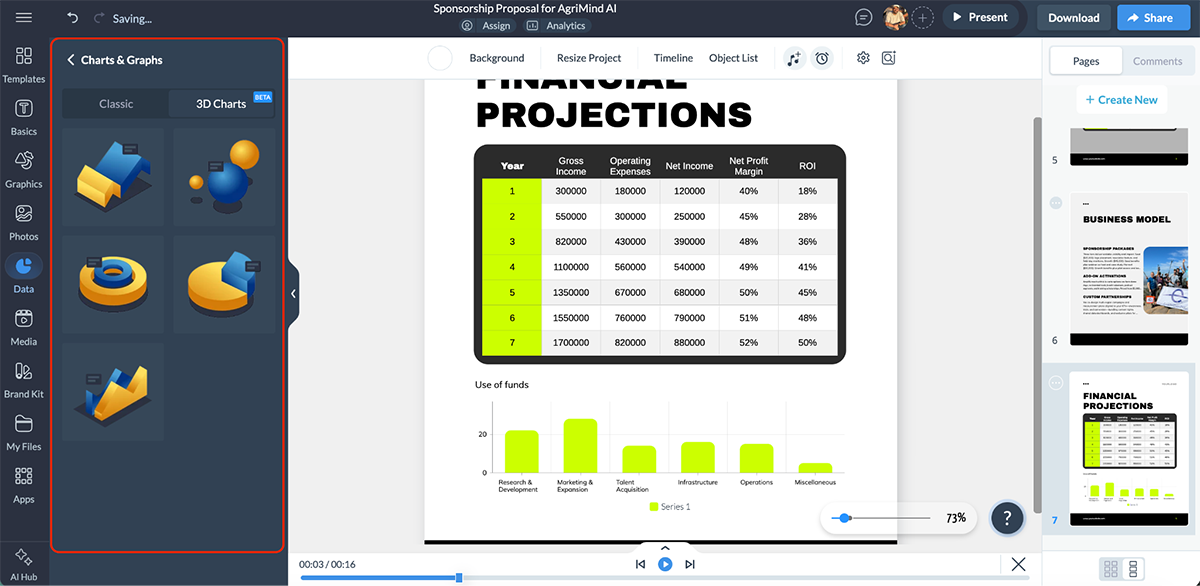
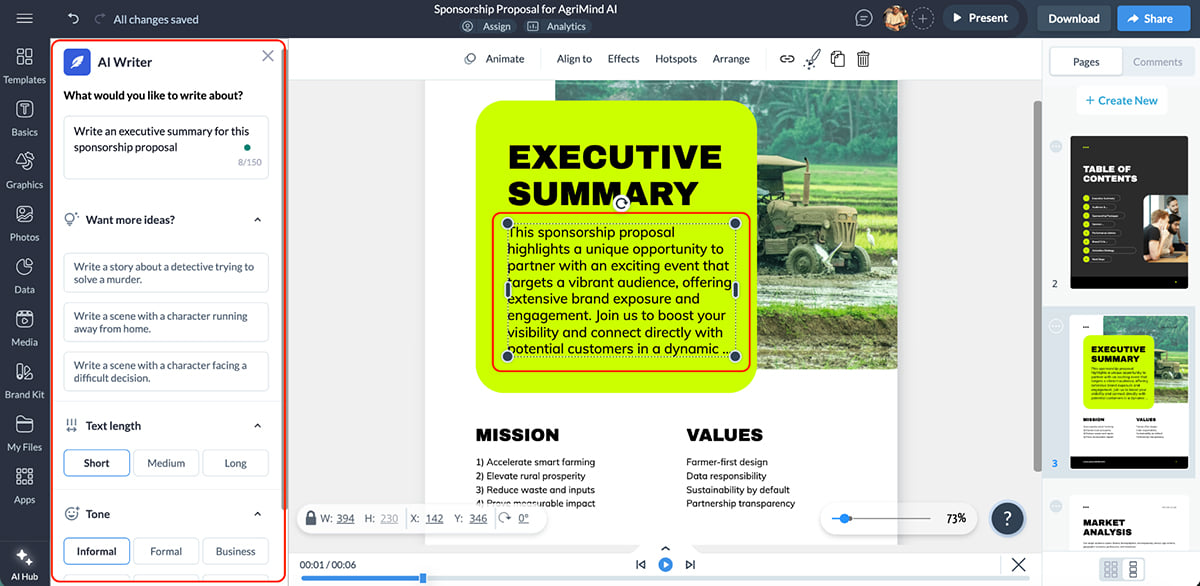
Copy: Instead of manually writing and rewriting sponsorship copy for every deck, use Visme’s AI Writer to generate, rewrite or tone-shift text on the fly.
You can use this to draft sponsor benefit descriptions, tweak activation summaries for different prospects or tighten up your event overview.
Branding: Next, upload your colors, logos, fonts and icons into Visme’s Brand Kit to keep every sponsorship deck on-brand from the first slide to the last.
And if you’re starting fresh or rebranding, Visme’s AI Brand Wizard can pull your brand assets directly from your website and apply them across your projects automatically. Here’s a quick tutorial on how to update brand logos and colors across all projects in Visme.
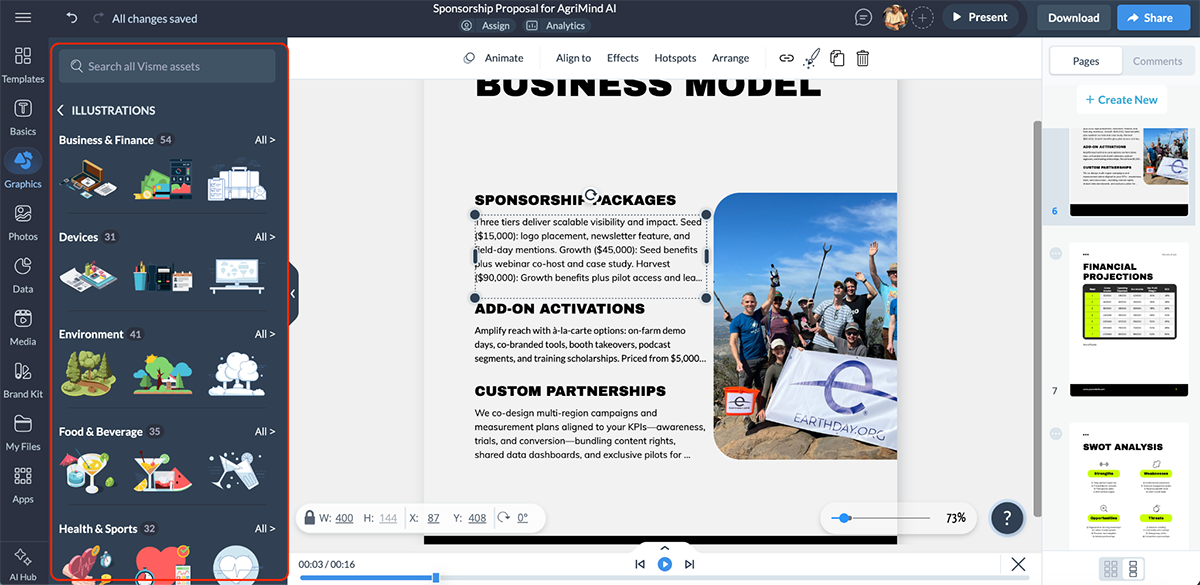
Also, if you don’t have icons or want some cool-looking options, then Visme has got you covered there too. You get access to both static and animated options, shapes, 3D characters, illustrations, gestures, wireframes, avatars and more in Visme’s icon library.
In short, anything you want to change in your doc, you can do it with ease using Visme.
READ MORE: How to Write an Impressive Sponsorship Deck + Best Templates to Use.
If you’re pitching to 20 different sponsors, you don’t need 20 completely different decks. What you need instead is one strong deck with the ability to swap in sponsor-specific details: company name, logo, relevant audience segments, tailored activation ideas.
With Visme’s Dynamic Fields, teams can personalize sponsorship packages for individual prospects without duplicating the entire project every time. Change it once and it updates everywhere across the document.
Sponsorship packages rarely involve just one person. Partnerships, marketing, sales and sometimes legal all need to weigh in. Visme offers some of the most advanced collaboration and workflow features you’ll find in a visual content platform.
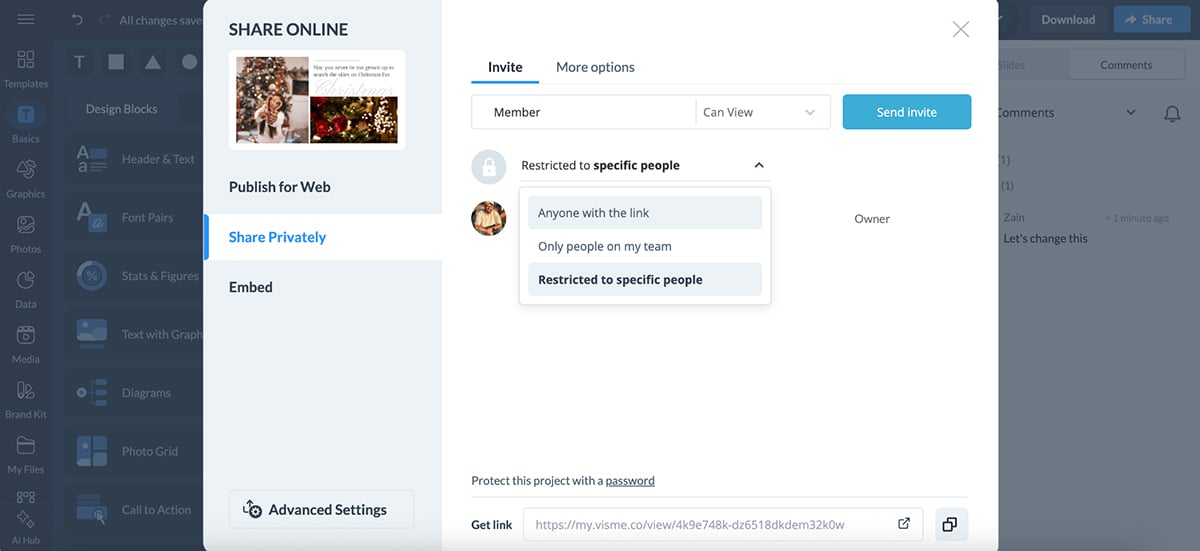
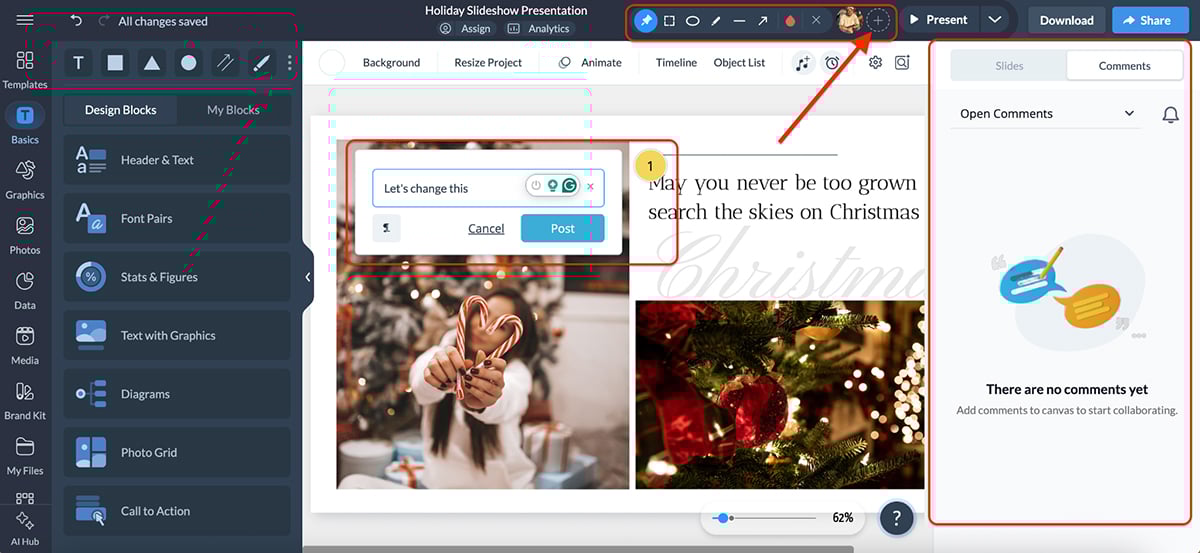
You can invite team members into projects with role-based permissions (viewer, editor or admin), so everyone has the right level of access. Feedback is streamlined too, since teammates can leave comments directly on slides or individual elements rather than sending notes over email.
Where it really shines is in workflow management. You can assign tasks to specific team members, set due dates and move projects through stages like draft, review and approval.
All tasks and deadlines are automatically tied into Visme’s content calendar, giving you a clear, visual overview of where every sponsorship deck stands at any given time.
For partnership and marketing teams juggling multiple sponsor pitches at once, this means fewer bottlenecks and faster approvals.
Recommended for you: A Quick Guide on Business Collaboration: Best Practices, Types & Tools You Should Use.
Different sponsors prefer different formats. Some may want a downloadable PDF, while others may prefer a link they can click through or a PowerPoint file they can share internally.
Visme offers various sharing and publishing options. You can export your sponsorship package as a PDF, PPTX, image or shareable link with optional password protection, so you’re never stuck reformatting at the last minute.
The work doesn’t stop once the deck goes out. Teams that close more deals track what happens next: who opened the deck, how long they spent on it, which pages they lingered on and whether they shared it internally. These insights help you follow up smarter and refine your approach for the next prospect.
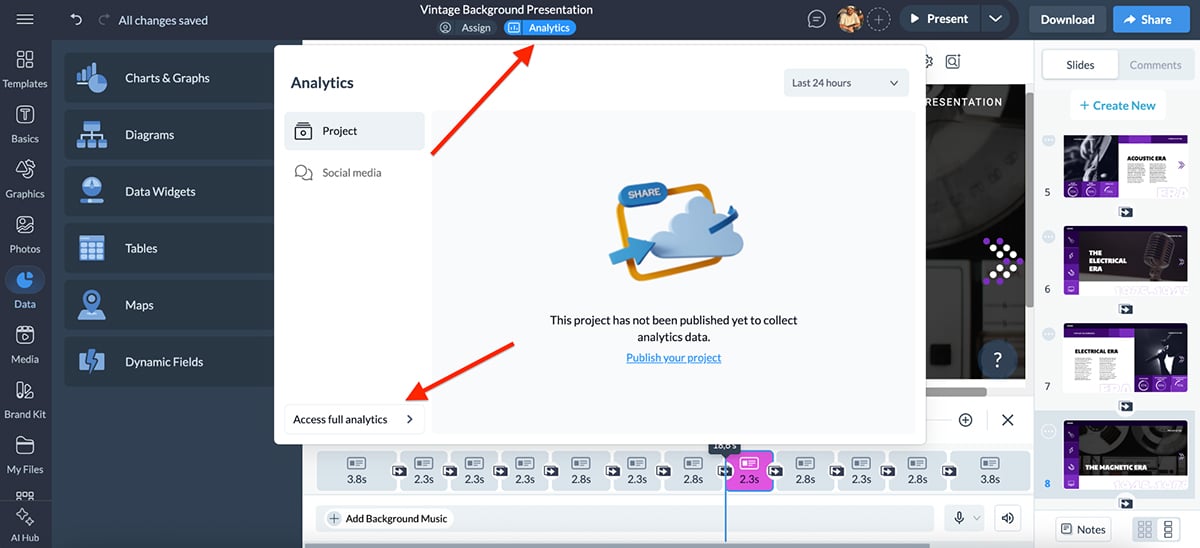
Visme’s built-in analytics let you track views, average time, unique visits, completion rates and more for any document published using Visme’s share button.
Pro Tip: Once you’ve onboarded a sponsor, consider signing a sponsorship agreement with them to keep everything recorded. A formal agreement protects both parties by clearly outlining deliverables, payment terms, timelines, usage rights and cancellation policies, so there’s no room for misunderstanding down the line.
All in all, it doesn’t matter if you’re a business looking to land its first sponsor, a sports marketing team pitching season-long partnerships or an event team selling conference sponsorship opportunities; the process is the same: build once, customize quickly and stay on brand at scale and track everything.
A sponsorship package is a document that outlines the benefits, pricing and opportunities available to potential sponsors of an event, organization or initiative. You can also think of it as a sales pitch in document form, one that’s designed to show sponsors exactly what they’ll get in return for their investment.
Not all sponsorship packages are the same, but most should include the following:
The top 1% of sponsorship packages will also go further and include activation options, content opportunities, reporting expectations, renewal paths and more. The more specific and visual you can make each section, the easier it is for a sponsor to say yes.
To price your sponsorship packages, start by evaluating the market value of your event, the benefits offered at each tier and the reach and quality of your audience. Also, factor in demographics, purchasing power and industry relevance.
If you’re unsure, research what comparable events in your industry charge and adjust based on the level of visibility, exclusivity and activation access each tier provides.
Yes, and in many cases they should be. While having structured tiers makes your package easy to scan, offering flexibility for sponsors to mix and match benefits can significantly increase close rates. The key is to offer a clear starting structure while leaving room for sponsors to shape the partnership around their goals.
Without a sponsorship package, you’re relying on verbal pitches and back-and-forth emails to communicate your value. A sponsorship package puts everything in one place: who your audience is, what the sponsor gets and why the partnership is worth the investment. It also signals professionalism and builds credibility before a single conversation happens.
The difference between a sponsorship package that gets ignored and one that closes comes down to a few things: clear structure, real audience data, strong activation options and professional presentation.
The five examples in this article prove that this applies across industries, whether you’re selling trade show sponsorships, nonprofit event partnerships or niche conference packages.
But knowing what works is only half the battle. You still need to build, customize and deliver these packages at a pace that matches your pipeline.
Visme is an all-in-one visual content platform that comes with 10,000+ pre-built templates, advanced animation and interactivity features, a dedicated video maker and a powerful suite of AI tools for generating designs, copy, images and more. There’s even brand governance, real-time collaboration and built-in analytics.
In short, it’s got everything partnership and marketing teams need to create sponsorship packages that look professional, stay on brand and actually convert.
Ready to build sponsorship packages that win and renew partners? Get started with Visme’s sponsorship deck tools.
Design visual brand experiences for your business whether you are a seasoned designer or a total novice.
Try Visme for free