





AI Healthcare Marketing: Strategy, Tools & Real Examples for 2026

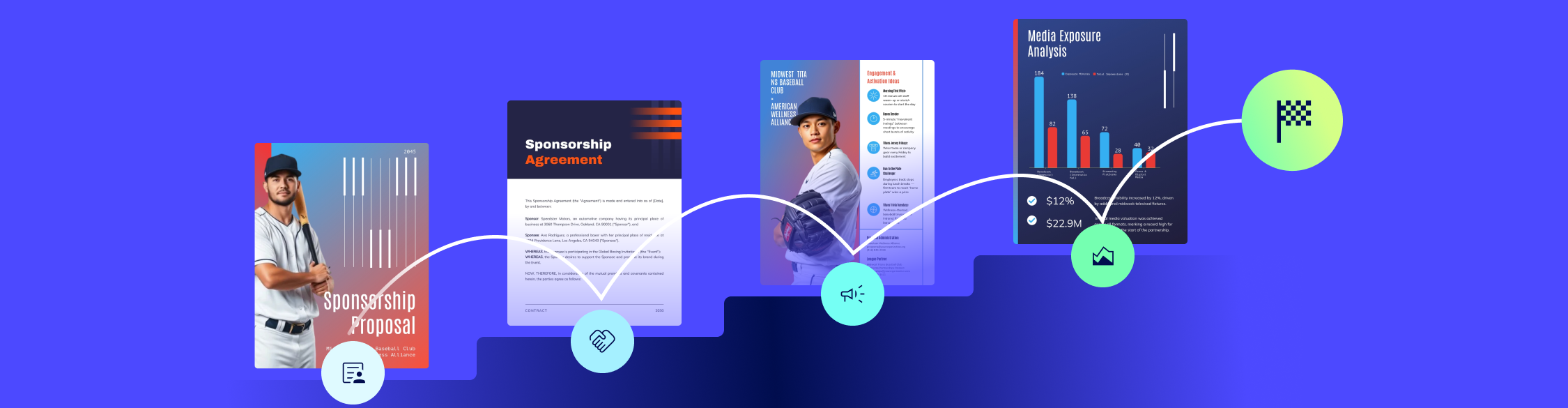
Sponsorship marketing is the most effective way to tap into an audience you might not reach otherwise.
When done well, it can deliver a positive return on investment through shared trust and awareness lift.
But how can you achieve those results with every partnership agreement you sign?
By using a repeatable framework. This guide gives you one: a four-part system for selecting and activating partnerships.
We also include examples of how sponsorship plays out across industries and show you the metrics that tell you whether it's all working.
Finally, we’ve also got the tools that support the full lifecycle from first pitch to renewal report.
Quick Reads
Sponsorship marketing is a commercial arrangement in which a brand provides financial or in-kind support to an event, organization, cause or individual in exchange for promotional access to that property’s audience.
When you sponsor something, you associate your brand with things that ideally your audience already cares about. That association carries emotional weight through shared values and aligned brand storytelling.
Larry Weil, founder of The Sponsorship Guy, defines it perfectly. He says,
“When you sponsor a property, you are borrowing their fans, premises, and associating yourself with their values.”
In technical terms, sponsorship involves three parties:
The exchange between the sponsor and the property is structured around specific marketing tactics such as:
For a deeper look at how this plays out at the organizational level, see Visme's guide on corporate sponsorship.
Now that we have clarity on what sponsorship marketing is, here's a quick look at the key aspects that lie within it.
Each of these is explored in depth later in the guide.
Getting the most from a sponsorship investment requires discipline at every stage: before the deal, during the campaign and at renewal. And for that, you need a reliable and strategic framework.
The four steps below reflect the lifecycle framework that IEG, the sponsorship industry's leading consultancy since 1983, applies across its client work:
Each step builds on the last. Let’s discuss the process.
Before evaluating any property, define why you need a sponsorship strategy.
What are you trying to achieve?
If you’re not sure how to figure this out, our guide on goal-setting will help. It’s full of tips and templates to use.
The objective will determine which properties are worth evaluating through sponsorship audience targeting. This process matches your ideal buyer profile to the right property's existing community.
To start, map your ideal audience's demographics, values and the kinds of experiences they actively seek out. Then, look for properties where your audience profile overlaps with their own existing fan base and values.
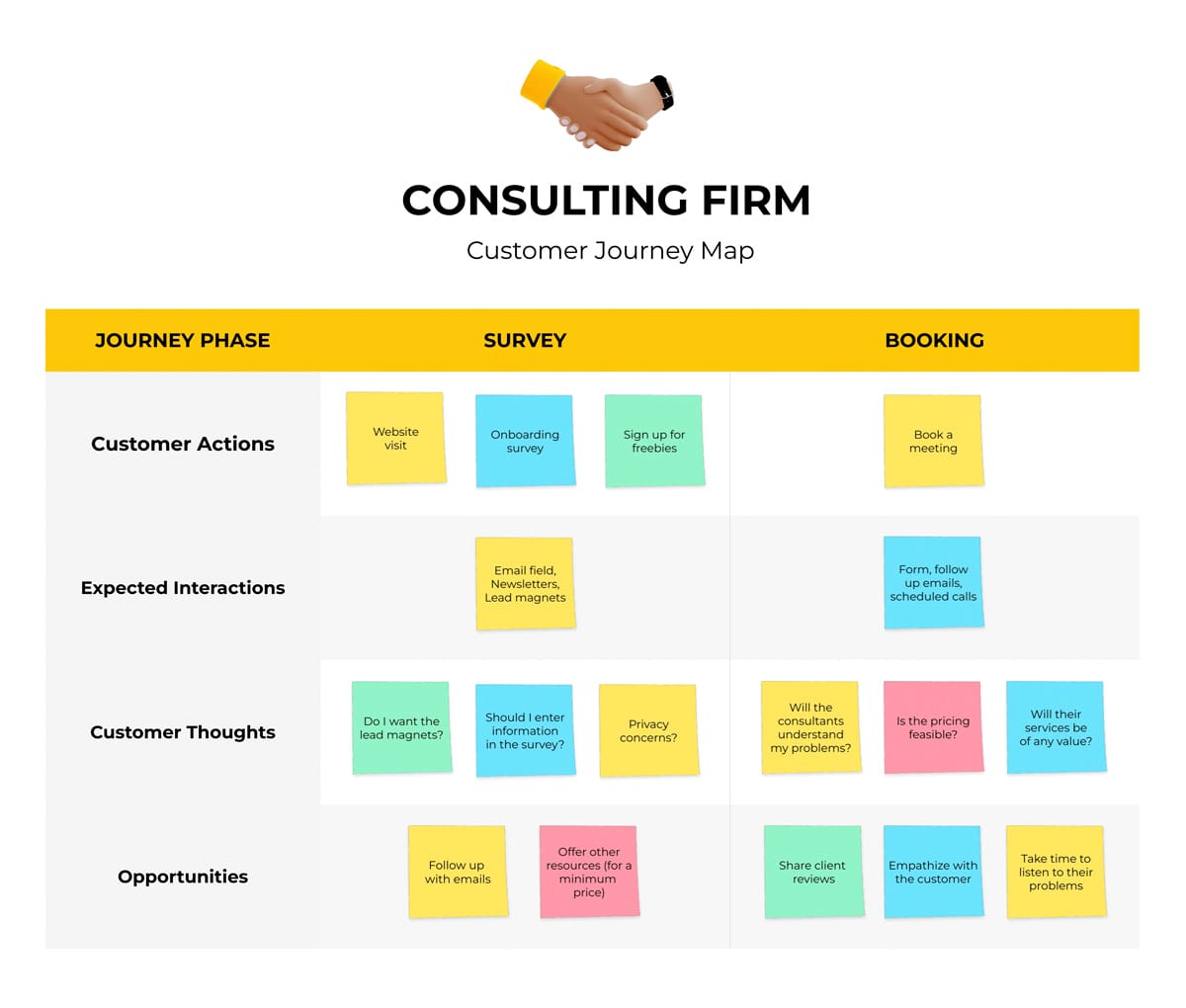
A great way to conduct this comparative analysis is to use a whiteboard environment where you place digital post its with benchmarks and data to see where they overlap. This customer journey template can help you get started. Since the canvas is infinite, you can duplicate the journey for the different audiences and analyze it all visually.
It's important that the partnership makes sense. Forced sponsorships are increasingly visible to audiences. If you insert yourself into a community you don't authentically belong in, you risk being labeled as tone-deaf or appropriative.
But that's not a rule set in stone. Sometimes, two very different brands can partner and succeed.
In fact, one of the most counterintuitive findings in recent sponsorship research is that brands entering a category outside their core industry can actually outperform endemic ones when they find authentic activation angles.
Lumency's 2025 Global Sponsorship Trends report, citing IEG data, found that effective non-endemic activations drive 15–20% higher engagement than endemic brands at the same property.
A McKinsey survey of the German esports market found that non-gaming brands achieved 53% recall compared to 43% for endemic sponsors. These stats are evidence that the category gap, when bridged authentically, becomes an advantage rather than a liability.
One standout reason is memorability: a brand that finds a genuine reason to belong in an unfamiliar space stands out precisely because it's unexpected.
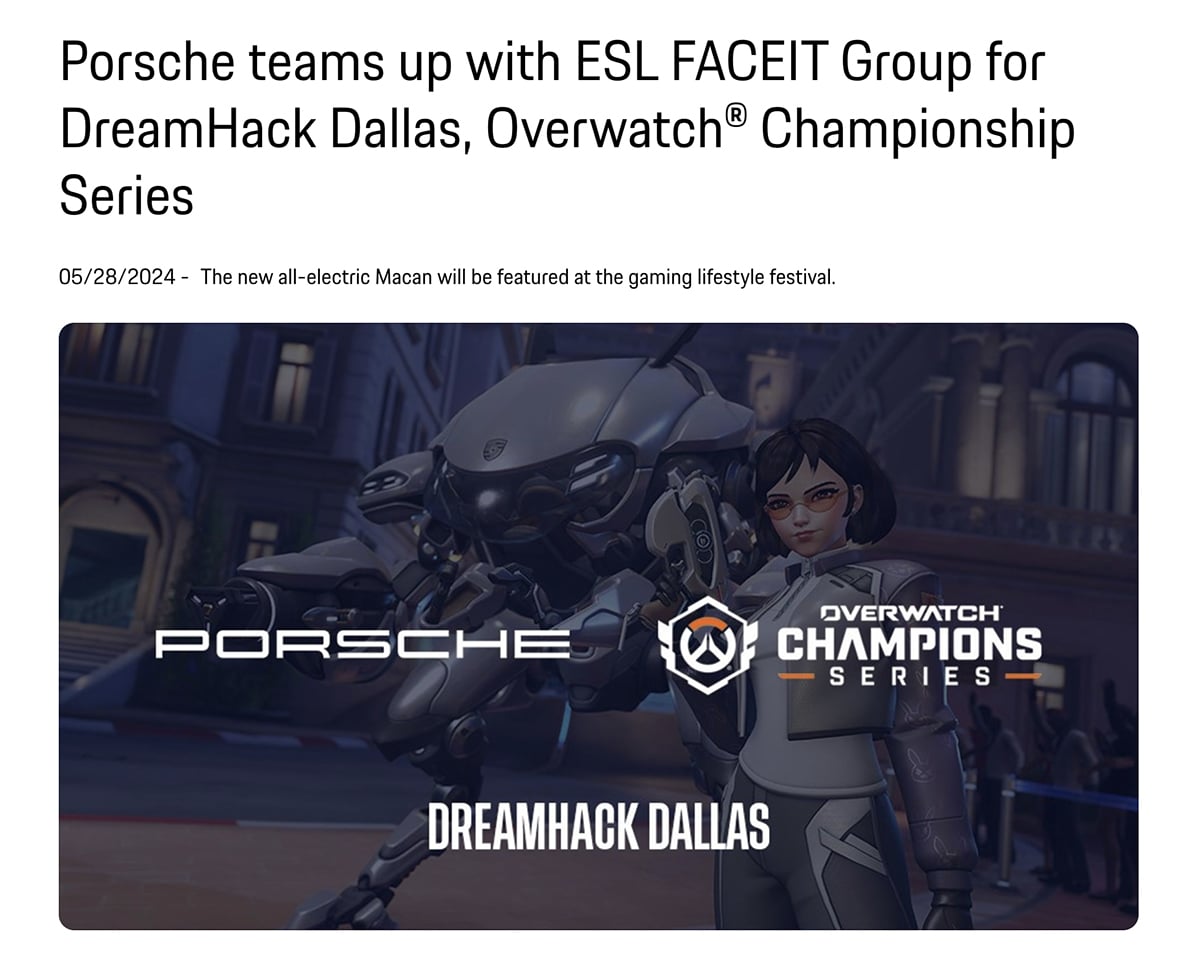
In 2024, for example, Porsche partnered with the video game Overwatch, with the headline activation being the design of a game character modelled on a Porsche. This works not despite the category gap but because of how the activation bridges it.
If your brand team has ruled out a sponsorship category because "we don't belong there," the data suggests it's worth a second look, provided the activation strategies are authentic.
After searching for the best sponsorship opportunities, the final step is to contact the brands or teams with the highest potential fit.
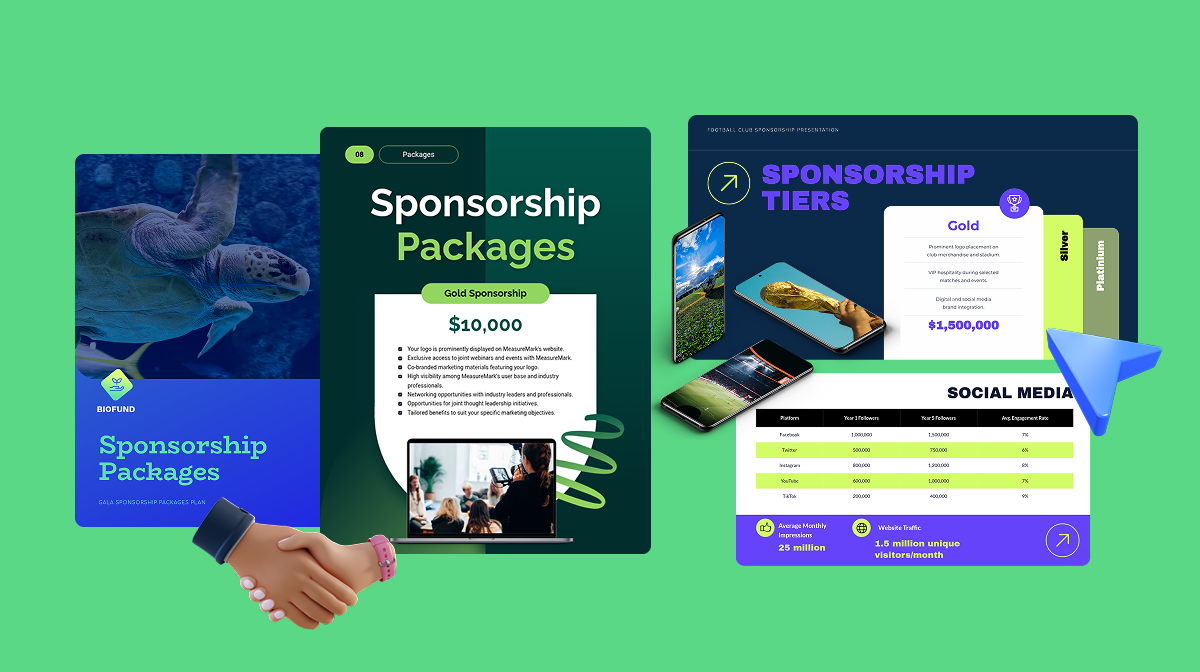
When you get in touch, structure your presentations and proposals with attractive sponsorship packages.
Here’s a template you can use straight away to create the perfect proposal.
After aligning with the right properties, closing deals with them and signing agreements, it’s time to start the activations.
Dan Kozlak, vice president at IEG, stated in an article on LinkedIn that yes, sponsorship secures access to the audience, but it’s activation that makes that access worth the investment.
He’s 100% right. Build your activation strategies to cover several channels, styles and types. Check out Visme’s guide on sponsorship activation, which outlines the creative and logistical elements that go into building activations that work.
Here's a quick rundown of everything that should happen around an activation:
Right from the start, you need to track performance with the right metrics.
We have a whole section on that later. But here's a quick look at how it fits into the framework.
The principle here is to establish measurement baselines before the campaign launches. A baseline is a snapshot of where your brand stands before the sponsorship begins: your current awareness levels, website traffic, social sentiment, lead volume or whatever metrics align with your objectives.
Without this baseline, you have no reference point to measure change against.
Take this example: if brand awareness among your target audience is 34% before the campaign and 41% after, you can attribute that 7-point lift to the sponsorship with confidence. Without the pre-campaign benchmark, the 41% figure is just a number.
Pre- and post-awareness studies, UTM tracking, CRM tagging and audience sentiment tools should all be configured before activation begins.
A great way to measure ongoing performance is a real-time or regularly updated dashboard. The template below will help you create a custom metrics tracking system for your team and stakeholders.

Sponsorship marketing doesn't end when the partnership's time window closes; you can always renew.
The teams that consistently achieve the best renewal rates don't wait until the contract is expiring to think about performance. They treat the portfolio as a living system, regularly evaluating which properties are delivering against objectives, trimming underperformers without sentiment and doubling down on what the data shows is working.
Renewal is also the moment to renegotiate, not just re-sign.
IEG's guidance on renewals is direct: go into the conversation with your performance data, an honest assessment of what didn't work and a clear brief on how the next term should be structured differently.
The iterative step is also where portfolio discipline pays off. The instinct is to accumulate sponsorships by adding new properties without exiting old ones, but this dilutes your portfolio. Fewer, better-activated partnerships consistently outperform broad portfolios.
Sponsorship marketing tends to cluster around sports, but the principles apply across several other industries, such as:
Let’s discuss how sponsorship impacts these industries.
For some inspiration, open up Visme's event sponsorship examples in a new tab. It covers standout activations across several event formats.
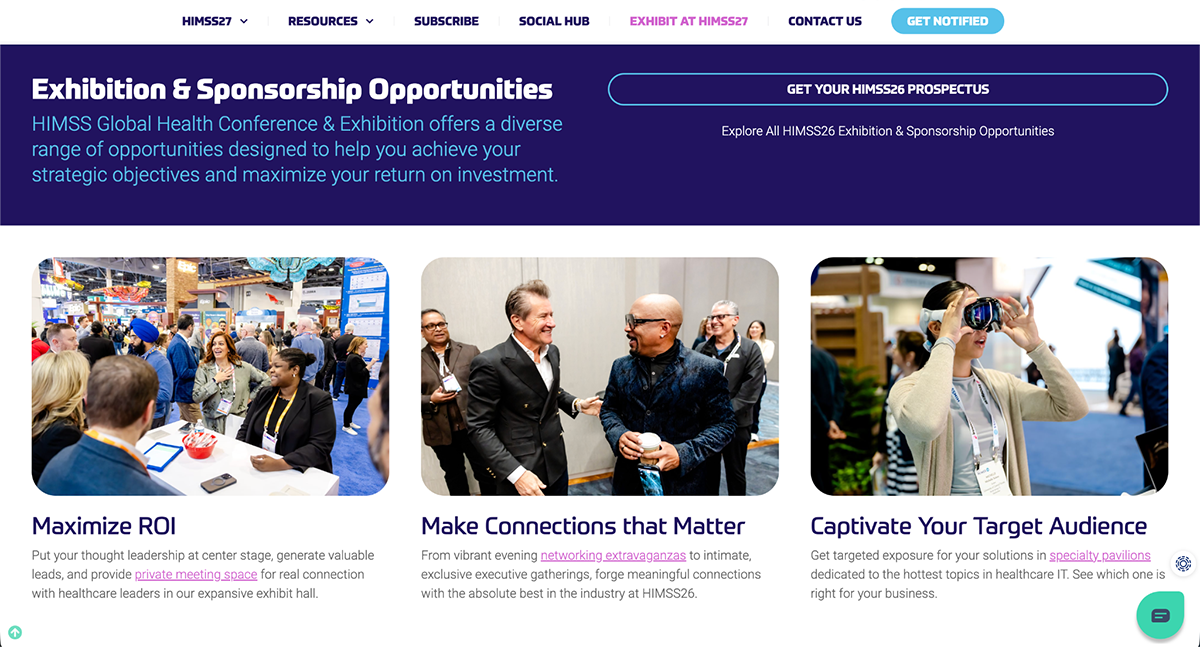
In healthcare, sponsorship is one of the best channels for reaching healthcare professionals (HCPs). And since digital advertising targeting clinicians is heavily regulated, conference sponsorship is disproportionately valuable.
The best executed pharma conference sponsorships combine a branded exhibition space with an industry symposium or workshop. The ideal combination creates an educational environment where brands can share valuable information and enhance their thought leadership.
One such event is the HIMSS Global Health Conference & Exhibition.
Beyond conferences, pharma brands are also finding creative approaches to broaden patient awareness through social media and beyond.
Novartis has been blending sponsorship activation with influencer reach for several years now. Cyndi Lauper partners with the brand to raise awareness for psoriasis and arthritis.
View this post on Instagram
Do you work as part of a healthcare team? Take a moment to explore Visme's healthcare solutions for compliant, on-brand content creation and more.
If you work in B2B SaaS, event sponsorship marketing is one of the most direct routes to the decision-makers who control software budgets. According to Sagefrog’s 2024 research, 38% of B2B marketers say sponsoring or exhibiting at in-person events is a top marketing tactic.
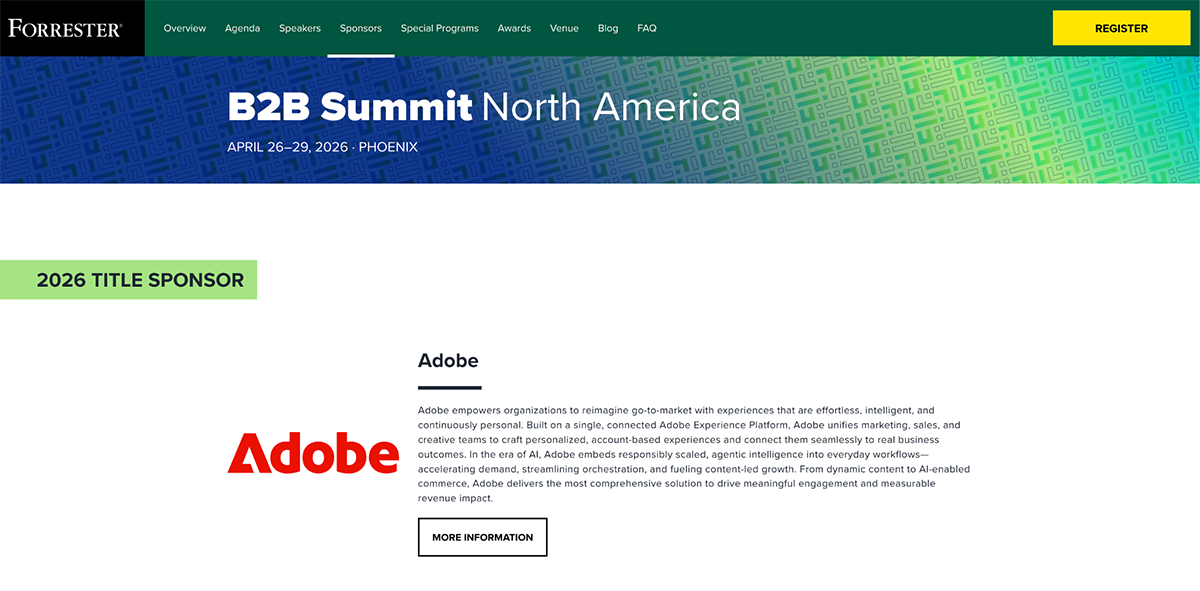
Sponsorship at an industry conference like SaaStock, the Forrester B2B Summit or a trade show puts your brand in a room full of qualified buyers.
In B2B SaaS event sponsorship, branded workshops and speaking sessions work best. These tend to deliver more measurable value than booth-only presence because they deliver genuine value to the attendee while positioning you as a credible expert.
For the 2026 Forrester B2B Summit, they have hundreds of sponsors lined up with Adobe at the forefront.
Other types of partnerships beyond in-person events include co-marketing campaigns, joint webinars, co-authored research reports and shared content distribution on social media and beyond.
In 2023, Modern Sales Pro illustrated what sophisticated digital sponsorship can look like in the SaaS space. Using Goldcast, they ran nearly 200 webinars, giving sponsors detailed post-event analytics, including attendance, questions asked, and click data. That process made sponsorship ROI measurable and concrete.
The video below is the last webinar in that series: Sales Planning Power Hour: Aligning Strategy, Execution, and Incentives for Success. The sponsor for this webinar was Xactly.
U.S. corporations gave an estimated $44.4 billion to charitable causes in 2024, a 9.1% increase from the prior year.
We’ve already discussed how important it is for sponsoring brands to align with their properties, but it’s even more critical in nonprofit and social cause sponsorship marketing.
You don’t want your brand to seem tone-deaf, ever. So you need to ensure that the cause you’re sponsoring resonates with your own communities as well as theirs.
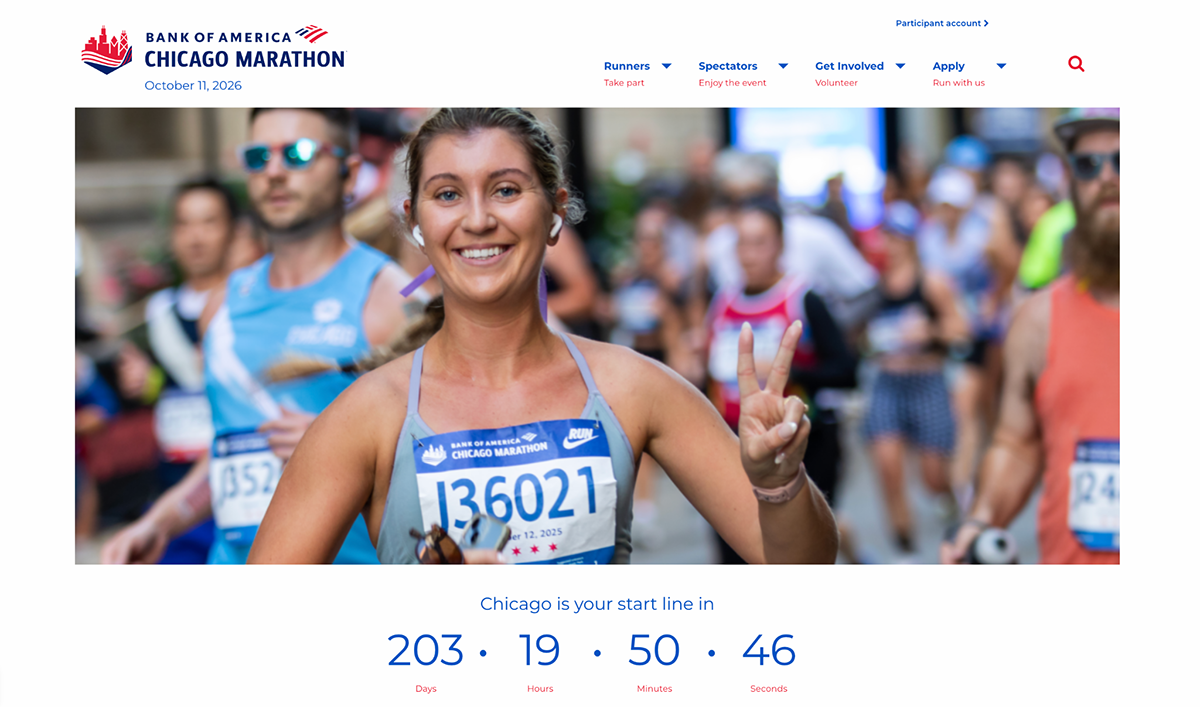
Bank of America's sponsorship portfolio reflects this approach well. Their major-event sponsorships, the Bank of America Chicago Marathon and, since 2024, the Boston Marathon, are explicitly structured as vehicles for community investment.
Together, the two races raised $108 million in philanthropic impact in 2024 alone, with funds flowing to local, national, and global nonprofits.
Music sponsorship has become a powerful strategy, particularly for brands targeting Gen Z. According to Lumency’s 2025 Global Sponsorship Trends report, 73% of Gen Z say music forms a core part of their identity. That’s a huge opportunity for brands.
That said, Gen Z’s music consumption is different and more fragmented than that of previous generations, with digital platforms replacing broadcast as the primary discovery channel.
Red Bull is the canonical example of what music sponsorship done strategically looks like: genuine participation in culture through festival partnerships and artist collaborations that generate engaging own content for the brand.
Just one example is the RedBull Culture Clash. “The world's biggest, loudest, most unpredictable music battle.”
Likewise, the AB InBev and Netflix global deal announced in 2025 offers a more contemporary model: a cross-platform partnership spanning NFL Christmas Day game sponsorships, the 2027 Women's World Cup, live events and beer packaging featuring Netflix intellectual property.
Marian Lee, Chief Marketing Officer at Netflix, had this to say about the partnership,
“We’re always looking for creative ways to build our brand and connect with fans, to keep fueling the fandom that comes from our great shows, thrilling movies, and can’t-miss live events. The popularity of our titles allows us to pierce the cultural zeitgeist in ways few others can, and a great partnership can make that even better. We are super excited about creating attention-grabbing campaigns with AB InBev that are just as unique, fun, and creative as the shows and movies they support.”
ROI tracking lets sponsors see how their contributions are making an impact, both for their own business and the property’s.
Effective metrics measurement spans three main levels:
Sagar Ramsinghani, Analytics Director at Kantar, offers a great explanation about the importance of ROI in sponsorship marketing:
“The full value of a sponsorship is a combination of its direct impact on sales and the longer-term impact from driving brand perceptions and engagement. Evidence proves sponsorships can create awareness, promote brand associations and allow for deeper consumer engagement that drives long-term effects.”
We’ve established its critical value. But who takes care of the analysis and tracking? Both the sponsor and the property need to keep track of the metrics that matter to them.
The table below identifies the eight metrics that matter most, why they matter and how to measure them.
| Metric | Why It Matters | How to Measure |
|---|---|---|
| Media Exposure Value (MEV) | Quantifies brand visibility by estimating what equivalent exposure would cost in paid media. | Use logo tracking tools (Zoomph, Blinkfire) and benchmark against equivalent ad rates. |
| Brand Awareness Lift | Measures whether more of your target audience recognizes your brand after the campaign. | Run pre- and post-campaign surveys with exposed vs. control groups. |
| Social Engagement | Indicates audience interest, share of voice and sentiment during the sponsorship. | Track impressions, engagement, hashtags and sentiment using social listening tools. |
| Lead Generation | Links sponsorship activity directly to pipeline growth and qualified contacts. | Use UTM links, QR codes, event apps and CRM source tagging. |
| Audience Reach & Quality | Measures both the size of the audience and how well it matches your target customer profile. | Analyze platform analytics, attendance data, broadcast reach and registration insights. |
| Net Promoter Score (NPS) Lift | Tracks changes in trust, loyalty and brand perception after the sponsorship. | Compare post-event survey results against baseline NPS scores. |
| Revenue Attribution | Connects sponsorship investment directly to revenue and pipeline impact. | Track 30/60/90-day pipeline and closed deals in your CRM using source attribution. |
At the start of every sponsorship, you must build an evidence base and then measure outcomes during and after the sponsorship. For all that, you need the right tools.
Here’s a table of the most helpful platforms, followed by a profile of each.
In fact, you can create a practical workflow with these four tools, like this:
| Tool | Primary Use | Best For | Key Features |
|---|---|---|---|
| SponsorUnited | Intelligence & discovery | Brands, agencies and rights holders | AI-powered deal pricing, competitive intelligence database and in-app valuation tools |
| Visme | Branded sponsorship content creation | Marketing teams and rights holders | Visual content editor with AI and manual tools, plus templates and design assets for interactive, on-brand content |
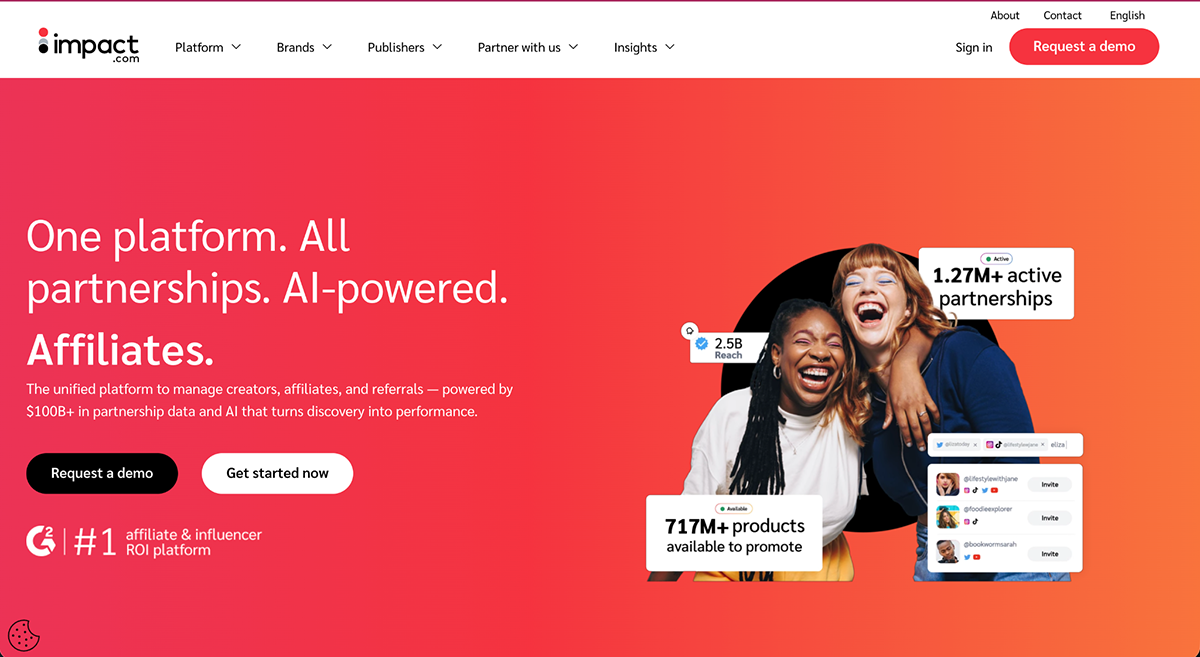
| Impact | Digital partnership tracking | B2B SaaS and multi-partner campaigns | Cross-channel attribution, performance tracking and automated partner payouts |
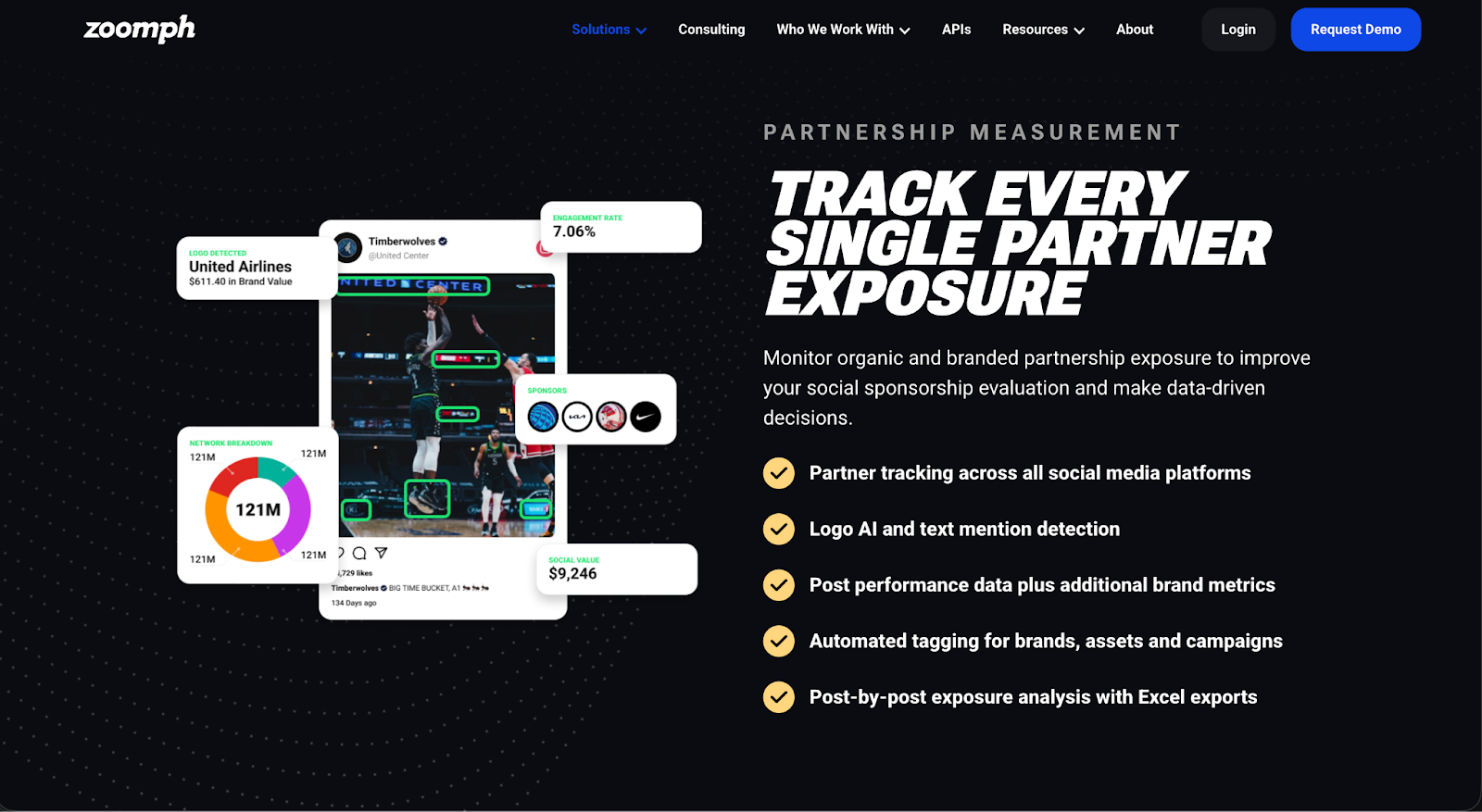
| Zoomph | Measurement & ROI tracking | Sports properties, media teams and brands | Logo detection across broadcast, social and in-venue channels, plus performance benchmarking and reporting |
SponsorUnited is an AI-native sponsorship intelligence platform. It’s tailored for brands, agencies, media companies, rights holders, and educators to research the market, evaluate deals and manage partnership portfolios.
Its database spans hundreds of thousands of brands and millions of recorded deals across sports, entertainment, media and talent. The platform offers a competitive view of who is spending where, at what scale and in which categories.
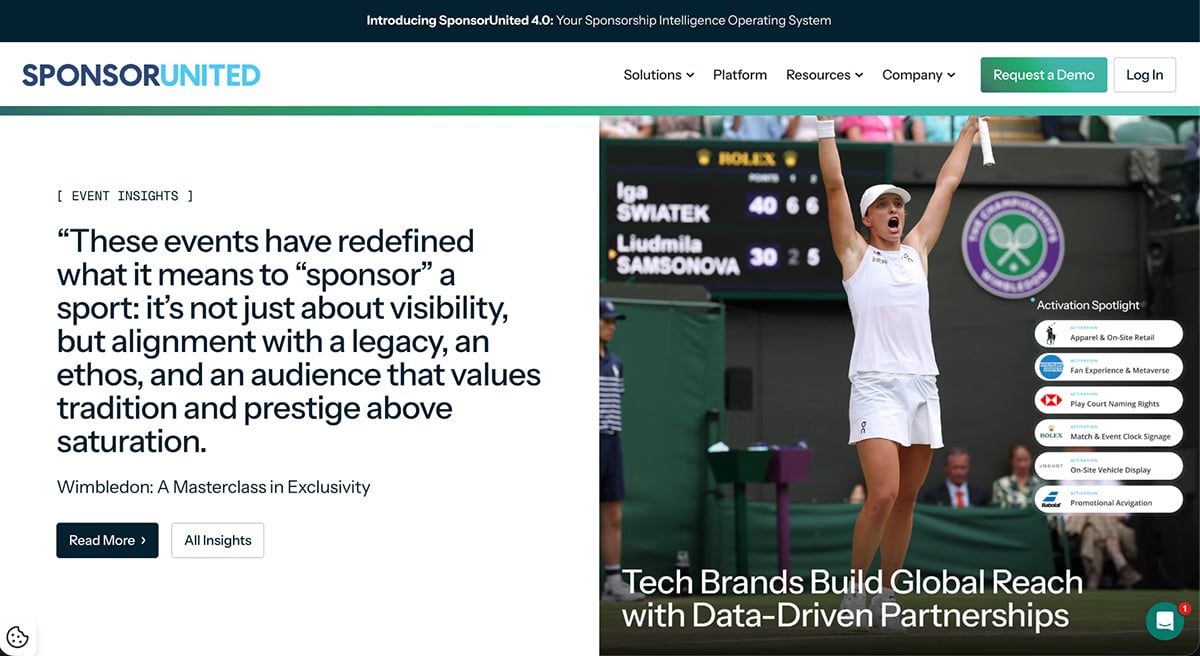
As a brand looking for sponsorship opportunities, you can use SponsorUnited to find the right properties and validate pricing before committing. As a rights holder, use it to identify which brands are actively investing in their space and build targeted outreach lists.
How to Use SponsorUnited for Sponsorship Marketing:
A note on compliance: SponsorUnited is SOC 2 Type II-certified and GDPR-compliant, so the platform itself meets enterprise data security standards. The practical compliance consideration for users is at the export stage.
So, when you pull contact data from SponsorUnited and load it into Salesforce or another CRM for outreach, you must ensure your use of that data is consistent with applicable data protection laws in your region. This is particularly important if you're operating in or targeting contacts in the EU, where GDPR governs how personal data can be collected, stored and used for commercial outreach.
Visme is a visual content creation platform that supports the full sponsorship lifecycle. It covers the creative and communication layer of the sponsorship workflow: turning validated data into proposals that win deals, producing the activation content that brings them to life and building the ROI reports that secure renewals.
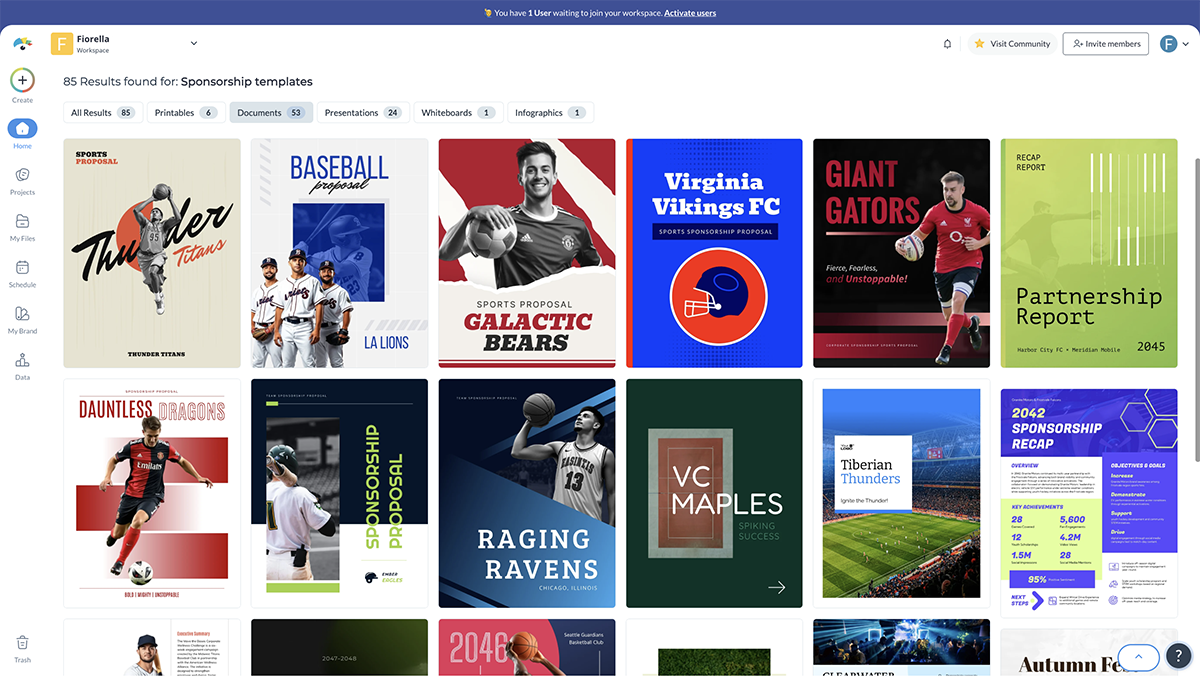
What makes Visme particularly well-suited for sponsorship marketing is the combination of an AI-powered design suite, built-in brand governance, collaboration and approval tools, plus publishing analytics; all in one platform.
A sponsorship manager can move from initial proposal through to post-campaign ROI report without leaving the workspace.
Just one of the things you can do with Visme is create content for getting sponsorships. This video shows you how.
Here’s how Visme supports the sponsorship lifecycle:
1. Build the sponsorship deal assets. Using the pricing and audience data validated in SponsorUnited, you can create several content items, such as an in-house analysis for prospect planning, personalized proposals to send to potential partners, sponsorship package overviews and even agreements or contracts to seal the deal.
To start, open the Visme dashboard and either choose to Generate with AI or select a template directly (which you can then also edit with AI). Use the Brand Wizard to apply your branding assets to the design and then populate the slides or pages with your deal terms, audience demographics or activation plan.
Use Visme's AI Writer to draft proposal copy, value statements and section narratives quickly, then refine them to match your brand voice. Drop in icons, stock photos and videos from Visme's built-in library of millions of assets to give the proposal visual weight without sourcing assets externally.
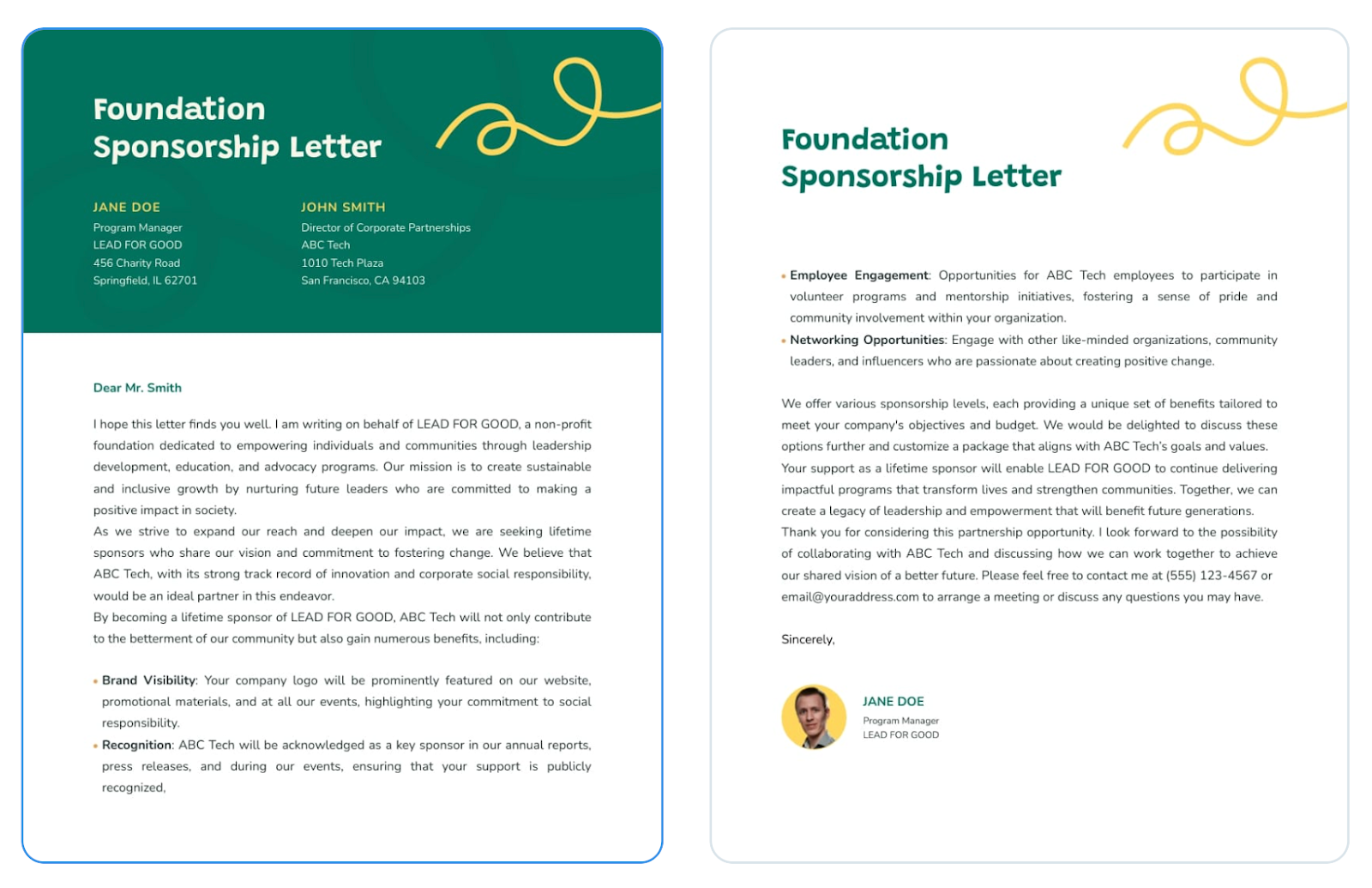
Here’s a sponsorship letter template you can customize right now to use as part of your prospecting strategy.
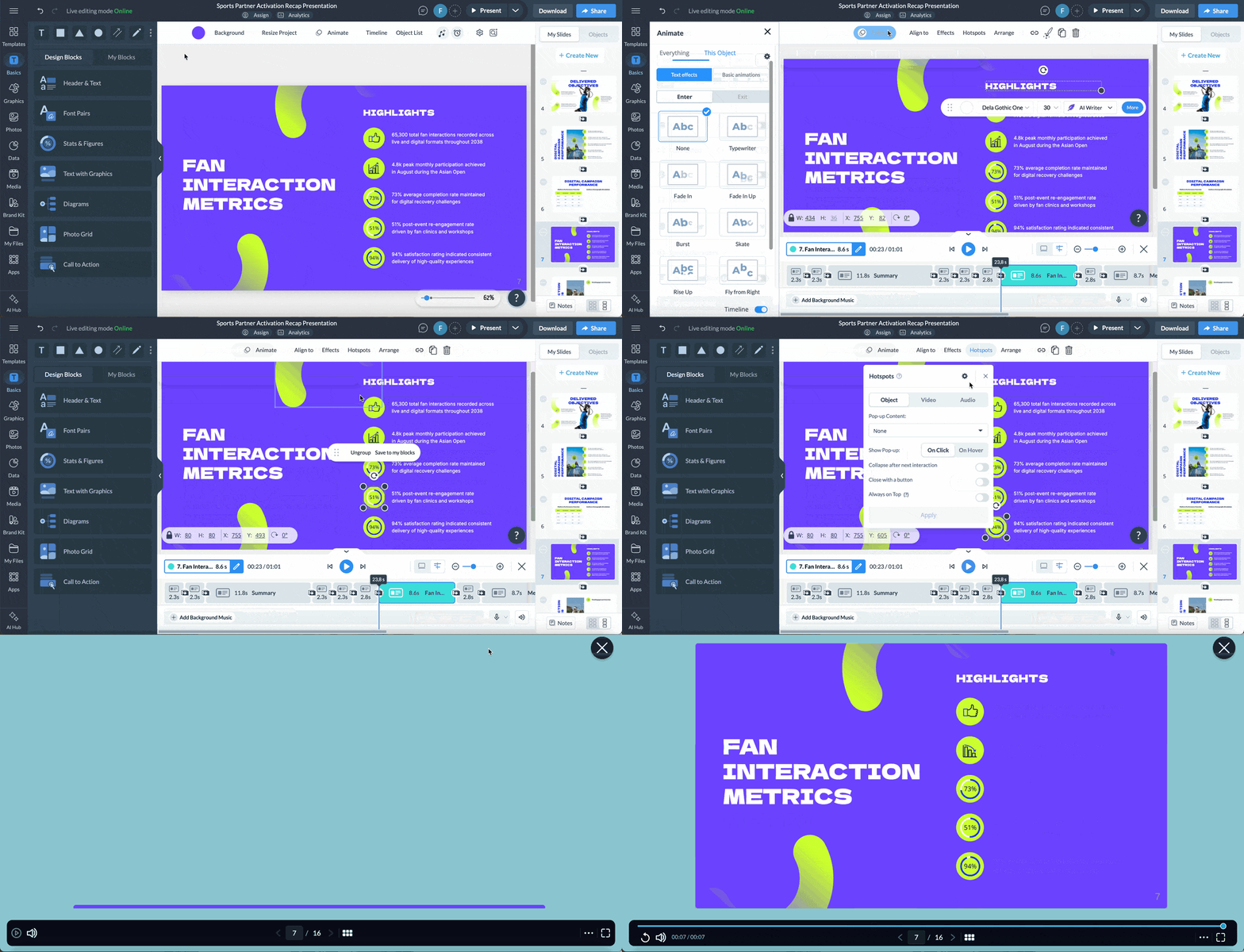
For digital content, add interactive elements like hotspots, hover effects, clickable menus, and embedded video to transform a static deck into an experience a sponsor/property will gladly engage with.
2. Create activation content. Once the deal is signed, use Visme's AI Image Generator to create custom visuals for social campaigns, event signage and digital materials tied to the sponsorship. The AI Edit Tools let you remove backgrounds, upscale images, unblur photos and swap out objects, making rapid iteration on activation assets super easy.
Use the Social Media Scheduler to plan and publish pre- and post-event content directly from Visme's dashboard, keeping your activation cadence on track across channels.
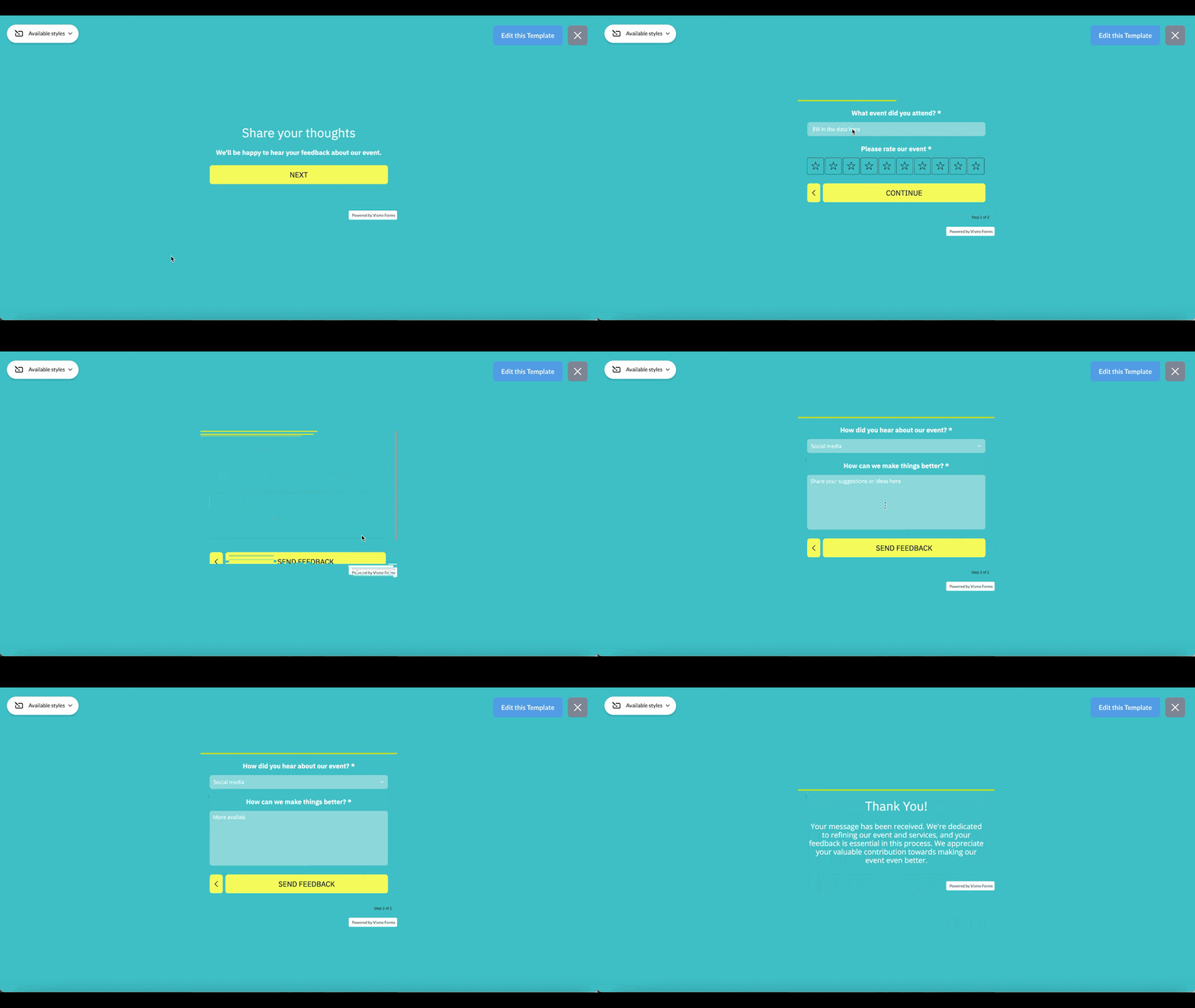
3. Gather audience data during activation. Embed Visme Forms into event microsites, QR-code landing pages or post-event follow-up emails to capture attendee data and opinions directly into your campaign records. This will turn activation touchpoints into structured data you can use in your performance measurement strategies.
4. Collaborate and approve. Route assets through Visme's Workflows for structured internal review and sign-off. Team members can comment, give feedback and move assets from draft to final without the back-and-forth of email chains. This process will keep approvals traceable and brand standards enforced before anything reaches the sponsor or goes live.
5. Deliver sponsor materials. Share, publish and send proposals, activation decks and campaign assets via secure, password-protected links. Use deeper analytics to see how recipients engage with shared content: total views, unique visitors, time spent and referral source. This data gives you visibility into whether your proposal has actually been read before you follow up.
6. Report on performance. At campaign close, pull metrics from Impact and Zoomph and bring them into an interactive post-campaign report using our data visualization tools. The result is a sponsor recap that tells a clear, visual ROI story; the kind that supports renewal conversations and positions you as a professional partner.
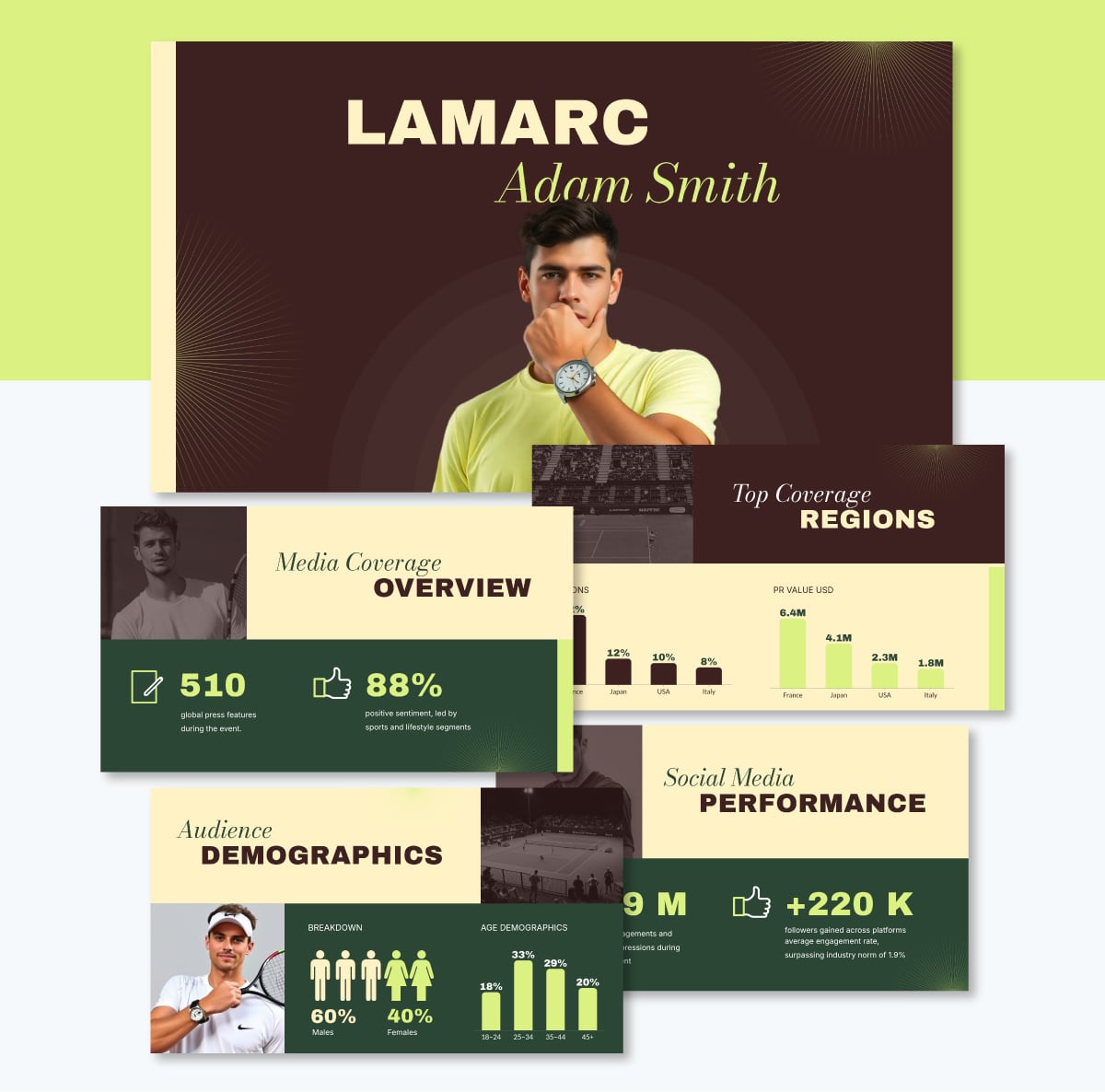
A note on compliance: Visme operates as a cloud-based platform, so any brand assets, sponsor data, or audience information stored within it is subject to your organization's data governance policies.
If your sponsorship materials contain personal data, contact details, audience research, or partner information, ensure that storage and sharing practices are consistent with the GDPR if you're operating in the EU or working with partners in the EU. Use Visme's secure sharing features rather than open public links when distributing confidential sponsor proposals or post-campaign reports.
Impact is a comprehensive partnership management platform that covers affiliate, influencer, and sponsorship programs in a single system. It's ideal for running digital sponsorship marketing campaigns with multiple partners, including podcasters, newsletter writers, B2B content creators and co-marketing partners.
Where SponsorUnited tells you which deals to pursue and Visme helps you pitch them, Impact manages what happens after the contract is signed.
Here’s how to use Impact for sponsorship marketing:
A note on compliance: Because Impact is used to manage influencer and affiliate partnerships, it falls under the FTC's regulations. Any partner compensated through the platform is legally required to clearly disclose that material relationship to their audience. This applies regardless of compensation size.
Brands are also liable if partners fail to disclose properly, so explicitly build disclosure requirements into your partner contracts within Impact and establish a monitoring process to verify compliance throughout the campaign.
Zoomph is an AI-powered measurement platform that uses computer vision logo detection to identify and value brand exposure across every channel, delivering unified reporting with audience demographic and sentiment data.
For sponsorship teams, Zoomph solves the most difficult conversation in partnership marketing: proving to a CFO or a rights holder exactly what a sponsorship delivered, with real evidence.
How to use Zoomph for Sponsorship Marketing :
This completes the loop: SponsorUnited identified the opportunity, Visme pitched it, Impact tracked the digital activation, and Zoomph proves what the sponsor actually received.
A note on compliance: Zoomph collects and processes social media data, audience demographic profiles and broadcast measurement data, which may include personally identifiable information depending on the channels being tracked. Zoomph recommends that EU-based clients sign a Data Processing Agreement before using the platform for campaign activations.
If you're running sponsorship campaigns that involve audience data collection, particularly through digital activations, social listening, or audience segmentation, ensure your privacy policy clearly discloses how that data is used. Also, confirm with your legal team whether a DPA is required for your jurisdiction.
Every stage of a sponsorship generates a content need. The quality of that content often determines whether a partnership succeeds and renews. So, this is where visual communication becomes a genuine competitive differentiator.
Picture this: Two brands sponsor the same conference. They pay the same rights fee, activate in the same space and reach the same audience. One sends a beautifully designed post-event report with interactive data visualizations and a clear ROI narrative. The other sends a spreadsheet.
Which one do you think has a higher possibility of getting renewed?
According to Content Marketing Institute's 2025 B2B research, organizations with a scalable content creation model are significantly more likely to achieve the outcomes they're after. In sponsorship, where every touchpoint is a direct argument for continued investment, having that system in place compounds across the entire partnership lifecycle.
Most importantly, sponsorship communicates values through association. So, when the content built around that association looks consistent and intentional, the association lands. When it looks rushed or generic, it undermines the deal regardless of how much was paid for it.
Visme supports your content creation at every step of the sponsorship cycle and makes it easy to create impactful sponsorship assets like:
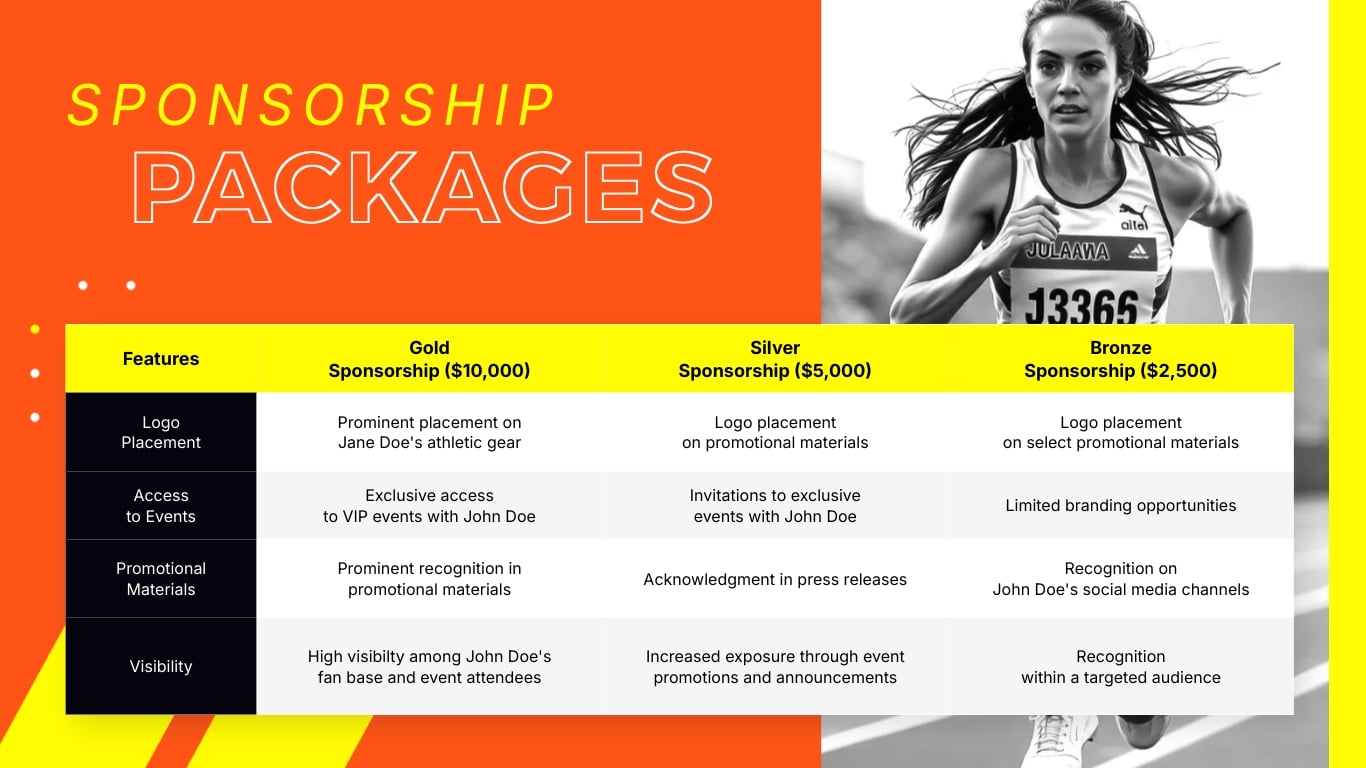
Check out this slide from one of our sponsorship decks. It’s a beautiful package visualization that grabs attention fast while also sharing all the critical info.
Sponsorship marketing is a commercial partnership where a brand provides financial or in-kind support to an event, organization, athlete, or cause in exchange for promotional access to that property’s audience.
The brand gains visibility through agreed assets, including logo placement, speaking opportunities, branded experiences and digital integrations. ROI comes not from signing the deal but from the activation campaign built around it.
Coca-Cola’s Olympic sponsorship, extended through 2032 in a deal worth over $1 billion, is one of the most recognized examples. It aligns the brand with global reach and celebration across every market where the Games are broadcast.
At a smaller scale, a B2B SaaS company sponsoring SaaStock might host a branded dinner, secure a speaking slot and run UTM-tracked follow-ups to convert attendee relationships into pipeline.
Sponsorship is a form of marketing, not traditional advertising. Advertising buys media space to push a message outward. Sponsorship earns brand association by supporting something an audience already values, making it experiential and contextual rather than interruptive.
Most effective sponsorship strategies are amplified with advertising to extend reach beyond the event itself.
A sponsorship marketing template is a structured proposal framework that outlines the audience, available assets, investment levels and expected outcomes of a sponsorship opportunity.
A strong template is built around the sponsor’s objectives and uses data and visuals to make the value case clear. Visme’s sponsorship proposal templates are customizable for any partnership context.
In this guide, we covered what sponsorship marketing is and why it requires a framework and repeatable system
We walked through the framework that will help your brand select the right properties, build activation strategies to drive audience engagement, and organize the best measurement systems to prove ROI and justify renewals.
We also looked at real examples of sponsorship done well and the tools and workflows that let marketing teams produce sponsorship content that builds shared trust and awareness lift.
We showed you how Visme supports every stage of the cycle, from the first sponsorship proposal to the post-campaign report that secures renewal.
Now you can try all of the templates, data visualization tools, collaboration workflows, and AI-powered features to start building your sponsorship content.

Design visual brand experiences for your business whether you are a seasoned designer or a total novice.
Try Visme for free