Presentation Software for Sales Teams: Buying Guide (2026)

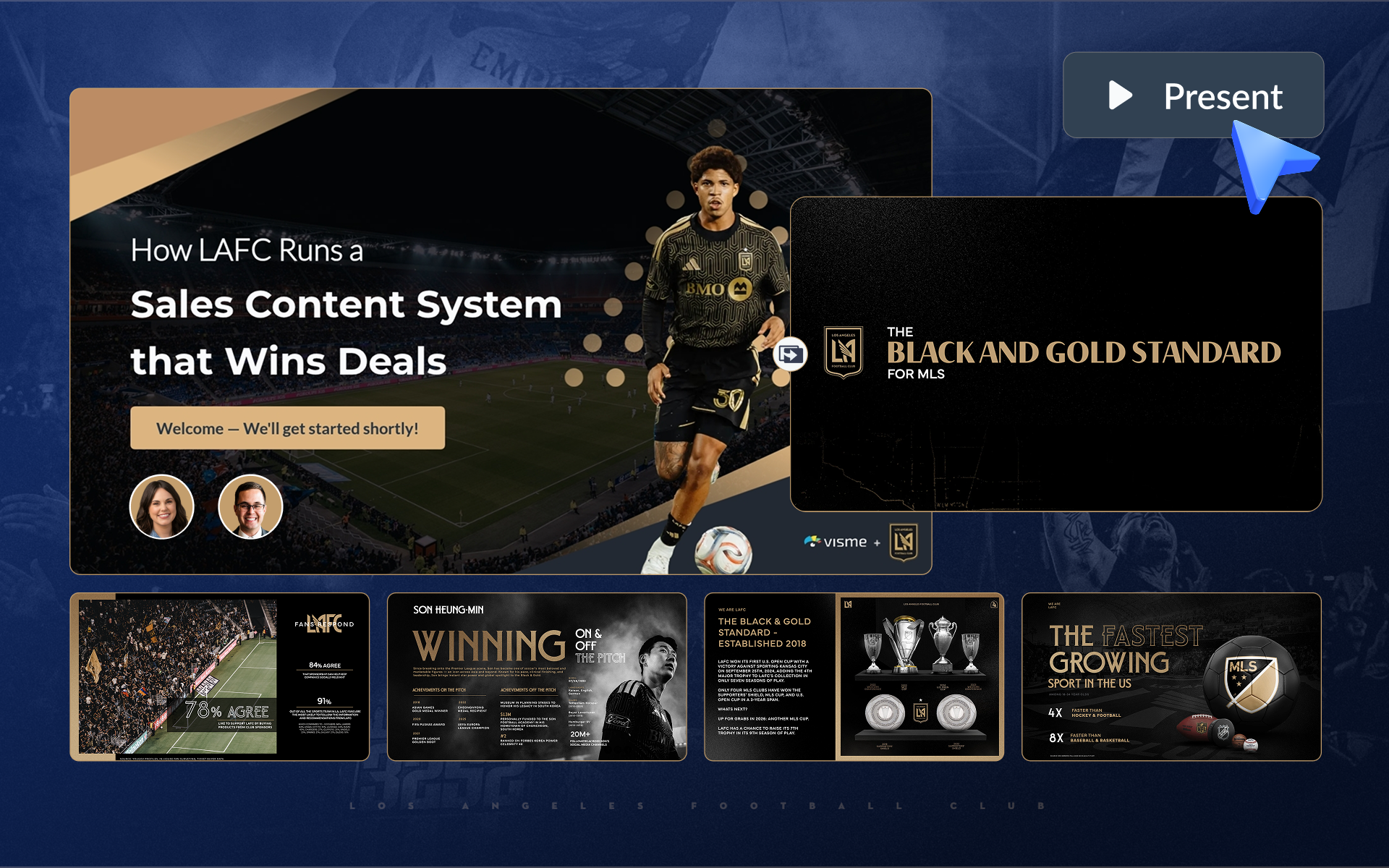
During a webinar I hosted with Alex Zani from LAFC's Corporate Partnership Strategy department, he said something that really stuck with me.
He was talking about what goes through a typical sales rep's mind when a brand wants to talk on short notice:
“How much time do I have? Is a deck really necessary? Or is it better to just talk it through?”
Then, he told us that his team had completely erased that moment of doubt for every single rep in the department. He said, "We don't want them to even have to contemplate that." I thought that was such a positive and unique perspective, one that many sales and partnership teams don’t really have. I couldn’t stop thinking about it.
So I asked him why. Where does a decision like that come from, and what makes it non-negotiable?
He walked the logic back without hesitating. More content creates more views. More views create more conversations. More conversations create more deals. More deals create more wins. And we all know what more wins mean for the business.
Don't come for me, salespeople, but let's be honest with each other: sales is a numbers game. The more at-bats you get, the more chances you have to swing. The more swings, the more hits. The more hits, the better your odds of a home run. Anyone who has ever carried a number knows this, even if it isn't the most romantic way to describe the work.
Here's where it gets complicated, though. You can't simply send more content. A generic deck with a logo swapped in doesn't move anybody. The brand on the other end needs to feel like the deck was made for them. It should show that someone thought about their goals and how the partnership could actually serve them.
And there's another reason this matters: the person your rep speaks to is rarely the only person making the decision.
I asked a sales rep once what he did for a living. He told me he makes money talking to people. I'm in sales and I would never describe it that way, because talking is only the part you can see.
You might have a great conversation with one stakeholder, but everything you said doesn't automatically travel with them to the next three people involved in the decision. That's the gap content fills, and it's why it can't be generic.
That is what I find so interesting about LAFC’s approach. Instead of asking reps to decide which conversations deserve personalized content, they built a system that makes personalized content practical enough to support every conversation.
Having sat through more pipeline reviews than I can count over the years as a sales and customer success manager, I had never heard anyone treat that particular hesitation as a problem worth engineering out.
Because it isn't a metric. There's no field for it.
No dashboard tells you how many opportunities received a personalized deck and how many moved forward with only a conversation.
Reps just consider what to do every time, make a decision and go through with it. Everyone assumes that's fine.
I'd always seen that decision as a matter of time management. Now, I think framing it that way misses something important.
Every sponsorship team has a qualification process made up of specific criteria, stages, scorecards, relationships, urgency or anything else they might have set up in the CRM. Increasingly, AI tools are helping teams uncover patterns and opportunities too. Alongside all that is the rep’s own judgment. That's the specific moment Alex spoke about in the webinar.
Using their own combination of signals, reps sometimes build the deck and other times they don’t. By choosing not to build a deck, they just wing it, because there isn't enough time, the opportunity doesn't seem far enough along or they think the conversation itself will be enough.
When that happens, the opportunity moves forward without anything tangible or personalized for the buyer to share internally. And, if the deal stalls three months later, the post-mortem may point to price, timing or fit. Hardly anyone will pinpoint that early “decision to not build a deck” as the culprit.
Plenty of things decide whether a brand gets a piece of content, and most of them have nothing to do with the brand itself. The time of year. Where the partnerships team is in the season. How many other pitches are already live that week.
One brand gets the full treatment. Another brand, same size and same fit, comes in six weeks later and gets a good conversation with nothing to take away from it.
As far as the work goes, nobody in this story did anything wrong. After all, these are the types of decisions that sales and sponsorship reps regularly make.
But nothing tracks that moment. So when the lead goes cold three months later, nobody connects it back to the fact that this brand never got anything tangible, nothing personalized that showed them how the partnership would actually serve them.
Alex realized that, in fact, that decision was definitely making a difference. And that’s specifically after the initial conversation, when the interested buyer moved the conversation internally to the actual decision-makers.
The people his reps meet with generally have to go back to a procurement lead or CFO and make the case for what they just heard.
The rep usually isn't in that room. If there were no deck, the buyer would need to rebuild forty minutes of conversation from memory, the notes they jotted down or their AI note-taker captured . There is nothing visual for stakeholders to review and nothing personalized showing them what the partnership could look like; it all just stays a story passed along in emails and chats.
What Alex noticed in his team isn't unique to sponsorship sales; it happens across the board. We see it here at Visme too. Gartner surveyed 646 B2B buyers and found that 67% now prefer a rep-free experience, which means a growing share of the people weighing up your proposal will never speak to anyone on your team at all.
That makes content important for a reason we don't talk about enough: your content has to keep selling when your salesperson isn't there.
When a rep decides to make the deck, that internal process flows better, faster and is more likely to lead to a positive outcome. Because can you really trust that the initial point of contact will remember everything from the meeting, communicate it with the same context and answer all the questions that will pop up during that internal buying decision process?
A personalized deck gives them something tangible to carry into those conversations.
You still might think not every conversation deserves a deck, and that objection is fair. So are these:
When you look at it that way, building a deck for every conversation doesn’t seem worth the extra work. But LAFC didn’t simply ask reps to make more decks. They made personalized decks easier to create.
Alex put together a small team of designers and reps to build a branded slide and deck library that makes it ridiculously easy to create a personalized deck for every conversation.
A rep doesn't open a blank slide or dig through the deck they built for a similar brand last season. They open one of four audience-specific decks where every slide is always current and approved, pull what they need and personalize the content using the dynamic fields that are already set up.
This system not only removes the deck-or-no-deck question, but also shortens the review path. It used to take three people to sign off on a deck: Alex checking that the data was right, the design team checking the visuals, and the head of partnerships checking it against brand standards. Now it's just the head of partnerships.
The logic is simple. If a rep is building from library slides, the data is already correct and the design is already approved, so why check it a second time?
Over twelve months using this library in their Visme account, the LAFC partnerships team produced 42% more content with no new hires and no extra hours for anyone.
That number is easy to misread, so I want to make sure it’s clear. It doesn't mean their reps got faster. Alex made it clear during our conversation that a deck takes about as long to build as it always has.
What changed is that decks that previously wouldn't have existed now get made no matter what.
"The time saving is just having more conversations, and more conversations will lead to more wins. That's been crucial for our team." - Alex Zani, LAFC's Corporate Partnership Strategy.
That's what I find most interesting about the 42%.
We tend to think about productivity as doing the same work faster. LAFC's experience points to another kind: removing enough friction that valuable work that used to get skipped now gets done.
To his credit, Alex doesn't present any of this as finished. He talks about it as something the team is still working toward, which I'd take over a tidier claim any day.
If you’d like to listen to the full conversation I had with Alex, watch the recorded webinar. And to see how else LAFC is using Visme, check out the case study.
Think about how often this happens on your own sales team.
Your reps have good conversations, but they don't always create a deck afterward. And when an opportunity eventually goes cold, you can't tell whether having something personalized and tangible to carry that conversation forward might have made a difference.
Because the value of the deck doesn't end when the meeting does. It gives your contact something to share with the CFO, procurement team or other decision-makers who weren't in the room. It helps the original conversation travel further and gives the opportunity something concrete to keep moving around internally.
Will every deck win a deal? Of course not. But if creating one gives a good sales conversation a better chance of continuing after the rep leaves, why should the effort required to make it be the reason your team skips it?
That's the bigger lesson from LAFC. Don't just ask your reps to create more sales content. Build a system that makes the right content easy enough to create for every opportunity that deserves to keep moving.
Want to make that possible for your sales team? See how Visme helps sales teams create personalized, on-brand content at scale.

Design visual brand experiences for your business whether you are a seasoned designer or a total novice.
Try Visme for free