Why Teams Use Visme: 6 Reasons, Backed by Real Results


Since kicking off in 2018, the Los Angeles Football Club has won six trophies, and it owns BMO Stadium, which Alex Zani describes as the busiest grass-field stadium in North America.
Back in 2023, we published a case study on the LAFC’s partnerships team, focusing on how Visme cut their presentation creation time in half. Now we’re revisiting the team to see what has changed three years on.
In the team, thirteen people sell and service the partnerships; six are in sales and seven in success. Their decks argue for the value of a sponsorship with LAFC for a sponsor’s specific brand, using fan demographics and audience insights to connect the club's reach to the brand's objectives.
Those objectives vary widely. A brand entering the LA market wants awareness. Another wants product sampling at FanFest or a presence in community programming. The fact that reps were creating the decks faster was definitely a win, but there was still room for improvement.
We’re happy to share just how much it improved.
Alex Zani joined LAFC after we last spoke with the team and has been instrumental in the change we're covering in this case study. Alex works on LAFC's business and data strategy team, focusing on the partnership group. He also supplies fan demographics and insights for the sales process, recaps partner performance and advises the sales team on which packages fit a given deal.
When Alex started at LAFC, he inherited a team with fast deck production times, but it was still battling a deck quality issue. The problem was that reps were working from decks they had built earlier, causing old data to resurface in new pitches.
He saw an opportunity within Visme. One that could support all the reps as they built tailored decks for potential and existing clients.
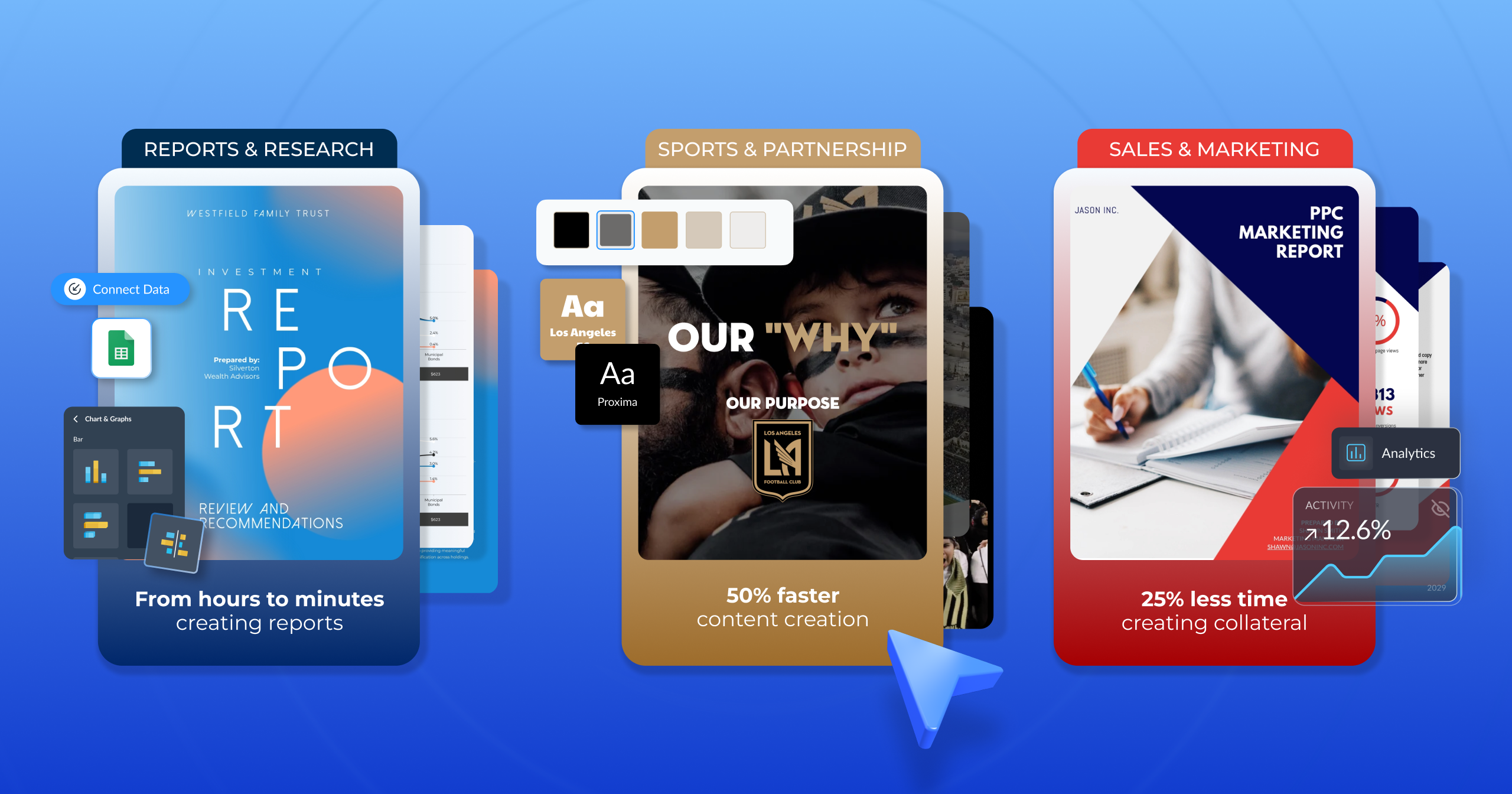
What was the solution? Rebuilding around a slide library that ultimately lifted the team's content production by 42% in 12 months, with no added headcount. Plus, it takes no more than 30 minutes to train a new person on the system.
"They were building slides that were almost repetitive, going to old decks they had previously created and duplicating off of those, using old data, and slides were not getting updated the way they are now in the library slides."
Alex shared that getting to this point took time and dedication from several people working together, but it paid off in a big way.
"It definitely took some internal buy-in and some upfront work…All this progress we've made over the last 5 or 6 years since we started, moving from siloed workspaces to bringing everyone onto the same platform so they can work together, to now taking all these people who were running in different directions and giving them the template they can all utilize so we all stay on the same track."
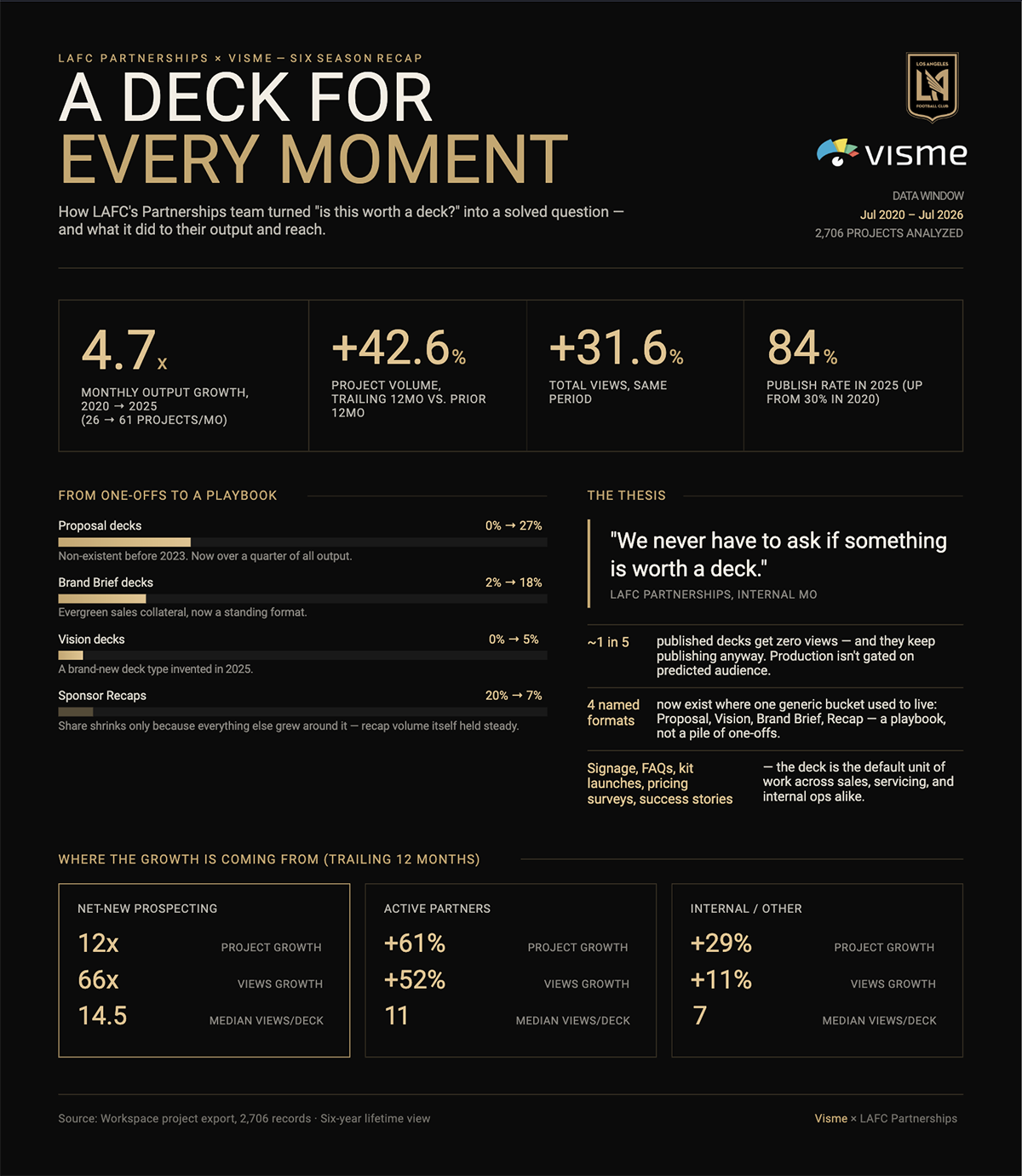
With the library, LAFC increased content production by 42% over 12 months without adding headcount or increasing production time. Most importantly, the quality didn’t suffer; it actually improved.
For Alex, the chain runs from content to conversations to wins.
"The time saving is just having more conversations, and more conversations will lead to more wins. That's been crucial for our team."
Alex's read on why this happened is that reps stopped weighing whether a deck was worth building. A personalized deck used to be a real cost, enough that a rep facing a fast-moving conversation might decide to talk it through instead. Being able to pull from a library removed that calculation and made things move faster and better.
The two questions for every scenario had the same answers:
"Some of these conversations happen so quickly. How much time do I have to actually put into a deck? If they had to start from scratch, would they have time to put something together that would be that powerful, or is it best to just talk it through? We don't want them to even contemplate that."
That matters because the people in the room are often not the only decision-makers who need to be convinced.
"They might be talking to a few of the decision makers, but generally those people are going to have to go to somebody else and talk about what we just pitched. When we're able to provide a personalized deck, they're able to share it with whoever they need internally to try to progress the deal.”
The LAFC templates and slides library in Visme is set up as a foundation for all reps to use whenever they need to create a deck.
As the guiding force, Alex and a team of designers created a general brand brief that offers a high-level overview of the club and what it offers. In its current format, and since it’s regularly maintained, management or ownership can share the deck directly without making any changes.
The brand brief opens with why the club matters in Los Angeles and moves through soccer's growth in the US ahead of the World Cup and LA28. Then it turns to the fans, and to the point that matters commercially: LAFC's fans are highly engaged, and they support the brands that support the club.
From there, it covers matchday at BMO Stadium, the stadium's use for music and culture beyond soccer, the club's social following and global reach, and the brands already partnered with LAFC.
It closes on what a partner can do with the club: reach the next generation of soccer fans, build cultural relevance, and turn attention into measurable action.
Made with Visme Presentation Maker
The brand brief doesn’t go out personalized, so the reps needed deck versions they could use for every new rep.
And to make it easier for them to start with the right content instead of building from scratch or using old decks, Alex’s team created four sales decks that expanded from the general brand brief, each tailored to a different audience:
A rep can open the deck that fits the opportunity, duplicate it and use dynamic fields to personalize it for the brand they’re pitching. Since not every slide applies to every conversation, they can keep only what they need.
Every finished deck used to make three stops before it could be sent out. Alex checked the data, the design team checked the visuals, and the head of partnerships checked it against brand standards. Notes from each stop went back to the rep, who made the changes and sent the deck around again.
Two of those three reviews were no longer necessary.
Alex maintains the library slides, so the data in them is already up to date when a rep pulls one. There is nothing for him to check that he did not just check at the source.
The design team approved the fonts, sizing, imagery and icons in the templates and library slides, in line with LAFC's brand guidelines. A rep assembling from those pieces is working with visuals that have already passed design review.
That leaves the head of partnerships, who checks specific details and then signs off on a deck to go out.
"I'm not needed to review and make sure all the data is up to date, because we know that as long as they're using the library slides, everything is good to go. So instead of me, the design and head of partnerships, having to review it all, our reps just have to work directly with the head of partnerships to get his sign-off."
If a rep needs a slide that doesn’t exist, LAFC keeps a reference deck that includes the header, subheader, body fonts, recommended background images and the call-out icons used across decks. Reps only need to copy the text fields and icons over rather than setting the type by hand.
Over the last 6 to 12 months, LAFC has been promoting its jersey assets, which have attracted a range of interested brands, each with different objectives.
That meant a lot of pitches running at once, and every one of them needed the same people working on them. The partnership sales rep and the service rep for that brand draft the outline, Alex adds the data, and a designer builds out the visuals. Also, between 3 to 5 external vendors, some based in the UK, handle mock images, formatting and storytelling.
All those people work simultaneously on the same file, which lets the pitches move in parallel rather than in a queue.
"Being able to have everyone in there working at the same time on different things has been huge for us. It allows us to work on multiple different decks at the same time, and allows the sales reps to focus on selling and telling the best story they can rather than wasting their time searching for old slides, data, or formatting."
The designers work in Visme as well, so a rep can rewrite the copy on a slide without impeding the designer’s progress.
"Our designers work within Visme as well, which makes it super easy to go in and edit copy or work in tandem rather than worrying about our designers working in another platform. So at any moment we can see where we stand with the updates."
The UK vendor also extends the working day. LAFC marks where a mock image belongs, and it is in place by the time the team opens the file the next morning.
"The ability to have them work on it, and for us to jump in the next morning and see any questions or edits they made, make some edits ourselves, and have them ready to go, is huge."
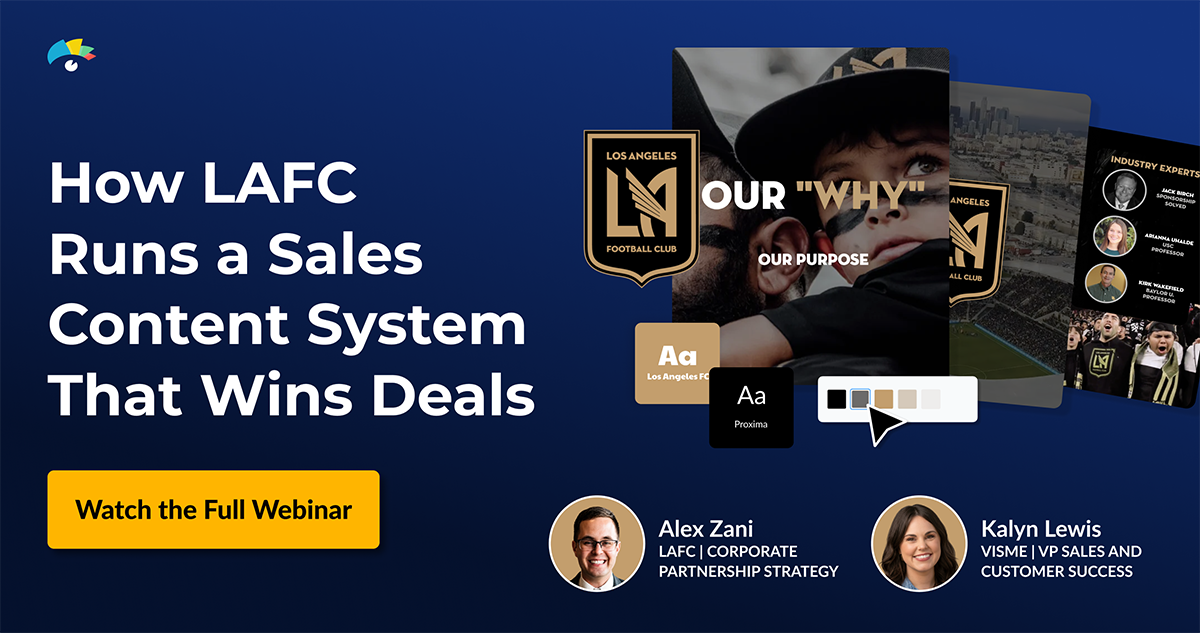
Watch our On-Demand Webinar with Alex from LAFC to see everything in action
Reps don't need to leave the CRM to see who engaged with their deck and what activity there was.
Once a deck is connected to the right account in Salesforce, the rep can see how many times it was viewed, which days it was viewed on and how many views each page received, without leaving the record.
A rep scanning their open opportunities, including those that haven't moved in a while, gets that alongside everything else in the account. It gives them a reason to reach out and something specific to say.
"We're just trying to arm them with as much information as possible in one location, so it makes it easier for them to make that touchpoint and continue that conversation."
LAFC has removed off-brand colors and fonts from the workspace, so the options a rep sees are only the approved ones.
The colors, their hex codes and the club's preferred crests sit in the Brand Kit and a brand guidelines deck. A rep picking a color or pulling the badge does not have to figure out which version is current.
Additional logos and partner images live in My Files, organized so reps can find the right one fast.
"Whenever they're working on a deck and want to know the exact hex code, they don't have to worry about hex codes anymore. We've got it pre-built with all of the colors that we use, the crests we prefer to use."
These guardrails also extend to the news slides built from the master slide kept in the library. When this happens, Alex works with the rep on the use case. Since the same slide could apply to other pitches, a similar one might already exist or they could create one to use in the future.
Then, approved slides are added to the library, so all the reps have access to the new slides. That way, they’re not lost in a deck somewhere that people have to hunt for.
"Sometimes they're not even the rep who initially created that slide, so they don't even know what's out there. Now we're able to add those to the slide library, and they don't have to go digging through hundreds or thousands of decks."
The old feedback process was a Word document with numbered instructions like: update the copy on slide 1, update the image on slide 5.
There was an issue, though. Throughout the changes, decks gain and lose slides while they are being built, and hidden slides shift the numbering. By the time someone read the feedback document, slide 5 had been renumbered.
"You're wondering, okay, I think they meant this slide, so let me update this image and see if that's what they're talking about. But with these comments, there's no confusion as to what slide they're talking about, or what data point, or what image they want replaced."
Comments attach to the exact thing being discussed. So, whoever makes the fix replies in the same thread to confirm it is done, which gives the rep a running list of what is still outstanding without having to ask anyone.
"Everyone can work in here, everyone can see these live updates, everyone can see the comments, and there's no confusion about what they're talking about."
The team publishes decks as live links instead of sending files, which means that a correction made after sending is never an issue. Plus, these links are often restricted to named recipients for privacy reasons.
"You don't have to worry about downloading a PowerPoint and wondering if what you sent them was the most up-to-date version. If we notice something off, or if we want to add another video or another piece of information, we're able to update that live in the link so they can view those edits."
Sharing as a live link also helps with tracking who viewed the deck, which slides they opened, how long they spent and whether they returned.
"It's a great touchpoint for us to reach out and say, ' Hey, we saw you were looking at our slide about what we've done in the first 8 years and wondering what's next. We'd love to chat with you more about it.' "
LAFC works with vendors in the UK and an external designer, each with their own login. Because the vendors work while LA sleeps, the team picks up their edits and questions the next morning.
"The ability to have them work on it, and for us to jump in the next morning and see any questions or edits they made, make some edits ourselves, and have them ready to go, is huge."
Alex runs implementation and training for every new adopter in the partnership team or new sales reps himself. He says that it takes no longer than 30 minutes.
The session is a tour of where things are: the library slides they will build decks from, the brand guidelines deck, the Brand Kit and the AI photo tools.
"A lot of times it's just, here are all the key areas to find what you need to find. From there it's going in, exploring and getting the hang of it."
Alex's read is that anyone who has used presentation software can pick it up without much help. Deeper training, new releases and the harder questions go to Alan Taussik, LAFC's Visme customer success manager.
Visme use started with the partnerships team. But presently, Alex shared with us that three other departments now work in it too. Content from the branded template and slide library moves between them to ensure aligned outputs across the board.
First of all, the Marketing team sets the boundaries with the LAFC brand guidelines deck. Since it exists as a Visme project, it’s shared as a live link internally and with external vendors. These guidelines are also the basis for all the slides and templates in the reusable library.
The Soccer Ops team contributes to the pitch decks that the sponsorship team works on. Alex says partners are always curious about the academy and LAFC2, so soccer Ops jumps in and collaborates with the partnership team on those slides.
Thirdly, ticketing has also adopted Visme for its content production. They create their own member event materials, such as a graphic inviting season ticket holders to a member dinner at the stadium. They can also open any deck the partnership team has built, where Alex says they find community events and food and beverage offers that their own members would want to know about.
LAFC didn't add anyone to the partnership team last year, nor did they have to work more hours.
Regardless, they produced 42% more quality content. Why? Because the work started to launch from the same foundation, it stopped needing several reviewers and it made reps more confident in the idea that they should always have a deck for every conversation.
Your team can build that same foundation. Turn the decks you already send into templates, break the slides worth reusing into a library and put your fonts, colors and logos in a brand kit. Once your best content is approved and in one place, a rep assembling it will be on brand by default, and your reviewers will get their time back.
Connect with sales to see how it could work for your team.

Design visual brand experiences for your business whether you are a seasoned designer or a total novice.
Connect with Sales